If you have ever watched a detailer bring a hood up to a mirror finish and wondered how anyone proves it actually got better, you are asking the right question. Most before-and-after photos are taken under a camera flash in a driveway, which makes a modest improvement look dramatic or a strong result look ordinary, depending on the light. A paint gloss meter gives you a repeatable number taken from the same spot, at the same angle, every time. Here is how we use gloss readings on Chicago-area vehicles at our Glendale Heights shop, what the numbers mean, and where they stop being useful.
Table of Contents
- Quick Takeaways
- What a Paint Gloss Meter Actually Measures
- Why 60 Degrees Is the Default for Car Paint
- Setting a Baseline Before Correction Starts
- Reading Haze and Surface Defects Alongside Gloss
- Comparing Measurement Approaches for Correction Work
- Taking After-Correction Readings That Hold Up
- Common Mistakes That Skew Gloss Readings
- Where Gloss Numbers Stop Being Useful
- Frequently Asked Questions
- References
Quick Takeaways
| Key Insight | Explanation |
|---|---|
| Pick one angle and stick to it | Use 60 degrees for general before-and-after work and write the angle next to every number you log. |
| Mark test spots before you start | Tape and number the same panel locations so the before and after readings compare the same surface. |
| Decontaminate before the baseline read | Bonded contamination scatters light and pulls the number down, which makes the correction look like it did more than it did. |
| Treat gloss as a relative number | A gloss value only means something against your own baseline, on the same panel, with the same meter. |
| Check haze separately | A panel can read high on gloss while still looking cloudy under direct light, so pair the meter with a controlled inspection. |
| Log a reading after every stage | Stage-by-stage numbers show which step produced the gain and which polish pass added little or nothing. |
| Keep the eye in the decision | A meter cannot judge reflection depth or clarity the way a trained eye can, so use numbers to support your judgment, not replace it. |
Quick takeaways aside, the real value of a gloss meter is discipline. It forces you to measure the same way on the same panel before you start, and that habit is what turns a shiny finish into a documented result you can defend to a client.
What a Paint Gloss Meter Actually Measures
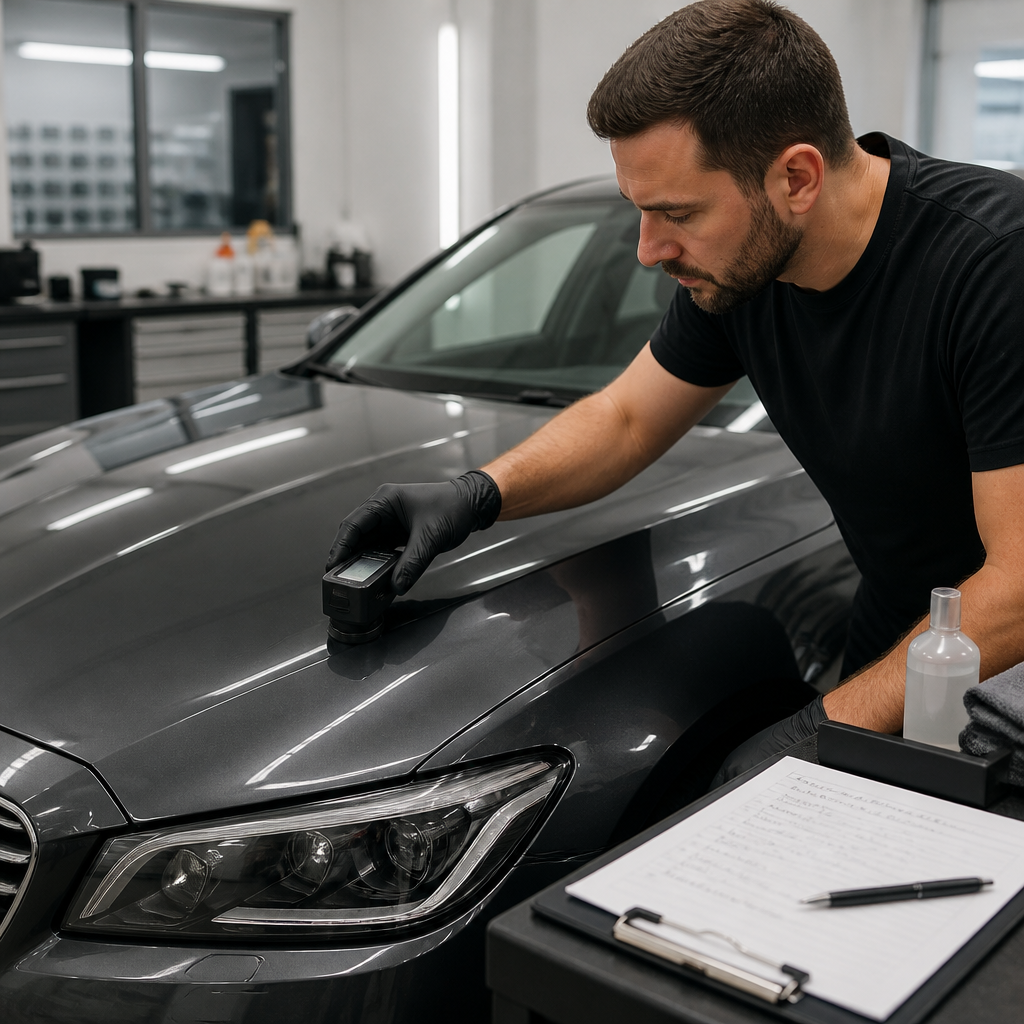
Gloss is an optical property that describes how well a surface reflects light in a specular, mirror-like direction. A paint gloss meter quantifies that behavior using a calibrated light source and a sensor placed at a fixed angle to the panel. The reading is only as good as that geometry.
Inside the meter, the light source hits the surface at a set angle and the sensor sits at the matching opposite angle. The device compares how much light left the source with how much came back, then converts that ratio into a gloss value using an internal look-up table. You never see the math, only a number in gloss units.
Gloss Units Versus Percent Reflectance
Most meters display gloss units (GU), while some can also show percent reflectance, which is the light detected compared with the light sent. For a detailer, the unit matters less than consistency. A 60 GU reading from one meter and a 60 GU reading from another are not guaranteed to match unless both are calibrated to the same standard.
In our shop, the same meter is used for the whole job and is checked before each session. We never compare a number from one device against a number from another, even when both claim the same unit.
Why the Same Paint Reads Differently Across Panels
A smooth, flat panel reflects light in one direction, while a rough texture scatters it in many directions. That is why a panel that has been finished with a fine polish can read differently from one that was left with heavier marring, even when both look shiny to the eye. The meter is measuring the texture of the surface as much as the color of the paint.
Why 60 Degrees Is the Default for Car Paint
Gloss meters typically offer 20, 60, and 85 degree geometries, and each one is suited to a different kind of surface. For automotive paint, the 60 degree setting is the one most people start with. Automotive paint is often evaluated at 60 degrees because it offers a good balance between overall gloss and the ability to see past small surface flaws.
That balance is the practical reason we default to it. A single angle gives you a stable comparison across a whole vehicle, and it is the angle most budget meters are built around.
What 20 and 85 Degree Readings Tell You
Forum members who own multi-angle meters generally describe 20 degrees as better suited to very high gloss surfaces, where it can separate similar finishes more clearly. They describe 85 degrees as more useful for low gloss surfaces, where a 60 degree reading may not show much difference. These are observations from owners, not laboratory standards, so treat them as a starting point rather than a rule.
We have found that a 20 degree reading can be useful on a freshly corrected dark panel for a quick check, but we still record the primary comparison at 60 degrees so every job lines up with the others in our files.
Why Most Shops Standardize on One Angle
Consistency beats coverage. If you read a hood at 20 degrees before correction and at 60 degrees after, you have no valid comparison at all. Pick one angle, record it with every number, and keep it for the entire job. One forum poster who works in a paint lab said their lab reads only at 60 degrees, which matches how we run our own workflow.
Pro tip: Write the angle next to every reading in your log. A number without its angle is useless six weeks later, when a client asks what actually changed on their car.
Setting a Baseline Before Correction Starts
A before reading only means something if it captures the paint as it really is. Most inaccurate baselines come from measuring a dirty panel. Road film, bonded contamination, and iron fallout all scatter light, which lowers the number and makes the correction look like it accomplished more than it did.
The baseline is only as honest as the prep behind it. If the panel is not clean, the first number is a measurement of dirt, not paint.
Decontamination Comes Before the First Reading
On Chicago-area vehicles, the baseline often includes winter road salt residue, brake dust, and tree sap or industrial fallout, depending on where the car is driven. We wash, clay, and chemically decontaminate first, then dry the panel fully before taking any readings. Reading before decontamination gives you a number that reflects the grime on top of the clear coat.
A panel that tests low before decontamination often reads higher after decon alone. That gap is exactly why the sequence matters, and why we never record a before number until the panel is clean.
Marking Test Spots So Before and After Match
We mark the same test locations on every panel, usually a hood, a driver door, a rear quarter panel, and a roof section. Painter's tape with a small number on each spot works well, and we photograph the layout so we can recreate it later. Without fixed locations, you end up comparing a fresh edge to a flat center and calling the difference a result.
Take three readings per spot and average them. A single reading near a body line or panel edge can throw off the whole number, and averaging is the simplest way to avoid building a conclusion on one outlier.
Pro tip: Photograph the marked layout with the meter in place before you start. When you return to re-read the same spots, you will know you are on the right coordinates without guessing.
Reading Haze and Surface Defects Alongside Gloss
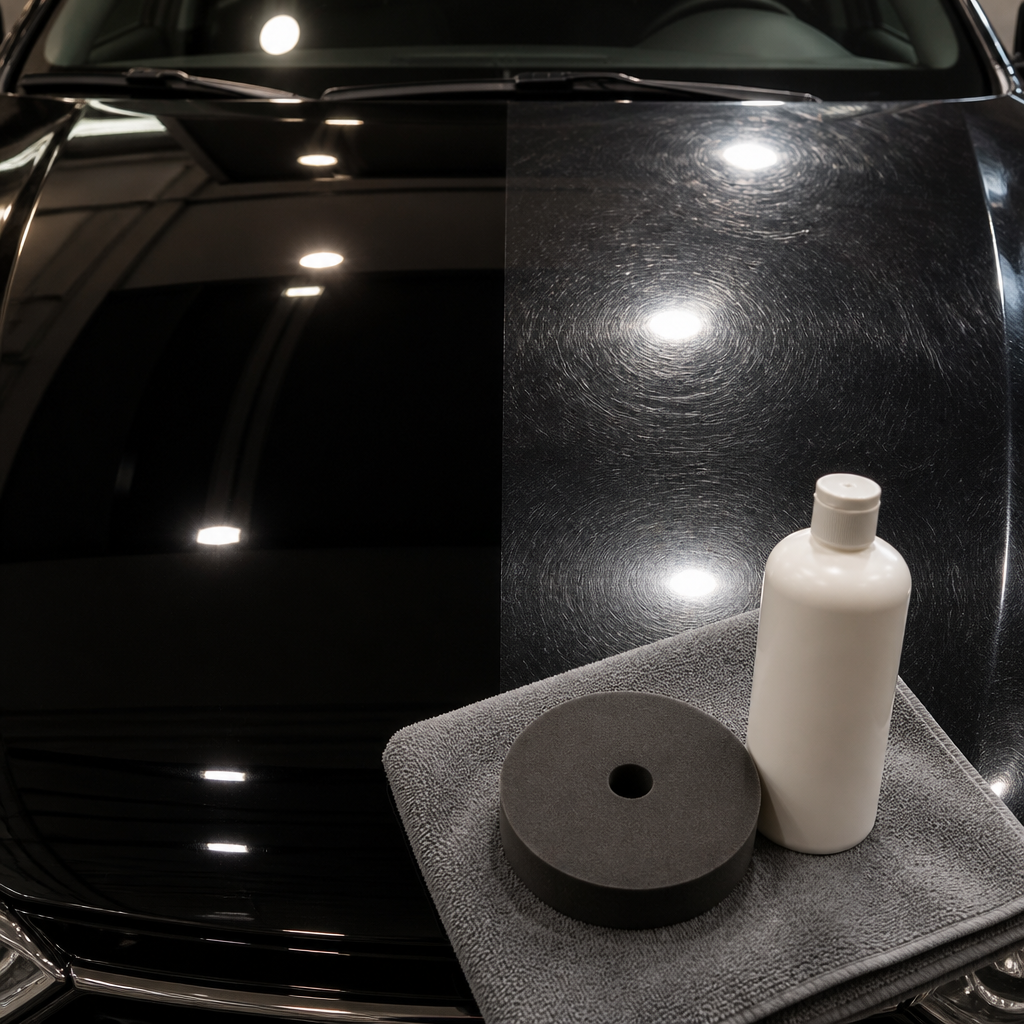
Gloss tells you how much light a surface reflects in a mirror direction. It does not tell you whether that reflection is clean. Haze is the milky halo or bloom that appears around reflections when microscopic imperfections scatter light, and a panel can read high on gloss while still looking hazy in direct light.
Why Haze Can Hide Behind a High Number
Haze is quantified separately as a haze index on some meters, which is why it deserves its own check. A panel with heavy hazing left by a compound or a contaminated pad can still produce a respectable gloss number at 60 degrees. That is the trap. If you chase only the gloss number, you can declare victory on a panel that still looks cloudy under a shop light.
We have seen panels that read well and still need another pass once the inspection light is on them. The meter is a fast check, but it does not replace looking at the paint from the right angle.
Inspecting Under Controlled Light
After each reading, we inspect the panel under a dedicated work light held at a low angle, looking for holograms, buffer trails, and haze. The meter captures the average reflectance. The light reveals the pattern. Both belong in your log, because a good average can still hide a defect that a client will spot in the sun.
Pro tip: Use the same light source and the same angle every time. Changing lamps between the before and after inspection can make a clean panel look better or worse for reasons that have nothing to do with the polish.
Comparing Measurement Approaches for Correction Work
Not every detailer needs the same measurement setup. The right choice depends on whether you are documenting results for a client, comparing products, or simply checking your own work every day. The table below compares the three approaches we see most often in practice.
| Approach | What It Tells You | Where It Falls Short |
|---|---|---|
| Single-angle handheld gloss meter at 60 degrees | A repeatable gloss number for before and after comparison on the same panel | Does not show haze, texture, or the depth of the reflection |
| Multi-angle gloss meter at 20, 60, and 85 degrees | Gloss across different geometries, useful for very high or very low gloss finishes | More readings to log, and the extra angles only help if you record them consistently |
| Controlled light inspection with photo documentation | Haze, holograms, and defects the eye can judge directly | Photos shift with lighting and camera settings, and they cannot produce a number |
For most shops working on daily drivers and luxury sedans alike, a single-angle meter combined with a documented inspection routine covers the job. Multi-angle units earn their place when you regularly work on very dark or very low gloss finishes, where the 60 degree number alone can flatten the differences that matter.
Taking After-Correction Readings That Hold Up
The after reading should be taken on the same marked spots, under the same conditions, with the panel clean and dry. Re-washing before the final read is standard practice, because polish residue and dust will drop the number. Note that step in your records so nobody mistakes a cleanup for a change in the paint.
The after reading is also where many detailers lose credibility, usually by comparing a fresh panel to a dusty one. Keep the process identical each time, and the numbers become useful.
Logging Readings Stage by Stage
On a multi-stage correction, we record a reading after decontamination, after compounding, after polishing, and after protection. That log shows which stage actually did the work. Sometimes a second polish pass adds almost nothing, and the log makes that visible so you can stop spending time and product on a step that does not move the needle.
Stage-by-stage numbers also protect you from blaming the wrong step. If gloss dropped after protection, the log will show whether the drop came from the product or from a dirty panel.
Explaining Results Without Overpromising
A client who sees a higher number after correction may assume the car is now flawless. Explain that the number is relative to that car's own baseline on that panel, and show the inspection photos next to it. Numbers support a conversation, but they do not end it.
When we present results, we pair the gloss change with what the client can see in person. That approach has held up far better than leading with a figure alone.
Pro tip: Take a final reading after protection as well as after polish. Some sealants and coatings change surface gloss slightly, and clients deserve to know what the protection layer did to the finish.
Common Mistakes That Skew Gloss Readings
Most bad gloss data comes from avoidable habits, not from faulty meters. These are the errors we see most often when detailers start logging numbers for the first time.
Reading Wet or Freshly Dried Paint
Water beads and thin film scatter light, so a panel read while wet can look different from the same panel once it is dry and clean. Dry the panel fully and give it a few minutes after claying or washing so residue and moisture settle out before you measure.
Ignoring Temperature and Panel Position
Direct sunlight, a hot panel, and readings taken on a curved section can all shift results. Work in shade, read on flat areas where possible, and keep the meter square to the surface. A tilted meter changes the geometry you are measuring, which makes the number meaningless.
Switching Meters Between Readings
Each meter is its own instrument. If the before reading came from one device and the after reading from another, you have compared two instruments, not two paint conditions. Use the same meter, calibrated to the same standard, for the entire job.
Pro tip: Keep a calibration standard with the meter and check it at the start of every session. Drift is easy to miss until a client questions a number that looks wrong.
Where Gloss Numbers Stop Being Useful
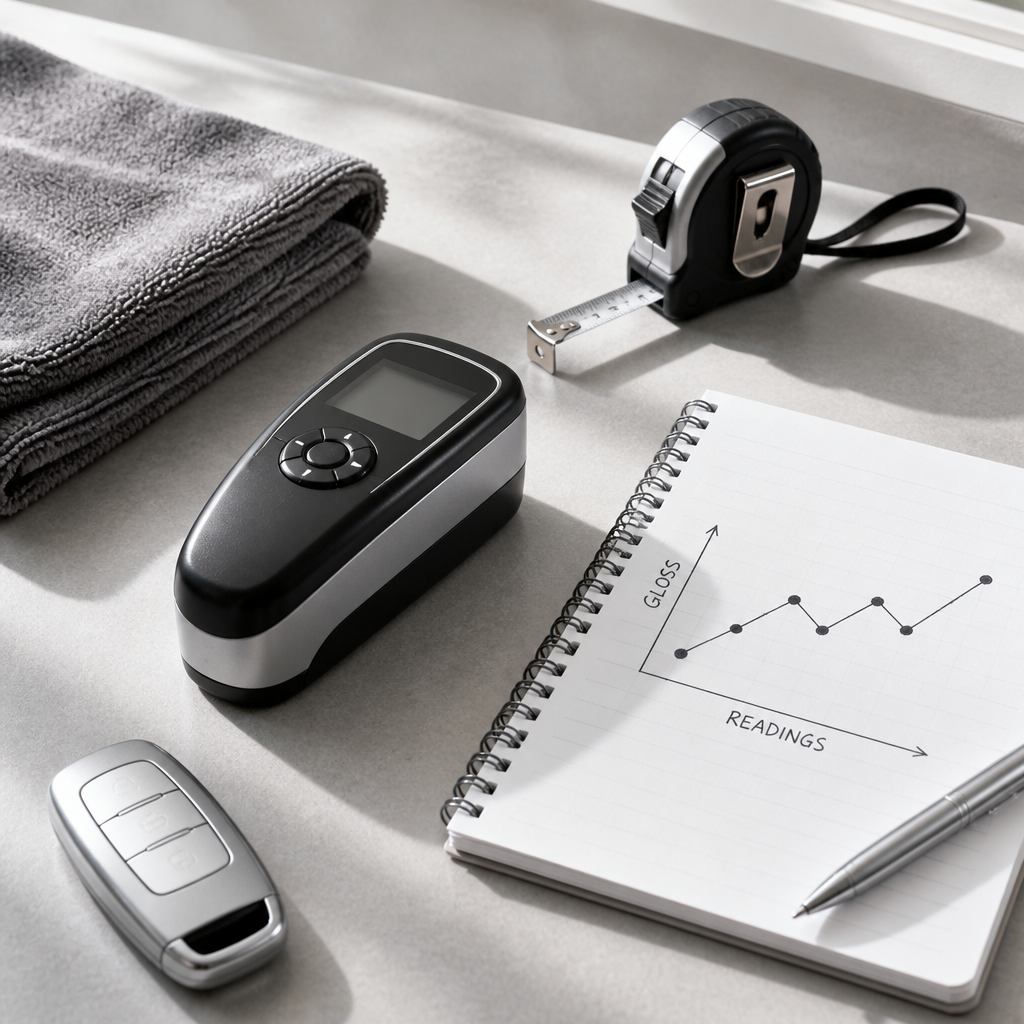
A gloss meter is a good tool, but it is a narrow one. A machine cannot capture everything the human eye perceives about a finish, including depth of reflection, color clarity, and how the paint holds up when viewed from across a parking lot. Forum users who own these meters have made the same point, and it is a fair one.
Depth and Clarity Are Visual Judgments
Two panels can produce similar gloss numbers and still look completely different. One shows deep, liquid reflections with sharp edges, while the other looks shiny but flat. The meter records how much light returns, not how well the reflection holds its shape. That judgment still comes from trained eyes and experience.
A gloss number tells you how much light a panel returns. It cannot tell you whether the reflection is worth looking at.
Using Numbers to Support Your Eye
We treat gloss readings as evidence that supports a decision, not as the decision itself. If a number rises but the panel looks worse under inspection light, we keep working. If the number stays flat but the paint looks dramatically better in person, we check the log and the marked spots before claiming a gain.
This is also where our multi-stage process and our nano-ceramic SiO₂ coatings, which carry five to eight year warranties, get judged on the same standard. The meter documents the change, and the inspection confirms the finish a client will live with every day in Glendale Heights, Carol Stream, Bloomingdale, or Wheaton.
Frequently Asked Questions
Do I need a paint gloss meter to show clients before and after results?
No, but it makes the results far easier to trust. Photos taken under consistent lighting are useful, yet they are easy to distort. A documented gloss reading on marked spots gives the client a number they can compare alongside the photos.
Is a 60 degree meter enough for most cars?
For most automotive paint, yes. It is the standard angle for general comparison and balances overall gloss against the ability to hide small flaws. Multi-angle meters help most on very high or very low gloss finishes.
Can a gloss meter tell me whether my correction removed swirls?
Not directly. Gloss can rise while light swirls remain visible. Inspect under a controlled light at a low angle to judge swirls and haze, then use the meter to track the overall change in gloss.
Why did my reading drop after I polished the panel?
The most common cause is residue, dust, or moisture still on the surface. It can also happen when the reading is taken at a different spot or angle than the baseline. Clean, dry, and re-read the same marked spots before drawing any conclusion.
Do gloss readings from different meter brands compare directly?
Not reliably. Each instrument is calibrated to its own standard and internal look-up table. Compare numbers only from the same meter, checked against its calibration standard before use.
Is a gloss meter worth buying for a small detailing business?
It depends on whether your clients ask for proof. If you sell paint correction and coatings, a documented baseline and after reading usually cuts down on disputes and makes pricing easier to justify. If you rarely discuss results with clients, a good inspection light and disciplined photos may be enough for now.
If you measure gloss on your own work, tell us which angle you use and where your readings surprised you, since experiences on different paint types are worth hearing.
We would love your feedback and any insights you would share with others. What perspective would you add?