Most drivers in the Chicago suburbs notice something is off with their car's paint but talk themselves out of doing anything about it. The finish looks a little dull. The color seems flat in direct sunlight. There are faint circular marks that no amount of washing seems to remove. These are not cosmetic quirks you learn to live with. They are measurable damage to your clear coat, and every week you wait, that damage deepens. If you own a luxury or high-performance vehicle and are searching for paint correction signs Illinois to make sense of what you are seeing, this guide gives you the five specific signals that mean professional intervention is no longer optional.
Table of Contents
- Quick Takeaways
- Sign 1: Swirl Marks and Fine Scratches You Cannot Polish Away at Home
- Sign 2: Paint Oxidation and Chalky Fading on Horizontal Panels
- Sign 3: Water Spot Etching That Survives Every Wash
- Sign 4: Chemical Etching from Bird Droppings and Tree Sap
- Sign 5: Loss of Depth and Reflective Clarity
- Paint Correction vs. Wax and Polish: What Actually Fixes the Problem
- Frequently Asked Questions
- References
Quick Takeaways
| Key Insight | Explanation |
|---|---|
| Swirl marks are not just cosmetic | Fine circular scratches in the clear coat scatter light and permanently dull the finish until the damaged layer is removed by machine polishing. |
| Oxidation accelerates once it starts | Once UV rays break down the clear coat, the underlying paint is exposed to moisture and pollutants. Illinois winters and summer sun both accelerate this process. |
| Water spot etching is not removable by washing | Mineral deposits from hard water etch into the clear coat. No detergent removes them. Machine polishing with a fine abrasive compound is required. |
| Bird droppings and tree sap are chemical attacks | Uric acid in bird droppings and the resin in tree sap can begin dissolving your clear coat within hours, especially in summer heat. |
| Wax cannot fix what is already damaged | Wax sits on top of the clear coat. If the clear coat itself is scratched or oxidized, wax provides only a temporary mask, not a repair. |
| Blurry reflections are an early warning sign | If your car's panels no longer produce sharp, mirror-like reflections, the clear coat surface has been compromised and correction will restore it. |
| The correction window closes over time | Defects that are still in the clear coat can be polished out. Once damage reaches the base coat, correction becomes impossible and repainting is the only option. |
Sign 1: Swirl Marks and Fine Scratches You Cannot Polish Away at Home
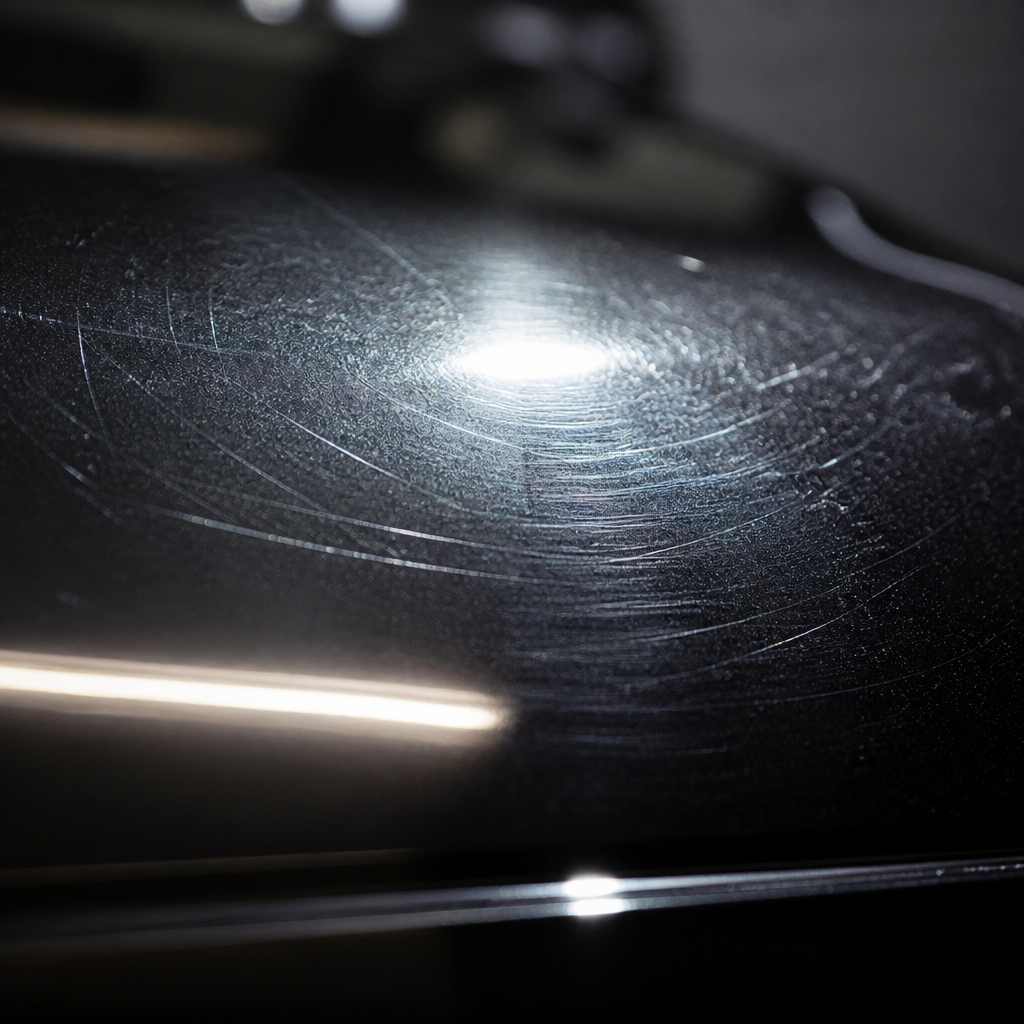
Stand next to your car on a bright day and look across the panels at a low angle. If you see a web of fine, circular lines spiraling across the surface, those are swirl marks. They are not dirt. They are not a trick of the light. They are physical scratches in your clear coat, and they are the single most common reason owners in Carol Stream, Bloomingdale, and across the Chicago suburbs book a professional paint correction appointment.
Swirl marks are created by improper washing technique. Automatic car washes with abrasive brushes, dry wiping, using the wrong microfiber towels, and circular hand-washing motions all deposit fine scratches in the clear coat. Over time, these accumulate into the hazy spider-web pattern you see in direct sunlight.
Why Over-the-Counter Polish Does Not Solve the Problem
Consumer-grade polishes fill swirl marks temporarily with fillers that wash out after a few weeks. They do not remove the scratches. A professional multi-stage machine polishing process, like the one used at Hershey's Detailing in Glendale Heights, uses progressively finer abrasive compounds on a dual-action or rotary polisher to actually level the clear coat surface. The scratches are gone, not hidden.
A practical test: run your clean fingernail very lightly across the area where you see swirl marks. If the nail does not catch, the damage is confined to the clear coat and can be corrected. If the nail catches, the scratch is deeper and needs professional assessment before you do anything else.
Pro tip: Dark-colored vehicles, especially black and navy blue, show swirl marks far more dramatically than light colors. If you own a dark luxury vehicle and it looks worse after every wash, the washing process itself is the source of damage and paint correction followed by a ceramic coating is the only lasting solution.
Sign 2: Paint Oxidation and Chalky Fading on Horizontal Panels
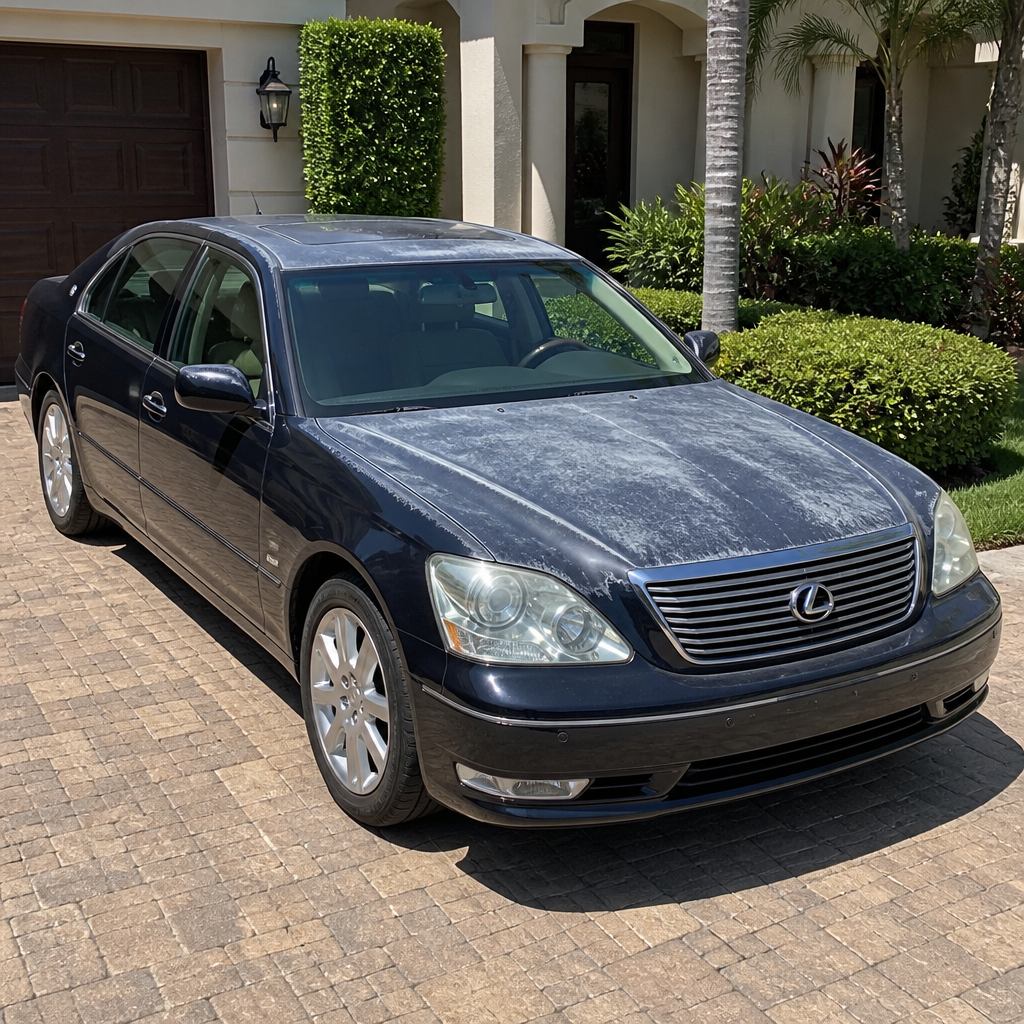
Paint oxidation is what happens when prolonged UV exposure, road pollutants, ozone, and acid rain break down your vehicle's clear coat at a chemical level. The surface dries out, the clear coat degrades, and the paint underneath loses its ability to reflect light cleanly. The result is a chalky, dull, or faded look that no amount of waxing reverses.
In Illinois, this process gets pushed along by both extremes of the climate. Summer UV radiation heats horizontal surfaces like the hood, roof, and trunk lid relentlessly. Winter brings road salt, freeze-thaw cycles, and moisture that accelerates chemical breakdown. A vehicle sitting on a driveway in Wheaton or Glendale Heights faces a specific combination of stressors that an Arizona or Florida car simply does not.
Where to Look First on Your Vehicle
Oxidation always appears first on surfaces that face the sky directly because those panels absorb the most UV radiation and heat. Check the hood, the roof, and the trunk lid before anything else. Run your palm across the surface. If it feels rough or powdery rather than smooth and slick, the clear coat has already started breaking down. Oxidation you can see and feel on horizontal panels means the process is well underway.
A clear coat that has started to oxidize does not stabilize on its own. Every additional month of UV exposure without protection accelerates the breakdown. Acting while the damage is still in the clear coat layer is the difference between a correctable finish and one that needs a full respray.
Paint oxidation removal in Glendale Heights at a professional level involves a decontamination wash to strip surface contaminants, followed by machine polishing with an appropriate compound to cut through the degraded clear coat layer and expose the healthy, glossy material beneath it. This is not a process that consumer products replicate.
Pro tip: If you rub a white cloth across your faded paint and it comes away with a chalky residue, the oxidation has progressed to a stage where correction is urgent. That powdery material is your clear coat breaking down. Once the clear coat is fully gone from an area, no polish or compound can restore it, and repainting becomes the only fix.
Sign 3: Water Spot Etching That Survives Every Wash
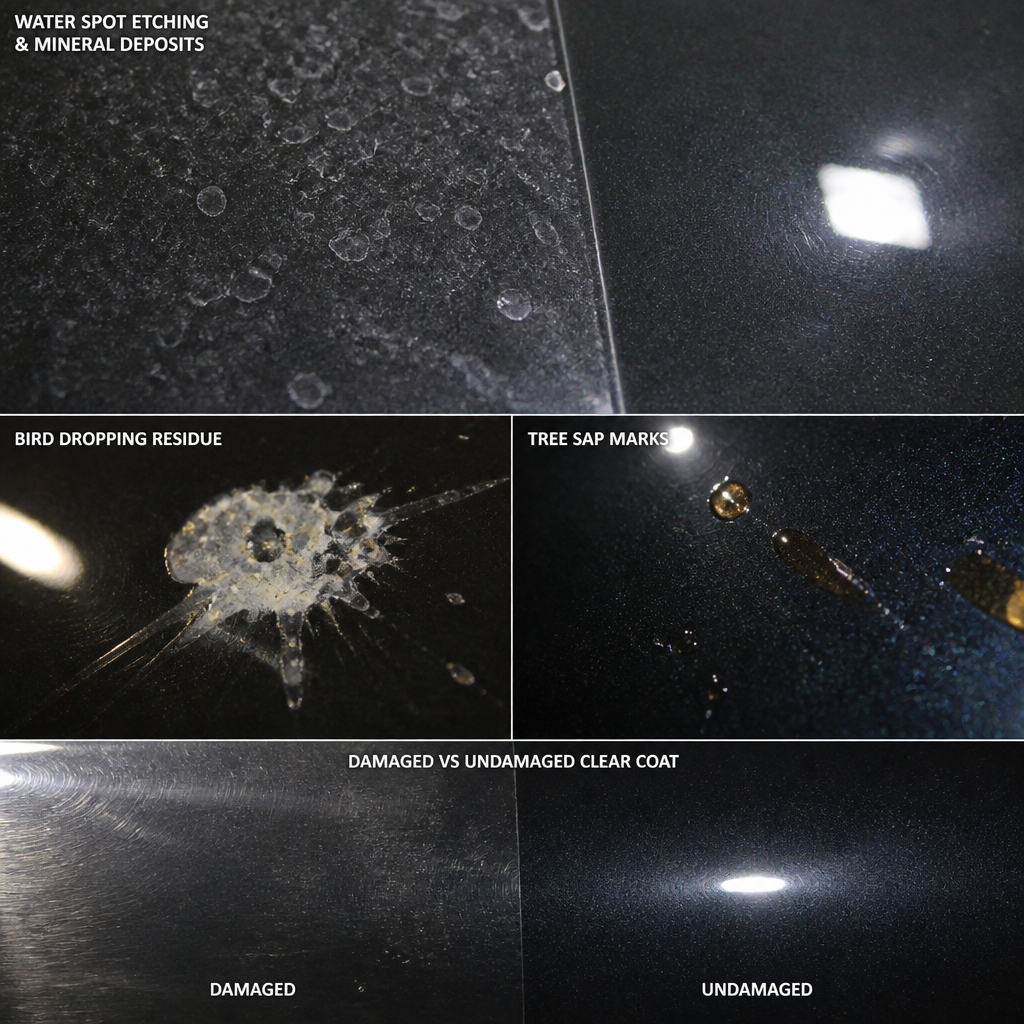
Hard water spots form when water sits on your paint and evaporates, leaving behind concentrated mineral deposits. In the Chicago suburbs, tap water and even well water carries calcium and magnesium minerals that bond to your clear coat under heat. In the summer, a sprinkler hitting your car or rain followed by immediate sun can leave dozens of spots across every panel within minutes.
There are two types of water spots and most owners cannot tell them apart until it is too late. Type 1 spots sit on top of the clear coat and can be removed with a proper chemical decontamination. Type 2 spots have etched into the clear coat itself, creating a physical depression in the surface. These do not wash off, ever. Repeated washing only confirms they are still there.
The Fingernail Test for Water Spot Etching
After a thorough wash and dry, look at the spots in direct sunlight. If they are still visible and have a slight rainbow iridescence or a faint ring pattern, they have etched. Lightly drag your nail across one. If you feel a tiny ridge or depression, machine polishing is the only path forward. A professional detailer will use a fine cutting compound on a machine polisher to level the etched area back to the surrounding clear coat surface.
Vehicles parked near lawn irrigation systems, in carports where rain splash occurs, or in areas with high mineral content in the water supply are particularly vulnerable. Once water spot etching is present across multiple panels, a single-stage or multi-stage paint correction is needed to restore a uniform surface before any protective coating will adhere properly.
Sign 4: Chemical Etching from Bird Droppings and Tree Sap
Bird droppings contain uric acid at a pH level that places them solidly in the corrosive range. The moment a dropping lands on warm paint, the acid begins attacking the clear coat. Summer heat dramatically accelerates the reaction. What is removable in the first hour can require full paint correction after just a few hours in direct sun.
Tree sap is a different type of chemical threat. As it dries, it hardens and contracts, which can actually pull at the clear coat surface and create micro-tears. Both contaminants are extremely common for vehicles parked under trees, which is the default situation for a large percentage of homes in the Chicago suburbs.
Identifying Etching Versus Surface Staining
After removing a bird dropping or sap deposit with a proper cleaner, look at the area closely. A surface stain will be flat and even. Etching appears as a slight depression, a rough patch in the surface, or a visible mark in the clear coat that changes how light reflects from that specific spot. If the affected area looks different from the surrounding paint even after cleaning, the clear coat has been damaged and professional correction is needed.
If you notice that multiple areas across your hood or roof have these irregular reflective patches after a season of parking under trees, that accumulated damage calls for a comprehensive paint correction treatment. Trying to mask it with wax or a spray detailer only delays the inevitable while the etching deepens.
Pro tip: After paint correction, a professional-grade nano-ceramic SiO2 coating creates a hard, chemically resistant barrier that makes bird droppings and sap much easier to remove before they etch. It does not make your paint bulletproof, but it buys you significantly more time to act.
Sign 5: Loss of Depth and Reflective Clarity
This sign is subtler than the others but it is the one that luxury vehicle owners in particular notice immediately. A properly corrected and protected finish produces sharp, distortion-free reflections. When you look at a building, a tree line, or another vehicle reflected in your car's hood or doors, the image should be crisp and clear, like a mirror. When the clear coat is compromised, those reflections look blurry, hazy, or like they are being viewed through slightly frosted glass.
This is not a lighting issue. It is a surface geometry issue. A clear coat damaged by micro-scratches, oxidation, or contamination scatters light in multiple directions instead of reflecting it in a single plane. No amount of spray wax or quick detailer restores that mirror quality, because those products sit on top of a compromised surface, not inside it.
Why This Matters Before a Ceramic Coating
If you are planning to protect your vehicle with a ceramic coating, this sign matters more than any other. A ceramic coating amplifies whatever surface it bonds to. On a corrected, glossy clear coat, a ceramic coating produces a stunning, deep, wet-look finish that lasts for years. On a hazy, scratched clear coat, it locks those defects in place under a hard protective layer that makes them even more difficult to address later.
This is exactly why the sequence at Hershey's Detailing begins with thorough decontamination and multi-stage machine polishing before any coating is applied. Skipping correction to save time or money and going straight to coating is one of the most common and costly mistakes made in the detailing industry. You end up paying to preserve damage rather than protect a restored finish.
The practical test here is straightforward. After washing and drying the car, stand back from a panel in good natural light and look at your own reflection. If you can read text on a shirt you are wearing in the reflection, the paint is in reasonable shape. If your reflection looks smeared or ghosted, correction is overdue.
Paint Correction vs. Wax and Polish: What Actually Fixes the Problem
Understanding the difference between a professional paint correction, an over-the-counter polish, and a standard wax application is essential before making a decision. Many owners in the Chicago suburbs have spent money on consumer products that provided no lasting benefit because the product type was wrong for the damage present. The table below breaks down the three options clearly.
| Approach | What It Does | Best For |
|---|---|---|
| Professional Paint Correction (multi-stage machine polishing) | Physically removes a controlled layer of clear coat using abrasive compounds on a machine polisher, eliminating swirl marks, oxidation, water spot etching, and chemical etch marks permanently from the affected layer. | Vehicles with visible swirl marks, fading, etching, or blurry reflections. Required before ceramic coating application. |
| Consumer Polish or Compound (hand application) | Contains light fillers or mild abrasives. May temporarily improve appearance by filling micro-scratches but does not remove them. Results last weeks, not months. | Extremely light surface hazing on well-maintained vehicles only. Not suitable for visible swirl marks, oxidation, or etching. |
| Wax or Sealant | Adds a sacrificial protective layer on top of the clear coat. Does not address any existing damage. Prevents new contamination from bonding directly to the clear coat. | Maintenance protection on already-corrected or new paint. Not a repair product. |
The hierarchy here is not about preference. It is about physics. Wax cannot fill a scratch in a clear coat because the scratch is a physical depression, not a surface contaminant. Polish can reduce very light surface hazing but lacks the abrasive power and machine speed to level out true swirl marks or etched areas. Only a professional machine polishing process, using the right compound-to-pad combination at controlled speeds, removes clear coat defects permanently.
For owners in Glendale Heights, Bloomingdale, and surrounding areas who are serious about the condition of their vehicle's finish, the paint correction service at Hershey's Detailing is specifically designed around this multi-stage approach, working from more aggressive cutting compounds down to finishing polishes to maximize clarity without removing unnecessary clear coat material.
Frequently Asked Questions
How do I know if my car needs a one-stage or multi-stage paint correction?
A one-stage correction uses a single compound and pad combination to address light to moderate defects. Multi-stage correction starts with a heavier cutting compound and progresses through finer polishes, and is required when damage is deeper or when you want the highest possible gloss level. A professional will assess the paint thickness with a gauge and evaluate defect depth before recommending the appropriate approach. Do not let anyone skip the assessment step.
Can paint correction remove deep scratches that catch my fingernail?
If a scratch is deep enough to catch your fingernail, it has cut through the clear coat and into the base coat or primer. Machine polishing cannot restore missing material, so these scratches cannot be fully corrected by polishing alone. A professional can minimize the appearance of such scratches and may recommend touch-up paint or panel respray depending on the severity and location.
How long does paint correction last?
The correction itself is permanent in that the defects removed are physically gone from the clear coat. What determines how long the results look great is what you do afterward. A vehicle that gets corrected and then goes through automatic car washes will develop swirl marks again within months. A corrected vehicle protected with a professional ceramic coating and maintained with safe hand washing methods can hold its results for years.
When should I get paint correction before a ceramic coating?
Always. A ceramic coating bonds directly to your clear coat and locks in whatever condition that surface is in. Applying a coating over a paint surface with swirl marks, oxidation, or etching permanently traps those defects under a hard layer that is very difficult to remove later. Paint correction before coating is not optional if you want the coating to perform as advertised and look the way it should.
Does Illinois weather make paint damage worse than other states?
Yes, noticeably. Illinois vehicles face UV radiation in summer that oxidizes horizontal paint surfaces, combined with road salt in winter that accelerates chemical breakdown at paint edges and lower panels. The freeze-thaw cycle also stresses any existing micro-cracks in the clear coat. Vehicles in the Chicago suburbs that spend winters outdoors or are regularly driven on salted roads accumulate paint damage faster than vehicles in more moderate climates, which makes regular professional inspection and timely correction more important here than in many other regions.
Is paint correction the same as paint polishing?
Polishing is one component of paint correction, but they are not the same thing. A complete paint correction process includes a thorough decontamination wash, clay bar or decontamination treatment to remove bonded surface contaminants, machine polishing with appropriate compounds to correct defects, and a final finishing polish to maximize gloss. Polishing alone without decontamination first risks dragging embedded contaminants across the clear coat during the polishing process, creating new scratches while trying to remove old ones.
Have you noticed any of these signs on your vehicle? Share what you are seeing and we will help you figure out the right next step.
References
- Guide to understanding when paint correction is the right service for your vehicle's condition
- How to identify whether your car's clear coat needs professional correction or basic maintenance
- Technical breakdown of clear coat failure versus paint oxidation: causes and correction approaches
- How tree sap and bird droppings chemically damage clear coat and when professional correction is required
- Practical visual signs that your vehicle's paint needs professional correction treatment