Most drivers blame their wiper blades when the windshield streaks in the rain. In our work at Hersheys Detailing in Glendale Heights, the blades are often innocent. The real problem is a layer of bonded contamination on the exterior glass that a regular car wash never touches, including road film, tar, overspray, and mineral deposits. Exterior glass decontamination removes that layer, and skipping it affects both how far you can see at night and how cleanly your wipers clear the glass. This is why car glass decontamination in Illinois deserves a place in your maintenance routine before the cold weather arrives.
Table of Contents
- Quick Takeaways
- What Exterior Glass Decontamination Actually Removes
- Why Contamination Builds Faster in the Chicago Suburbs
- How Bonded Contamination Turns Into Wiper Streaks
- The Exterior Glass Decontamination Process, Step by Step
- Glass Coatings and Wiper Performance
- Illinois Weather and the Timing of Glass Care
- Common Mistakes That Cause Streaks and Haze
- Frequently Asked Questions
- References
Quick Takeaways
| Key Insight | Explanation |
|---|---|
| Many wiper streaks start on the glass, not the blade | Bonded road film and mineral deposits smear under the blade even after a normal wash, so new blades streak too. |
| Decontaminate before you coat | A coating bonded over contamination locks in particles and wears out faster, so the prep step is what protects your investment. |
| Run the bag test after washing | Slide a plastic bag over dry glass. If you feel grit, the glass needs a decontamination step before any polish or coating. |
| Always use a lubricant with clay | Dry clay drags and can mar the glass, so use a dedicated glass lubricant on every pass and keep the surface wet. |
| Check wiper blades on a fixed schedule | The Car Care Council overview recommends checking and changing wiper blades about every six months, and extreme weather wears them faster. |
| Schedule glass work before the first hard freeze | Film and deposits bond more stubbornly in cold, salt-laden conditions, so late October is a better window than mid-January. |
What Exterior Glass Decontamination Actually Removes
Exterior glass decontamination is the process of removing contamination that a normal wash leaves behind. A wash lifts loose dust, salt, and surface grime. Decontamination goes after what has bonded to the glass itself, and that is the layer most drivers never notice until the sun drops low and hits the windshield at the wrong angle.
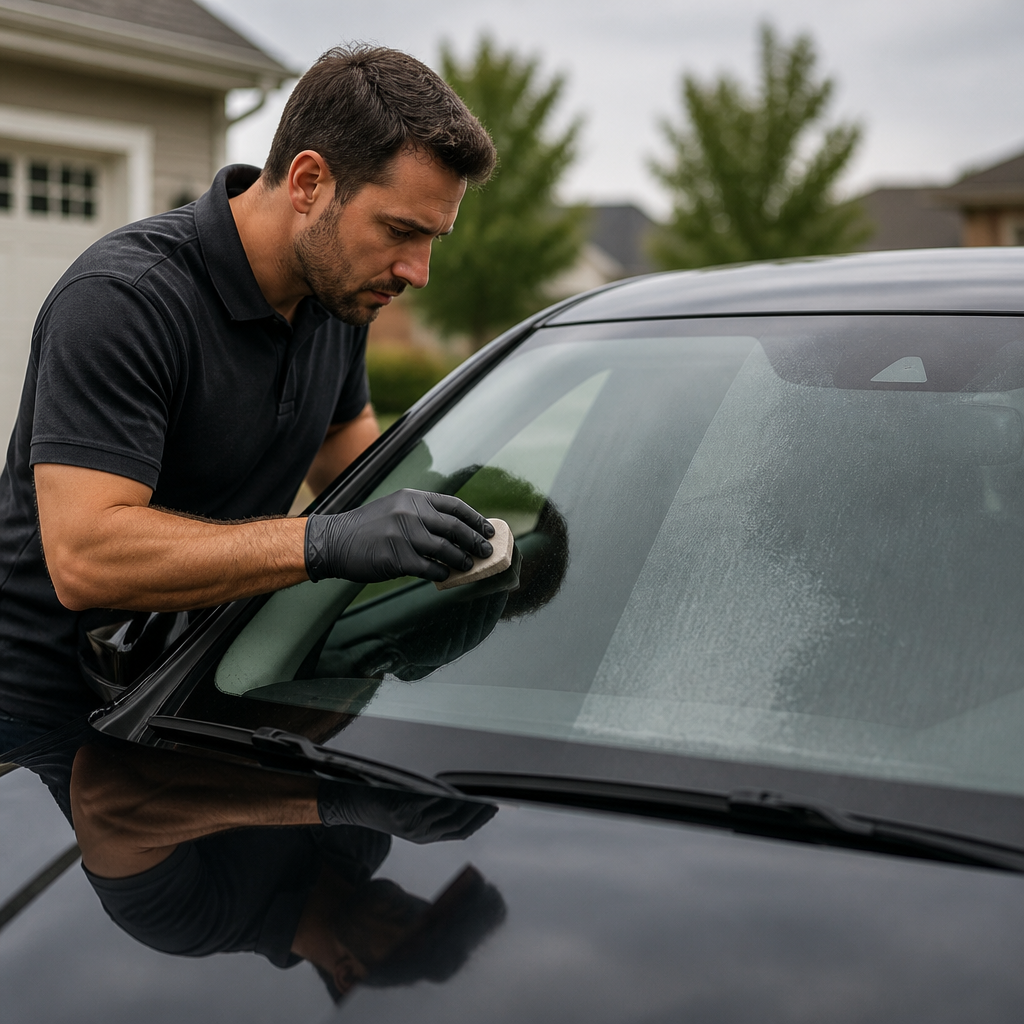
In practice, the contamination we pull off vehicles in Glendale Heights, Carol Stream, Bloomingdale, and Wheaton falls into a few predictable groups. Tar and road film from highway commutes, overspray from nearby painting or construction work, tree sap, insect residue, and industrial fallout that settles and sticks. Each one bonds differently, which is why a single pass with soap and a sponge rarely clears all of them.
The question we get most often is whether a car wash handles this. Most automatic washes are built to move loose dirt quickly, and they do not have the time or the chemistry to dissolve bonded residue. Hand washing helps, but a sponge can only lift what is already loose.
Bonded contamination versus loose dirt
Loose dirt sits on top of the glass and rinses away with water and light pressure. Bonded contamination has physically or chemically attached to the surface, so it survives a wash and keeps catching the wiper edge. You can usually tell the difference by running your hand over the glass after rinsing, since bonded grit feels rough even when the glass looks clean.
Tar and sap are the worst offenders on the lower third of the windshield, where the wiper parks and where road spray accumulates. These deposits do not respond well to soap alone, and they often leave a faint halo that only shows up at night or in low sun.
Mineral deposits and water spots
Hard water leaves mineral deposits when it dries on glass. Those deposits are not dirt in the usual sense, and they are one of the main reasons a freshly washed windshield can still look hazy in the morning. A decontamination step with an appropriate mineral remover dissolves them, while a wipe alone just moves them around.
Why Contamination Builds Faster in the Chicago Suburbs
Suburban driving creates its own contamination pattern. Many vehicles spend long stretches on arterial roads and highways, where road film and spray from passing trucks build up on the lower glass. That film is thin and oily, and it grabs dust, so it turns into a bonded layer faster than most owners expect.
Local conditions add to the load. Fall brings leaves, and wet leaves stain glass and trim with tannins that behave like a light film. Winter adds road salt and brine, which is corrosive and sticks to the glass as a fine crust when it dries. Spring brings pollen, which mixes with water and bonds to the surface in a sticky layer.
Fall leaves, tannins, and the October residue problem
Leaves that sit on a windshield overnight leave dark stains when they break down with dew and rain. Those stains can look like etching, but they usually come off with proper decontamination. If they are left through several rain cycles, they can bond deeply enough that a wash alone will not clear them.
Hard water and the spots that wipers smear
Municipal water in many suburbs carries dissolved minerals. When a car is washed and left to air dry, those minerals stay on the glass as spots. When the wipers pass over them, the spots smear into a film that catches light at night. Removing them early keeps the glass clean between full decontamination appointments.
How Bonded Contamination Turns Into Wiper Streaks
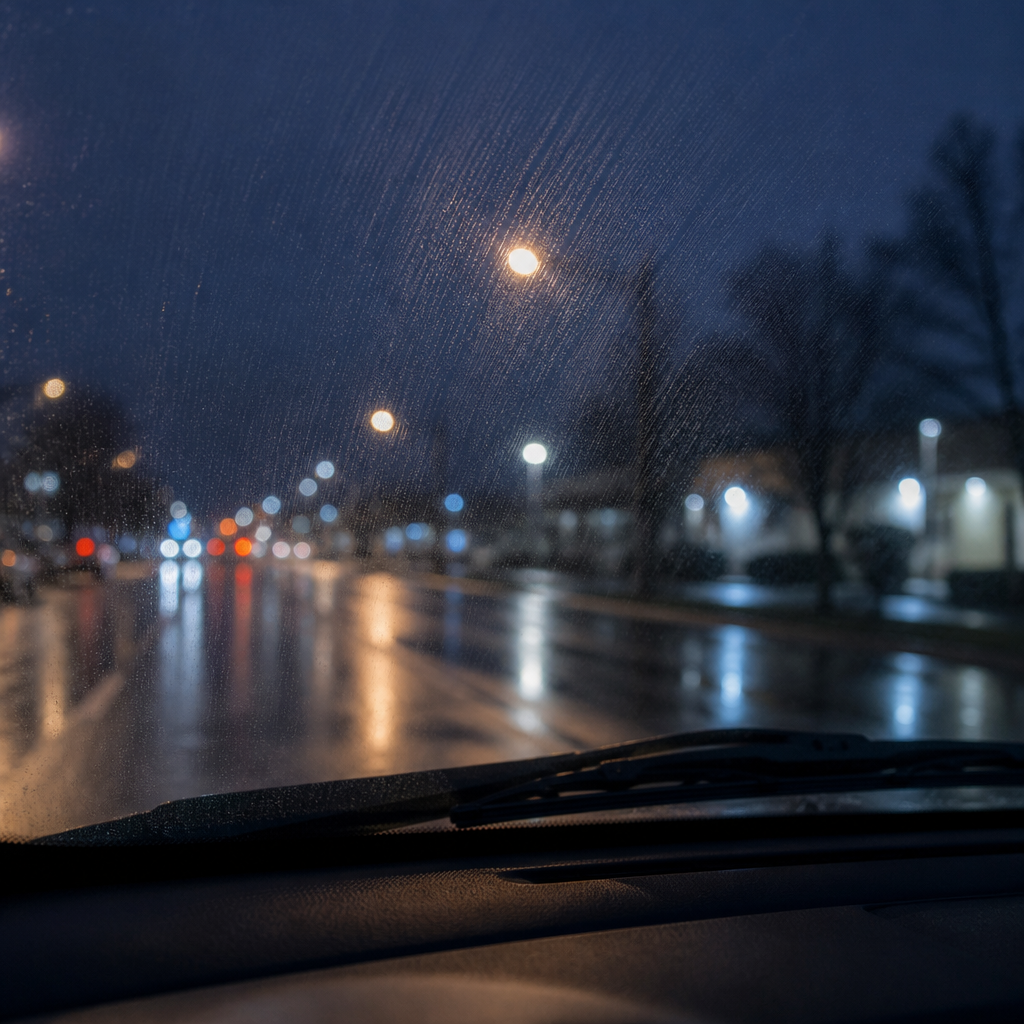
A wiper blade works by pressing a thin rubber edge against the glass and sweeping water across it. When the glass is clean, the water forms a continuous sheet that the blade pushes off. When bonded contamination is present, the water breaks into beads and the edge drags over raised particles, which produces the chatter, smearing, and arcs that drivers blame on the blades.
The result is a windshield that streaks no matter how often you change the blades. A new blade will still streak on contaminated glass, and the streaks often return within days. This is the reason the blade swap fixes the problem for a week and then fails.
Why new blades streak on dirty glass
A new blade has a sharp edge, and that edge is also the first thing to catch on bonded particles. Once it picks up a grain of grit, it starts to skip and leave lines. In practice, a blade that is only a few weeks old can look worn after a few passes on contaminated glass.
Wiper age and the six-month check
Blade rubber hardens and cracks with heat, cold, and sun exposure. The Car Care Council overview notes that extreme weather is tough on wiper blades and recommends checking and changing them about every six months. For Illinois drivers, that check is best done after decontamination, so you can tell whether a streak comes from the blade or the glass.
Our practical rule is simple. If the glass is clean and the blade still streaks, replace the blade. If the glass is contaminated, decontaminate first, then test the blade before you buy a new one.
The Exterior Glass Decontamination Process, Step by Step
A proper decontamination follows a sequence, and the order matters. Each step prepares the glass for the next one, so skipping ahead wastes product and can leave residue behind. The process below is the one we use on most vehicles before a coating or a maintenance program.
The goal is not to scrub harder. The goal is to remove contamination in stages, using the least aggressive method that works, so that the glass stays smooth and undamaged. Pressure and speed should stay low throughout.
Wash and rinse first
Start with a thorough wash to remove loose dirt, since anything left on the glass will act like sandpaper during the next steps. Rinse completely and dry the glass with a clean microfiber towel. The mafra guide to cleaning car windows also stresses clean tools and the right method, and that principle applies even more strongly before decontamination.
Chemical decontamination and mineral removal
Apply a suitable glass decontamination or mineral remover to dissolve embedded deposits. Let it dwell for the time the product specifies, then rinse thoroughly. This step is especially important for hard water spotting, because it reduces the amount of material the clay has to lift.
Clay with a dedicated glass lubricant
Next, glide a fine glass clay bar across the surface with a lubricant that is formulated for glass. Work in small sections, keep the surface wet, and fold the clay often so you are always using a clean face. When the clay glides without catching, the bonded contamination is gone.
Final wipe and inspection
Rinse the glass again, then dry it with a clean towel and inspect it at an angle. Use the bag test with a plastic bag over the glass, and if the surface still feels rough, repeat the clay step on that section. A decontaminated windshield should feel smooth under the bag and look clear from every angle.
Glass Coatings and Wiper Performance
Coatings are often sold as the answer to streaking, but a coating only protects the surface it is applied to. If the glass still has bonded contamination underneath, the coating locks it in and reduces the bond between the coating and the glass. That is why we treat decontamination as the first half of any coating job.
Coatings also change how water behaves on the glass. A well-prepared glass surface with a quality coating sheds water more readily, which can reduce how often the wipers need to run in light rain. It does not replace good blades, and it does not remove the need for periodic maintenance.
Why coatings fail on untreated glass
A coating needs direct contact with clean glass to bond properly. Any oil, film, or mineral residue creates a barrier, and the coating can cure with haze or uneven protection. Customers often notice that a coating applied over dirty glass looks streaky under sunlight, and the fix is always to strip and redo the prep.
Nano-ceramic SiO₂ coatings and what the warranty depends on
Our nano-ceramic SiO₂ coatings are designed for long-term hydrophobic performance and easier cleaning. We back our coatings with 5 to 8 year warranties, and those warranties depend on proper preparation and the maintenance steps we specify. Ask for the written terms before any coating is applied, because the details matter as much as the product.
The table below compares the three approaches most often discussed for glass care, along with the situations where each one makes the most sense.
| Approach | Best Use | Limitation |
|---|---|---|
| Clay bar with a dedicated glass lubricant | Removing bonded road film, tar, and overspray before any coating or polish | Requires patience and a fresh clay face, and dry or poorly lubricated clay can mar the glass |
| Chemical mineral and iron remover | Dissolving hard water spots and embedded metallic contamination | Needs thorough rinsing and does not remove organic film like tar or sap on its own |
| Nano-ceramic SiO₂ coating over decontaminated glass | Long-term water shedding, easier cleaning, and reduced buildup between maintenance visits | Only performs well when the glass is fully decontaminated first, and it needs periodic maintenance to hold up |
Pro tip: Before scheduling a coating, ask whether the glass will be decontaminated and tested with the bag method. A coating applied over untested glass is a gamble, and the bag test takes about a minute.
Illinois Weather and the Timing of Glass Care
Timing matters more in the Chicago suburbs than many owners realize. Late fall is one of the best windows for glass decontamination, because the glass is cleaner after the summer and before road salt and freezing temperatures set in. Work done now means fewer months of contamination bonding to the surface.

Cold weather also changes how glass performs. Temperature swings produce condensation on the inside and frost or ice on the outside, and both show clearly on contaminated glass. A clean exterior helps defrost and defog systems work with less effort because there is less film to fight through.
Why late fall is the right window
Late October gives you time to decontaminate, coat if you choose, and replace blades before the first hard freeze. Once winter is fully settled in, the glass can be harder to work on because of cold temperatures and salt residue that builds up quickly. Scheduling before that point keeps the process simpler and the results more consistent.
Winter defogging and wiper load
In winter, wipers work harder because they clear snow, slush, and salt spray in addition to rain. Contaminated glass forces the blades to fight through a surface that is already hazy, which adds strain to both the blades and the washer system. A clean, decontaminated windshield lets the wipers do their job with fewer passes.
Common Mistakes That Cause Streaks and Haze
Most streaking problems come from a handful of repeat mistakes. The fixes are not complicated, but they require breaking habits that feel reasonable, like wiping a dirty windshield with a dry towel or cleaning in full sun. Each mistake below is one we see regularly on vehicles that arrive for a first decontamination.
Glass that looks clean in the shade often shows its real condition the moment the sun drops low and hits it at an angle. Test the glass under those conditions before you decide the job is done.
Using household cleaners on car glass
Household glass cleaners are formulated for different surfaces, and some can dry out window tint edges or affect rubber seals over time. They may also leave a thin residue that causes streaking, especially on the inside where vapors and smoke already collect. A dedicated auto glass cleaner is a safer choice for routine work.
Cleaning in direct sun or with dirty towels
Cleaning in direct sun causes cleaner to dry before you can wipe it, and that leaves residue on the glass. Dirty or reused towels spread contamination across the surface, which creates new streaks while you think you are removing them. Use clean microfiber, work in shade, and turn the towel often.
Skipping the inside of the glass
Interior glass collects vapors, dust, and fingerprints, and that film can cause as much glare as exterior contamination. Many streaks that owners blame on the outside are actually coming from a dirty inside surface. Clean both sides before you judge the results.
Frequently Asked Questions
How often should exterior glass be decontaminated?
Most vehicles that drive daily on suburban roads benefit from decontamination at least once or twice a year, with a check in late fall before winter. Vehicles that sit under trees or park near construction may need it more often. The bag test is the simplest way to decide when it is time.
Can I decontaminate glass at home?
You can perform a basic version at home with a proper glass cleaner, a mineral remover, a fine clay bar, and a glass lubricant. The hard part is knowing when the glass is actually clean, which is why many owners find that a professional check gives them a more reliable result. Work in the shade, keep the surface wet, and never use dry clay.
Will decontamination fix wiper streaks by itself?
Decontamination fixes streaks caused by bonded contamination, and it often solves the problem completely. If the blades are cracked, worn, or hardened, though, streaks can remain even on clean glass. Test the glass first, then replace the blades if they still skip or smear.
Do I need to decontaminate glass before applying a coating?
Yes, decontamination should always come before a coating. A coating bonds to the glass surface, so any contamination underneath reduces adhesion and can leave haze or uneven protection. Skipping this step is one of the most common reasons coated glass disappoints.
Is glass decontamination different from a regular window cleaning?
Yes, a regular window cleaning removes loose dirt and film from the surface. Decontamination targets bonded residue, mineral deposits, and embedded particles that survive a normal wash. Both steps have a place, but only decontamination addresses the layer that affects wiper performance.
What does your windshield look like after the first heavy rain of the season, and have you ever traced a streak back to the glass instead of the blades?
References
- Guide to cleaning car windows without halos and streaks
- Municipal post on how cleaning interior and exterior windows reduces glare
- Car Care Council overview on wiper blade replacement timing