Your ceramic coating is not performing the way it did when it left our bay. Water is sheeting instead of beading, the paint has lost that wet-glass depth, and the hood feels slightly rough after a wash. The question most Glendale Heights and Carol Stream drivers ask at that point is the wrong one. They ask, "Does my coating need to be redone?" The right question is more specific: does your coating need a ceramic coating boost in Illinois, or does it need a full recoat? Those are two very different services, with very different price points, prep requirements, and outcomes. Getting the answer wrong costs you money in one direction or your paint protection in the other.
Table of Contents
- Quick Takeaways
- What Is a Coat Boost (SiO2 Top Coat Refresh)?
- What Is a Full Ceramic Recoat?
- How to Tell Whether Your Coating Needs a Boost or a Recoat
- The Illinois Climate Factor: Why Chicago Suburbs Are Harder on Coatings
- Coat Boost vs. Full Recoat: Side-by-Side Comparison
- Building a Maintenance Schedule Around Chicago Seasons
- Frequently Asked Questions
- References
Quick Takeaways
| Key Insight | Explanation |
|---|---|
| A boost fixes surface fatigue, not structural failure | An SiO2 top coat refresh restores hydrophobic performance when the base coating is still bonded but its outermost layer has thinned. It cannot save a coating that has delaminated or chemically degraded all the way through. |
| Decontamination is the diagnostic step | If gloss and water behavior return after a proper iron fallout and clay bar decontamination, the coating is intact and a boost is appropriate. If the surface stays dull and rough, a recoat is necessary. |
| Apply a ceramic boost spray every 3 to 4 months in Illinois | Road salt, chemical deicers, and heavy UV from May through August accelerate surface layer wear. A boost on this interval keeps the hydrophobic layer strong between full service visits. |
| A full recoat requires paint correction if marring is present | Applying a fresh nano-ceramic layer over swirl marks or water spot etching locks those defects in permanently. If light marring has appeared, a machine polishing stage must precede recoating. |
| Horizontal panels degrade faster than vertical ones | Hoods, roofs, and trunk lids take direct UV exposure and road fallout at a higher rate. These panels often need attention before the rest of the vehicle does. |
| Coating age alone does not trigger a recoat | A professionally applied nano-ceramic SiO2 coating maintained correctly can remain structurally sound well past its nominal warranty window. Performance testing matters more than the calendar. |
| Skipping boosts shortens the interval to a full recoat | Neglecting maintenance top-ups puts the full coating load on a progressively thinner surface layer, accelerating the point at which a complete strip-and-reapply becomes unavoidable. |
What Is a Coat Boost (SiO2 Top Coat Refresh)?
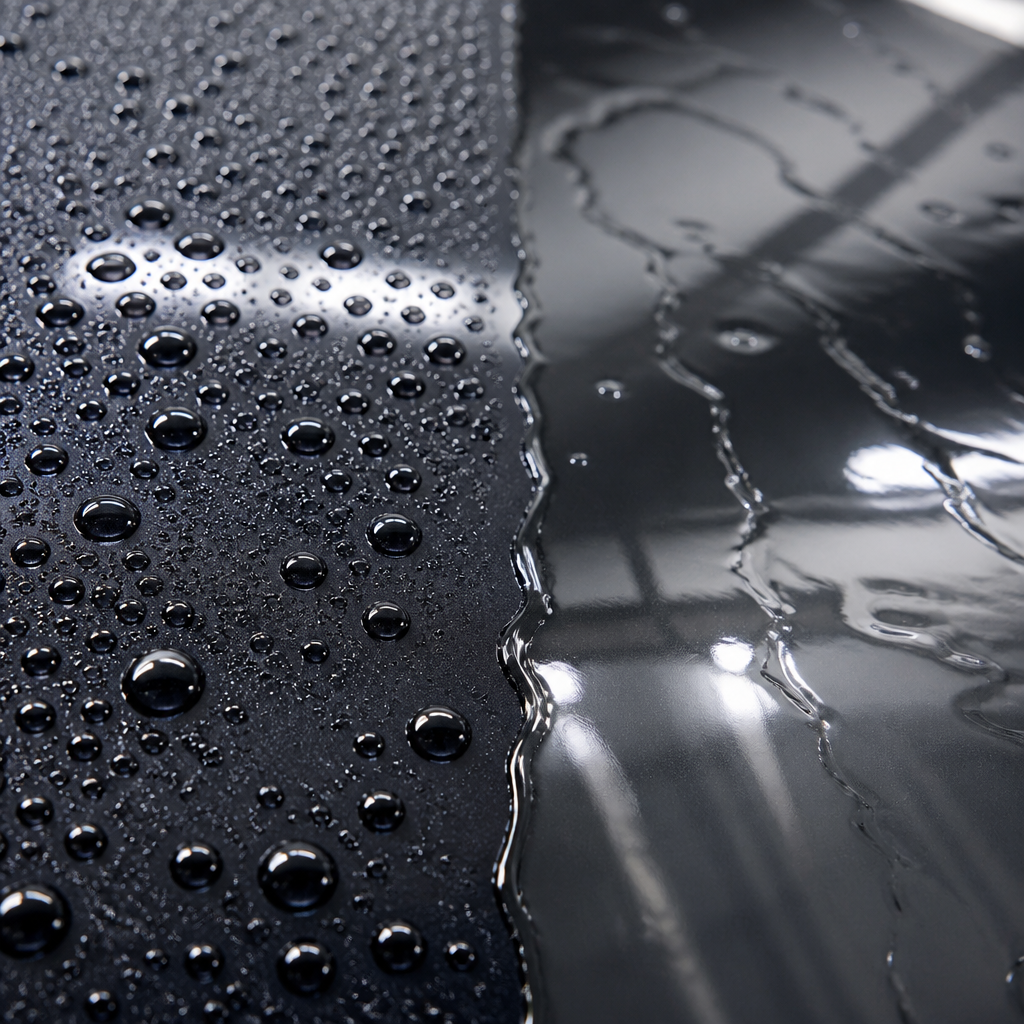
A coat boost, sometimes called an SiO2 top coat refresh or ceramic maintenance spray, is a supplemental service applied over an existing ceramic coating that is still structurally bonded to the paint. The product is typically a spray-applied silicon dioxide formulation that crosslinks with the surface coating to restore the hydrophobic contact angle, deepen gloss, and reinforce UV resistance.
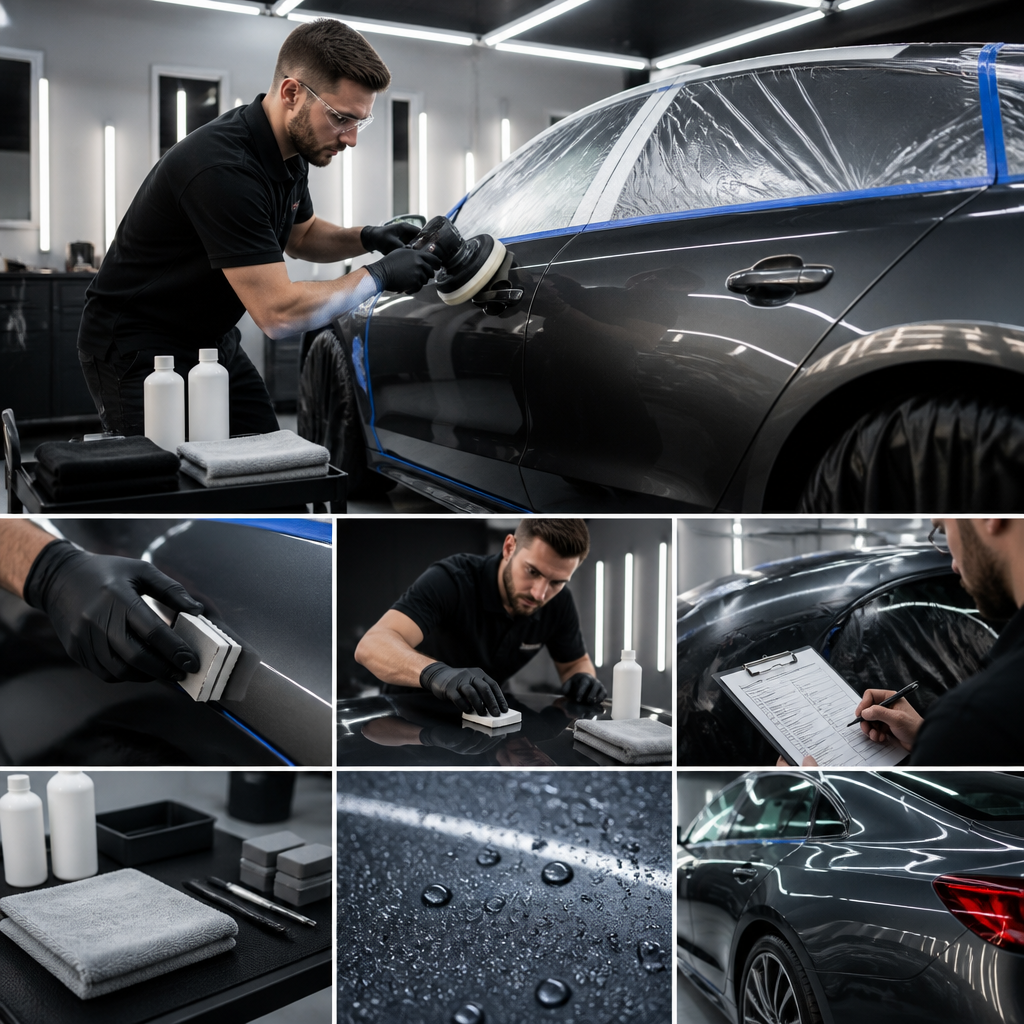
Think of it as conditioning rather than replacing. The base coating, whether a multi-layer nano-ceramic SiO2 system or a single-stage professional coating, remains in place. The boost replenishes the outermost sacrificial layer that takes the daily punishment from road film, wash cycles, and environmental fallout. The prep work is minimal compared to a full recoat: a thorough decontamination wash, iron fallout removal, and a panel wipe-down are typically sufficient before application.
In practice, a ceramic coating boost in Illinois is most appropriate at the following moments: after a vehicle comes out of a full winter driving season, before a long summer road trip, or when water behavior has softened from tight beading to slower sheeting but the paint still looks clean and reflective after washing. It is a proactive service, not a rescue service.
Pro tip: Before any boost application, run your clean, dry fingertips across the hood and roof. If the surface still feels glass-smooth, the coating is intact and a boost will perform exactly as intended. If it feels gritty even after washing, decontamination is required first, and that roughness may indicate a deeper problem worth a professional assessment.
What Is a Full Ceramic Recoat?
A full recoat is the complete process of removing or chemically stripping the degraded existing coating, correcting any paint defects that have accumulated during the coating's service life, and applying a fresh professional nano-ceramic SiO2 system from scratch. It is not simply spraying a new product over an old one. The process follows the same rigorous sequence as the original application: wash and decontaminate, clay bar or chemical decontamination, machine polish where needed, panel prep wipe-down, and then coating application with proper cure time.
The reason prep cannot be skipped during a recoat is straightforward. A ceramic coating bonds at the molecular level to whatever surface it contacts. If that surface carries embedded iron fallout, water spot etching, or light swirl marks from improper wash technique, the new coating bonds over all of those defects and traps them permanently beneath glass-hard chemistry. At Hershey's Detailing, our multi-stage machine polishing process ensures the paint is genuinely flawless before any coating chemistry touches it, because there is no correcting those defects once the coating cures.
When a Recoat Is Non-Negotiable
There are situations where no boost product will help and a full recoat is the only professional answer. Physical damage to the coating, such as deep swirl marks from an automatic brush car wash cutting through the coating layer, falls into this category. So does chemically etched paint where bird droppings or tree sap have been left sitting for extended periods and the damage runs through the coating into the clear coat itself.
Another clear indicator is inconsistent panel performance. If the driver-side door beads water normally but the hood and roof do not respond to repeated decontamination attempts, the coating on the horizontal panels has degraded beyond what a surface refresh can address. Horizontal surfaces receive dramatically more direct UV exposure and airborne fallout than vertical panels, which is why they typically show coating fatigue first.
Pro tip: If your vehicle is approaching the upper end of its coating's warranty window (our 5 to 8 year nano-ceramic SiO2 coatings are premium systems, but even they have a service life), book a condition assessment before the coating reaches complete failure. A recoat on a well-maintained coating requires far less machine polishing time than a recoat on a neglected one, which translates directly to lower cost and better results.
How to Tell Whether Your Coating Needs a Boost or a Recoat
The single most reliable diagnostic is a proper decontamination wash followed by a visual and tactile inspection. This is not something you need to guess at. The coating's behavior after decontamination tells you almost everything you need to know about whether the underlying structure is still sound.
The Decontamination Test
Perform a full wash with pH-neutral shampoo, apply an iron fallout remover and let it dwell until the purple reaction stops, then clay bar the surface. Rinse, dry, and then evaluate. If the paint regains its gloss and water starts beading into tight, high-contact-angle droplets, the coating is still structurally intact. What you were seeing was surface contamination masking the coating's performance, not coating failure. A boost service is the right next step.
If the surface remains dull, feels rough in areas, or water still sheets broadly without forming tight beads after this process, the coating has degraded past what decontamination alone can restore. Gloss that does not return after cleaning, panels that perform inconsistently compared to each other, and etching that persists after professional treatment are all signs pointing to a full recoat.
The Age and Exposure Factor
Coating age in isolation is not a reliable guide. A coating that is three years old on a garaged Wheaton luxury vehicle driven primarily in dry conditions may be in significantly better shape than a two-year-old coating on a daily driver commuting through Bloomingdale winters on heavily salted roads. What matters is cumulative exposure and maintenance history.
That said, there is a practical decision framework. A coating in the two to three year range with reduced water beading but smooth, defect-free paint is a strong candidate for a maintenance boost. A coating in the four to five year range with visible marring beginning to appear is a strong candidate for full decontamination, light polishing, and a fresh professional application.
The question is never "how old is the coating?" The question is "what condition is the paint in underneath it, and is the coating still doing its job?" Those two questions have specific, testable answers. Guessing is not a maintenance strategy.
The Illinois Climate Factor: Why Chicago Suburbs Are Harder on Coatings
Glendale Heights, Carol Stream, Bloomingdale, and Wheaton sit squarely in one of the most demanding environments for automotive coatings in the country. The Chicago suburbs combine multiple coating-stressing factors that most other regions do not experience simultaneously.
Road Salt and Chemical Deicers
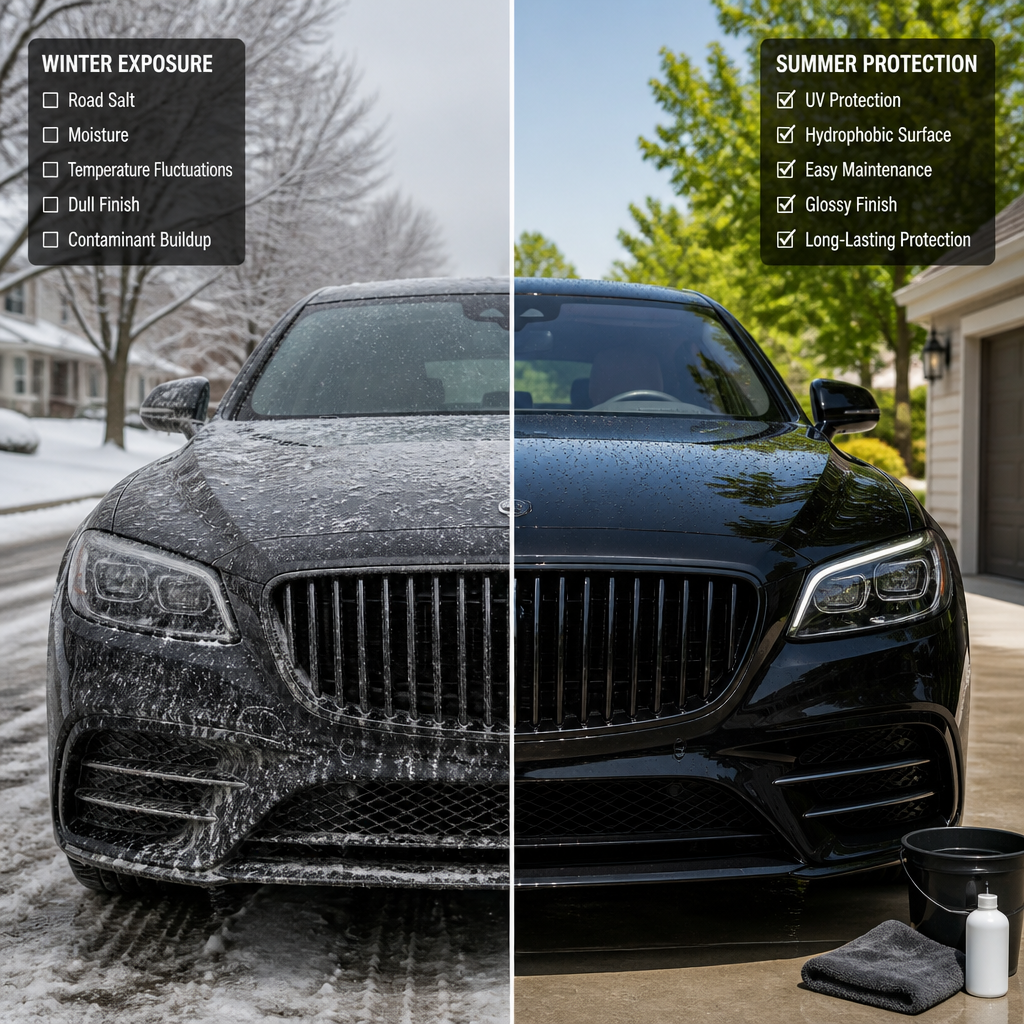
Illinois roads receive heavy road salt application from November through April, and the Chicago suburbs are no exception. Calcium chloride and chemical deicers are used alongside rock salt, and these chemicals are significantly more aggressive on coatings than rock salt alone. They break down the surface layer of the coating faster, accelerate contamination bonding, and can cause premature hydrophobic failure if a maintenance boost schedule is not followed.
The practical result: vehicles driven through a Chicago suburb winter without a pre-winter boost and a post-winter decontamination are asking a lot of their coating. The hydrophobic layer takes the hardest hit during February and March, when salt application is highest and the coating has been under chemical stress for months. A spring decontamination and boost at the end of every winter season is not optional maintenance here, it is the minimum responsible care for a coated vehicle.
UV and Summer Heat Cycling
Illinois winters are brutal, but Illinois summers are also genuinely hard on coatings. The UV intensity during June through August, combined with the thermal cycling a dark-colored vehicle experiences in a parking lot, accelerates oxidation of the coating surface layer. Black and dark blue vehicles in particular will show gloss reduction faster on horizontal panels during summer if a boost has not been applied since the previous year.
The net effect of Illinois's climate on a ceramic coating maintenance schedule is this: most Chicago suburb vehicles should receive a professional ceramic coating boost in Illinois twice a year, typically in late spring after the winter decontamination and again in early fall before winter begins. Vehicles driven less frequently or stored seasonally can manage with one annual boost, provided the pre-storage prep is thorough.
Coat Boost vs. Full Recoat: Side-by-Side Comparison
| Factor | Coat Boost (SiO2 Top Coat Refresh) | Full Ceramic Recoat |
|---|---|---|
| Purpose | Refreshes hydrophobic layer and gloss on an intact coating | Replaces a degraded or failed coating with a new professional system |
| Prep Required | Decontamination wash, iron fallout removal, panel wipe-down | Full decontamination, clay bar, machine polishing (if marring present), coating prep wipe |
| Paint Correction Included | No. Paint must already be defect-free for a boost to be appropriate | Yes, where needed. Swirl marks and etching are corrected before the new coating is applied |
| Best Candidate | Coating 1 to 3 years old, water beading reduced, paint smooth and reflective after cleaning | Coating showing inconsistent performance, permanent etching, or structural degradation that decontamination cannot resolve |
| Illinois-Specific Timing | Late spring post-winter decontamination and early fall pre-winter prep | As needed based on condition assessment, typically every 4 to 7 years for maintained vehicles |
| Outcome Duration | Adds 6 to 12 months of reinforced hydrophobic performance per application | Resets the full coating lifespan, up to 5 to 8 years with proper maintenance on a professional nano-ceramic SiO2 system |
| What It Cannot Fix | Deep swirl marks, etching through the clear coat, delaminated coating sections | Nothing. A full recoat with proper prep and correction addresses all pre-existing paint and coating issues |
Building a Maintenance Schedule Around Chicago Seasons
The most common mistake we see from Chicago suburb vehicle owners is treating ceramic coating maintenance as something they will get to eventually rather than something that follows a specific annual rhythm. The Illinois climate has clear seasonal patterns, and a maintenance schedule that aligns with those patterns keeps a coating performing at its best for years longer than one that does not.
Spring: Post-Winter Decontamination and Boost
Late March through April is the single most important maintenance window for coated vehicles in this area. After an Illinois winter, the coating surface carries accumulated iron fallout from brake dust and road particles, bonded salt residue, and chemical deicer contamination. A full iron fallout treatment and decontamination wash at this point is essential before any boost is applied. Applying an SiO2 boost over a contaminated surface traps those contaminants against the coating and accelerates further degradation.
After decontamination confirms the coating is still intact, a fresh boost application sets the vehicle up well for the summer UV season. This spring service is also the right time for a professional condition assessment if the coating is more than three years old.
Fall: Pre-Winter Prep and Boost
September and October are the ideal window for a fall boost before road salt season begins. A coating that heads into a Chicago winter with a fresh SiO2 top coat has a meaningful buffer against the chemical stress of November through March. The boost layer absorbs the initial contamination assault, slows surface layer degradation, and makes the post-winter decontamination significantly easier the following spring.
A coating maintenance recoat for Chicago-area vehicles that has been consistently boosted twice a year will show dramatically better condition at the five-year mark than one that has had no maintenance top-ups. The chemistry of the base coating remains structurally sound when the surface layer above it is regularly refreshed rather than allowed to thin and fail progressively. This is not theoretical, it is the consistent observation from years of assessing coated vehicles across Glendale Heights, Wheaton, and the surrounding suburbs.
Annual Professional Inspection
Once a year, have the coating professionally assessed. This does not require a full service visit. A trained eye can evaluate water behavior, gloss depth, tactile smoothness, and panel-to-panel consistency in a short inspection and tell you whether the coating is on track, whether a boost is due, or whether a recoat conversation is worth having. Catching the early signs of coating fatigue early almost always means a simpler and less expensive correction.
Pro tip: Schedule your annual coating inspection for September or October. You get the assessment before the coating faces its hardest season, you have time to address any issues found before November salt arrives, and the fall boost is built into the same visit. It is the most efficient use of one service appointment per year.
Frequently Asked Questions
Can I apply a ceramic boost spray myself between professional services?
Yes, with important caveats. Consumer-grade SiO2 spray boosters are widely available and can be applied after a proper maintenance wash. However, they do not replace a professional boost service because they typically lack the concentration and crosslinking chemistry of professional-grade formulations. They are a useful supplement between professional appointments, not a substitute. If you use a consumer spray, make sure the surface is genuinely clean and decontaminated first, because anything bonded to the surface will be sealed under the product.
How do I know if my coating has actually failed versus just being dirty?
Run the decontamination test described above. A thorough iron fallout treatment and clay bar process will remove surface contamination that mimics coating failure. If the paint returns to full gloss and water beading after proper decontamination, the coating was intact the entire time. If it remains dull, rough in areas, or performs inconsistently across different panels after professional decontamination, the coating has structurally degraded and a recoat assessment is warranted.
Does a full recoat always require stripping the old coating completely?
Not always. If the existing coating is still reasonably bonded but has simply reached the end of its service life performance-wise, a fresh professional nano-ceramic layer can often be applied over it after thorough decontamination and a coating prep wipe that removes oils and silicone residue. If the coating has delaminated, shows adhesion failure, or is contaminated in ways that prep chemistry cannot address, full removal is the right call before reapplication. This determination is best made by a professional who can assess the actual coating condition rather than a blanket rule applied to every vehicle.
Will a ceramic coating boost work on a coating that has never had any maintenance?
It depends entirely on the current condition. A coating that is two years old but has never had a boost or a proper decontamination will likely be carrying significant surface contamination. The first step in that case is a thorough professional decontamination service, not a boost application. Once the surface is clean and confirmed intact, a boost is appropriate. Skipping straight to a boost on a contaminated coating is one of the most common mistakes in coating maintenance, and it produces poor results because the product is bonding to contamination rather than the coating surface.
Is a coating maintenance recoat in Chicago more expensive than in other regions?
The base cost of professional ceramic coating services is broadly comparable across markets, but the prep work required in Chicago suburb vehicles is often more involved than vehicles from milder climates. A vehicle driven through two or three Illinois winters without a maintenance boost schedule will typically need more thorough decontamination and a more involved machine polishing stage before recoating than a comparable vehicle from a region without road salt. The better maintenance you keep throughout the coating's life, the lower the prep cost when a recoat eventually becomes appropriate.
How long does an SiO2 top coat refresh actually last in Illinois conditions?
A professional-grade SiO2 boost applied to a clean, intact base coating typically adds six to twelve months of reinforced hydrophobic performance under normal conditions. In Illinois winter driving conditions with regular road salt exposure, the surface layer of a boost applied in October may show measurable reduction by February or March, which is precisely why the spring decontamination and boost cycle exists. The boost is designed to sacrifice itself to protect the base coating below it, which is exactly what it should be doing.
Have you noticed your ceramic coating losing its water beading this season, or are you weighing whether a boost will carry you through another Chicago winter? Share your experience below and let us know what you are seeing on your vehicle.
References
- When to reapply ceramic coating versus applying a top-off treatment
- How to diagnose whether a ceramic coating is failing or just contaminated
- How long professional ceramic coatings last and when to choose a maintenance top-up versus a full recoat
- Seasonal ceramic coating maintenance schedule and booster application intervals
- Nano coatings: when to replace and how to prepare for a proper recoat