Most paint damage on luxury vehicles does not come from road debris or weather. It comes from improper washing technique, the wrong products, and skipped steps that compound over months and years. If you own a high-end vehicle in the Chicago suburbs and you care about preserving its finish, a proper exterior car detailing guide is not optional reading. This guide walks through every stage of a professional exterior detail, from the initial rinse to the final quality inspection, using the same methodology practiced at Hersheys Detailing in Glendale Heights after seven years and more than 500 vehicles.
Table of Contents
- Why Exterior Detailing Is Not Just a Wash
- Quick Takeaways
- Pre-Wash and Initial Rinse Stage
- The Two-Bucket Professional Hand Wash Method
- Chemical and Mechanical Decontamination
- Paint Correction and Machine Polishing
- Choosing the Right Paint Protection Layer
- The Final Inspection Process
- Exterior Detailing in the Chicago Suburbs
- Frequently Asked Questions
- References
Why Exterior Detailing Is Not Just a Wash
A drive-through car wash removes loose dirt. A professional exterior detail removes embedded contamination, corrects paint defects, and applies a protection layer that actually bonds to the clear coat. These are fundamentally different outcomes.
According to Statista, the U.S. car wash and auto detailing industry was valued at over $14 billion in 2023, and premium detailing services are growing faster than basic wash services. That growth reflects a shift in how vehicle owners understand paint care.
The Chicago suburb climate makes this especially relevant. Road salt from Illinois winters, industrial fallout from surrounding commercial areas, and UV exposure during summer months create a compounding threat to exterior paint. A single professional exterior detail done correctly provides protection that a monthly machine wash simply cannot replicate.
Quick Takeaways
| Key Insight | Explanation |
|---|---|
| Pre-wash matters as much as the main wash | Spraying a pre-wash foam loosens heavy contamination before contact, dramatically reducing the risk of wash-induced scratches. |
| The two-bucket method is non-negotiable for paint safety | Using one bucket for soapy wash water and a separate rinse bucket prevents dirt from being dragged back across the paint on every pass. |
| Iron decontamination is a skipped step in most basic details | Ferrous particles from brake dust embed into clear coat and cause orange rust spots. An iron remover dissolves them chemically before polishing. |
| Machine polishing is the only way to remove swirl marks | Hand polishing cannot generate the consistent speed and pressure needed to level clear coat. A DA or rotary polisher is required for genuine paint correction. |
| Ceramic coatings outperform wax on a three-year timeline | A professional nano-ceramic SiO2 coating bonds to clear coat and lasts 5 to 8 years with maintenance. Carnauba wax lasts 6 to 12 weeks. |
| Final inspection under correction lighting reveals what naked-eye checks miss | High-intensity LED or solar-spectrum lighting exposes holograms, buffer trails, and missed contamination spots before the vehicle leaves the shop. |
| Skipping clay bar decontamination before polishing causes new scratches | Polishing over embedded contamination drags particles across the clear coat surface. Decontamination must come before any abrasive correction work. |
Pre-Wash and Initial Rinse Stage
The pre-wash phase is where professionals separate themselves from enthusiasts who do a good job in the driveway. The goal here is to remove as much loose contamination as possible without any physical contact with the paint surface.
A snow foam or pre-wash solution is applied using a foam cannon at low pressure, coating the entire vehicle and allowing the chemical agents to dwell for three to five minutes. This lifts road grime, bird dropping residue, and loose organic matter.
Wheel and Tire Pre-Treatment
Wheels and wheel arches are treated first with a dedicated wheel cleaner, typically a pH-balanced or iron-reactive formula. Brake dust is one of the most aggressively bonding contaminants on any vehicle, and failing to address it before the main wash risks cross-contaminating your wash mitt with metallic particles.
In practice, a separate set of brushes and mitts is used for wheels and never touched to paint. This is a detail that separates professional shops from quick-detail operations.
High-Pressure Rinse Before Contact
After foam dwell time, a pressure rinse removes the loosened contamination. The rinse should follow a top-down path, rinsing the roof first and working down to the rocker panels. This prevents dirty water from running back over already-rinsed sections.
Pro tip: Never use a pressure washer closer than 18 inches to painted surfaces, and never direct the jet at door seals, rubber trim, or window edges at full pressure. Water intrusion at these points causes interior damage that is far more expensive to fix than any paint defect.
The Two-Bucket Professional Hand Wash Method
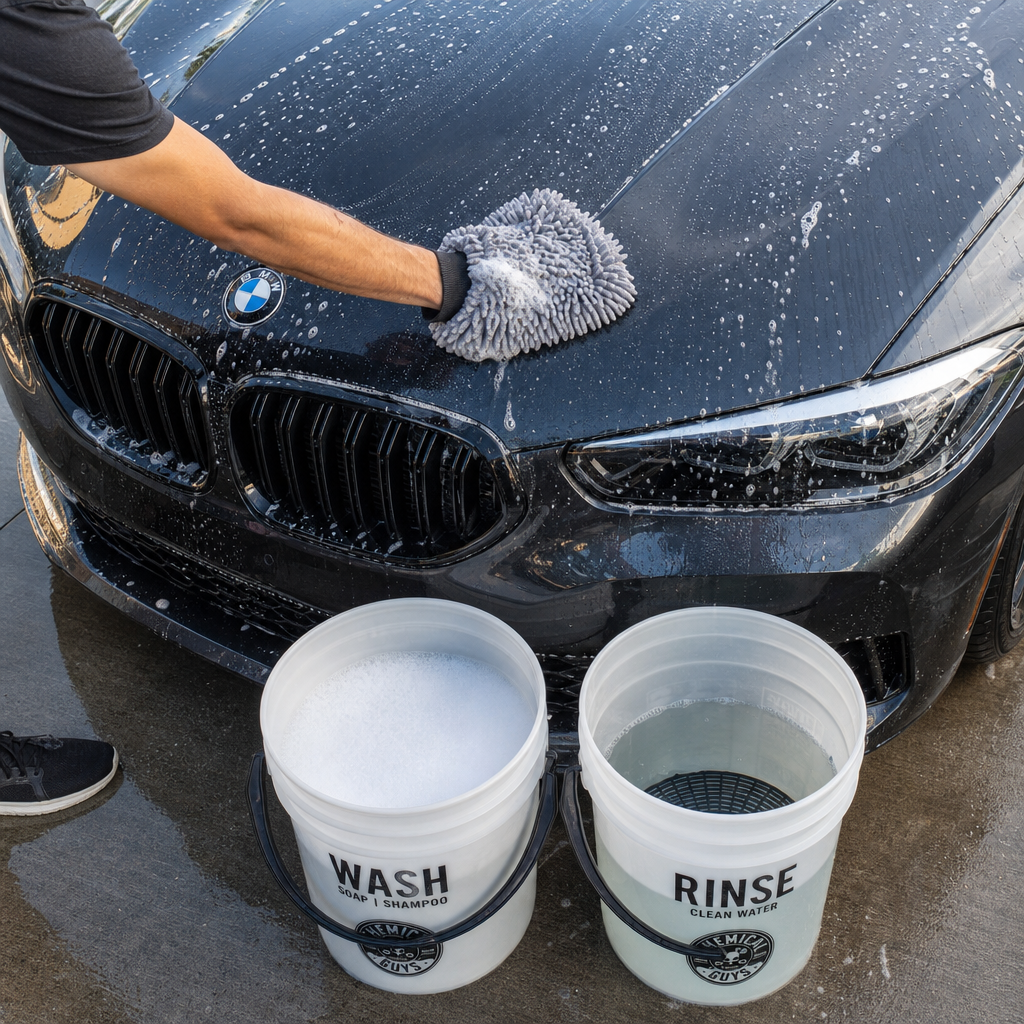
The two-bucket method is the standard for professional hand wash detailing, and there is no legitimate argument for departing from it on a high-value vehicle. Bucket one holds fresh pH-neutral car shampoo solution. Bucket two holds clean rinse water. Every pass of the wash mitt across the paint is followed by rinsing the mitt in the clean bucket before reloading with soap.
Both buckets should contain grit guards at the bottom. These plastic grids trap settled dirt below the water line so it cannot be picked back up when the mitt is agitated during rinsing.
Wash Mitt Selection and Technique
Microfiber wash mitts are the correct choice for painted surfaces on modern clear coats. Sponges are not acceptable on premium vehicles because they trap grit against the paint surface rather than lifting it away from contact.
Wash technique matters as much as tool selection. Straight-line horizontal strokes are preferred over circular motions. Circular motions create swirl marks that appear as orbital scratches under direct light. Straight-line marks, if created, are far less visible and easier to correct later.
Panel-by-Panel Sequencing
A professional hand wash processes the vehicle in sections: roof, hood, trunk lid, quarter panels, doors, front bumper, rear bumper, rocker panels last. The lowest and dirtiest panels are always washed last to avoid contaminating mitts that will touch the cleaner upper sections.
Rinse each panel immediately after washing it, before the soap solution has a chance to dry. In summer conditions in the Chicago suburbs, this becomes especially important when detailing outdoors in direct sunlight, where shampoo can dry and leave water spots within seconds.
Pro tip: Always dry the vehicle with a large, high-pile microfiber drying towel using a blotting and dragging motion rather than circular wiping. A two-towel method works well: one towel to absorb the bulk of the water and a second clean towel to dry to a streak-free finish.
Chemical and Mechanical Decontamination
Washing removes surface dirt. Decontamination removes embedded contamination that washing cannot touch. This distinction is critical, and skipping decontamination before paint correction is one of the most common mistakes made in cut-rate detail shops.
"Paint contamination is invisible to the naked eye until you run a clean fingertip across a freshly washed panel. That roughness you feel is embedded ferrous particles, industrial fallout, and mineral deposits. It has to come out before you polish or coat anything." - Hersheys Detailing, Glendale Heights, IL
Iron and Fallout Remover Application
An iron dissolving spray is applied to all painted surfaces and wheels after washing. The active ingredient, typically ammonium thioglycolate or similar compound, reacts with ferrous iron particles embedded in the clear coat and dissolves them. The reaction is visible as the product turns purple-red, indicating iron removal is occurring.
This step is not optional on any vehicle that has driven more than a few thousand miles. Brake dust is constantly shed by every vehicle on the road, and it deposits on the nearest painted surfaces. Illinois roads, particularly around Carol Stream and Bloomingdale where commercial traffic is heavy, make this contamination worse than average.
Clay Bar Treatment
After the iron remover is rinsed, a clay bar or clay mitt is used with a dedicated lubricant to mechanically decontaminate the surface. The clay grabs and removes contamination that the chemical stage leaves behind, including bonded wax layers, tree sap residue, and overspray.
A clean clay bar should feel smooth gliding across a properly lubricated panel. Any grabbing sensation indicates contamination still present. A single contaminated clay bar pass across a dry panel can cause more scratches than months of incorrect washing, so lubrication levels must be maintained throughout the process.
Paint Correction and Machine Polishing
Paint correction is the process of removing clear coat defects through controlled abrasion. Swirl marks, water spot etching, light scratches, and oxidation are all addressed at this stage. This is where the technical expertise of a professional detail shop makes the largest difference in outcome.
At Hersheys Detailing, multi-stage machine polishing is a core service because single-stage polishing with a one-size-fits-all compound does not achieve a flawless finish on soft European clear coats or harder Japanese paints. The correct combination of machine, pad, and compound for each paint type is learned through direct experience with hundreds of vehicles, not from reading a product label.
Single-Stage vs. Multi-Stage Paint Correction
Single-stage correction uses one compound and one pad to address surface defects in a single pass. It is faster and appropriate for vehicles with mild defects and newer paint.
Multi-stage correction typically involves a cutting compound with a foam or microfiber cutting pad to remove defects, followed by a finer polish with a finishing pad to remove any haze or micro-marring left by the cutting stage. On a high-end vehicle, skipping the refinement stage produces paint that looks worse under certain lighting than the original swirled paint did.
DA Polisher vs. Rotary Polisher
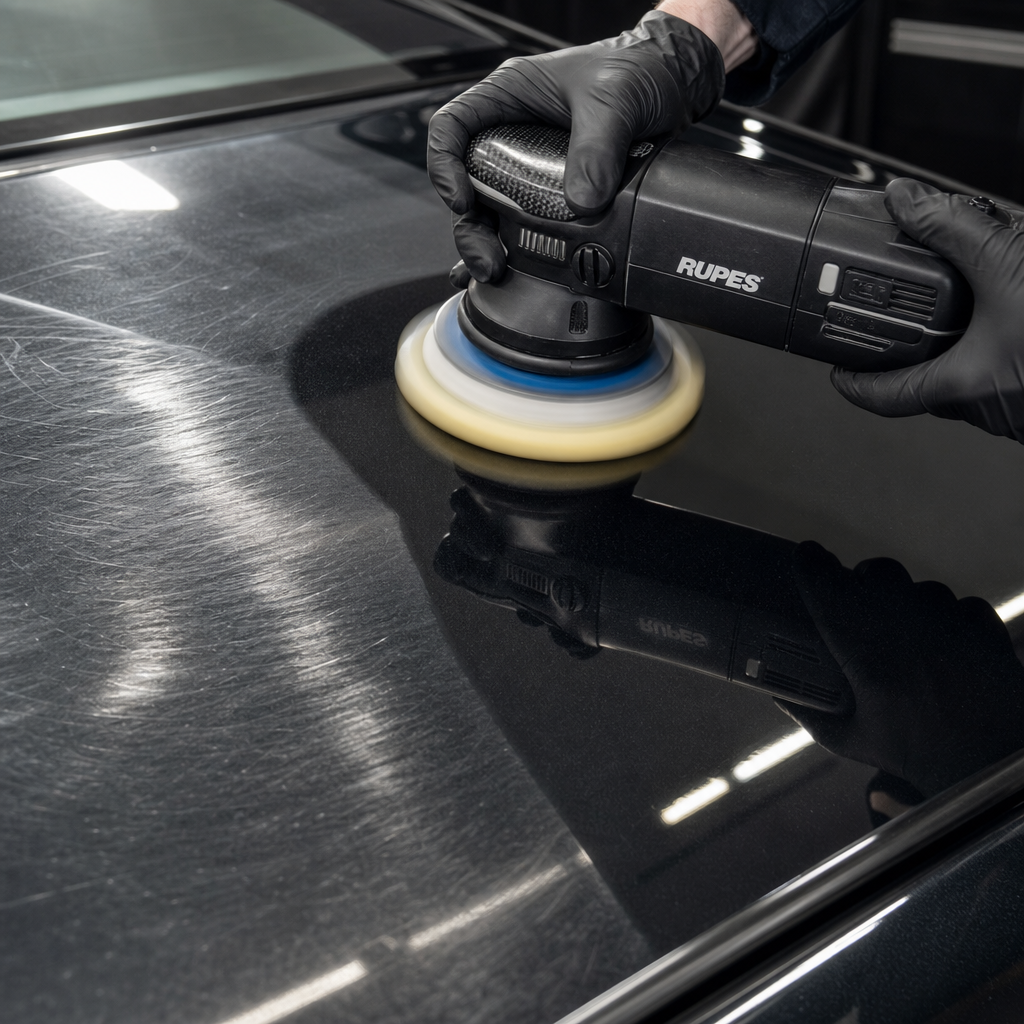
A dual-action (DA) polisher moves in an oscillating random orbit, making it more forgiving on delicate or thin clear coats. A rotary polisher spins on a fixed axis and generates more cutting power but also more heat, which can burn through thin paint or leave holograms if used by an inexperienced operator.
In practice, most professional correction work on luxury vehicles uses a DA polisher for safety on the primary panels and a rotary in targeted areas where more aggressive correction is needed. Both tools have legitimate places in a professional kit.
Choosing the Right Paint Protection Layer
After paint correction, the exposed and perfectly leveled clear coat needs protection. Three main options exist for this stage: carnauba wax, paint sealant, and ceramic coating. Each has a different performance profile and cost structure.
| Protection Type | Durability | Best Use Case |
|---|---|---|
| Carnauba Wax | 6 to 12 weeks depending on weather exposure and wash frequency | Show vehicles that are detailed frequently and rarely driven; owners who want a warm, deep gloss rather than slickness |
| Paint Sealant (Synthetic Polymer) | 4 to 8 months; withstands washing better than carnauba but degrades under UV and road chemical exposure | Daily drivers who want low-maintenance protection beyond what wax provides but are not ready for a full ceramic coating investment |
| Nano-Ceramic SiO2 Coating | 5 to 8 years with warranty when professionally applied; requires annual maintenance detail to preserve hydrophobic properties | Luxury and daily-driven vehicles where owners want permanent protection, self-cleaning hydrophobic behavior, and the highest gloss output available |
The data consistently shows that ceramic coatings are the only category that delivers a return on investment over a multi-year ownership period. When the cost of annual waxing and sealant reapplication is added up over five years, the price gap between a professional ceramic coating and consumable wax products narrows significantly, while the protection level is not comparable.
For vehicle owners in the Wheaton and Carol Stream areas who deal with harsh winters, road salt, and significant UV exposure in summer, a professionally applied nano-ceramic SiO2 coating is the rational choice for any vehicle worth more than $40,000.
The Final Inspection Process
A professional exterior detail is not complete when the last panel is wiped. The final inspection stage is where honest shops differentiate themselves, because it requires re-examining every surface under conditions that reveal defects that normal shop lighting hides.
Correction Lighting Inspection
High-intensity LED inspection lights or daylight-spectrum lights are used to examine every panel at multiple angles. This lighting reveals holograms left by rotary buffer passes, high spots in ceramic coating application, water spots from rinsing, and any areas where compound residue remains in panel gaps or around trim edges.
A common mistake in lower-quality shops is performing the final inspection under standard overhead fluorescent lighting. Fluorescent light scatters evenly and masks the kind of directional reflections that expose swirl marks and buffer trails. Any shop that does not use dedicated correction lighting for final inspection is not performing a true quality check.
Panel Gap and Trim Detail Check
Compound residue consistently accumulates in panel gaps, around emblems, in mirror housings, and along rubber window trim during the polishing stage. The final inspection includes removing this residue with detailing brushes and clean microfiber cloths before the vehicle is released.
Releasing a vehicle with white compound residue in the door jambs or around the fuel door is a visible sign of incomplete work. This step takes time but it is the difference between a complete professional detail and a polishing job.
Exterior Detailing in the Chicago Suburbs
Exterior detailing in the Chicago suburbs presents specific challenges that are different from markets with milder climates. Illinois road salt applied from November through March causes accelerated paint contamination and increases the frequency at which iron decontamination is needed. UV index during Chicago-area summers is comparable to much warmer climates during peak months, which degrades unprotected clear coat faster than many vehicle owners expect.
Glendale Heights, Carol Stream, Bloomingdale, and Wheaton all sit in suburban corridors with significant commercial traffic. That traffic generates brake dust, tire rubber particles, and industrial fallout at higher concentrations than purely residential areas. For vehicle owners in these communities, a schedule of at least two full exterior decontamination details per year, combined with a ceramic coating and quarterly maintenance washes, is the standard that protects paint finish over the long term.
Hersheys Detailing serves these communities directly, with seven years of working on the specific paint conditions created by this climate. The combination of decontamination, multi-stage polishing, and professional ceramic coating application reflects what the Chicago suburb environment actually demands, not a generic detail menu built for a mild-weather market.
Frequently Asked Questions
How long does a full professional exterior car detail take?
A complete exterior detail including pre-wash, two-bucket hand wash, iron decontamination, clay bar, paint correction, and protection application typically takes between 6 and 12 hours depending on the vehicle size, paint condition severity, and the protection product applied. Ceramic coating application adds curing time that may extend the process to two days.
Is a professional hand wash detailing service worth it over an automatic car wash?
Yes, without qualification. Automatic car wash brushes and friction mechanisms introduce swirl marks and micro-scratches into clear coat on every pass. A professional hand wash using the two-bucket method and microfiber mitts removes contamination without surface contact damage. For any vehicle with paint correction or ceramic coating already applied, an automatic car wash will degrade both investments within weeks.
How often should exterior detailing be done in Illinois winters?
For vehicles driven through Illinois winters and exposed to road salt, a full decontamination detail at the start of winter and again at the end of spring is the minimum recommended schedule. Vehicles with ceramic coatings should receive a maintenance detail every three to four months to keep the hydrophobic layer functioning at full capacity and to remove salt residue before it causes etching.
What is the difference between paint correction and paint restoration?
Paint correction refers to removing surface defects in clear coat through controlled machine polishing, including swirl marks, light scratches, and water spot etching. Paint restoration typically refers to addressing deeper damage such as oxidation, heavy scratching, or fading that may require wet sanding or more aggressive compounding before the refinement stages. Correction is a component of restoration, but the two terms describe different levels of intervention.
Can exterior detailing remove deep scratches that go through the clear coat?
No. Machine polishing works by removing a controlled amount of clear coat to level the surface around a scratch. If a scratch has penetrated through the clear coat layer and into the base coat or primer, polishing will not make it disappear. Those scratches require touch-up paint or body shop repair before any coating can be applied. A professional detail inspection will identify the depth of scratches before beginning work so the vehicle owner understands what correction can and cannot achieve.
Does a ceramic coating mean I never need to wash my car again?
No. A ceramic coating dramatically reduces the adhesion of dirt, water spots, and road grime, making washing faster and less frequent. But it does not eliminate the need for washing. What changes is the method: coated vehicles should be maintained with pH-neutral, coating-safe shampoos and never put through an automatic car wash. The hydrophobic self-cleaning effect reduces contamination buildup, not eliminate it entirely.
What separates Hersheys Detailing from other exterior detailing options in the Chicago suburbs?
Seven years of experience on luxury and high-end vehicles, a multi-stage machine polishing process rather than a single-pass compound, full decontamination before any correction work, and nano-ceramic SiO2 coatings with 5 to 8 year warranties distinguish the work from competitors who skip decontamination stages or offer single-stage polishing as paint correction. The final inspection under correction lighting ensures no vehicle leaves with defects that standard shop lighting would hide.
If you have had exterior detailing done on your vehicle in the Chicago suburbs, share your experience with what the shop did well and what you wish had been included in the process.
We would love your feedback and any insights you would share with others. What perspective would you add?
References
- Statista industry data on the U.S. car wash and auto detailing market size and growth trends
- U.S. Environmental Protection Agency guidelines on automotive chemical use and runoff from vehicle washing
- Consumer Reports analysis of car care products, coatings, and protective treatments for paint preservation
- Forbes coverage of the premium automotive care and detailing industry as a growing consumer services segment
- SAE International research and technical standards on automotive surface coatings, paint chemistry, and clear coat durability