Most vehicle owners in the Chicago suburbs pick a detailing package the same way they pick a paint color: by instinct, not information. They either overspend on a show-quality finish their commute will destroy in a week, or they settle for a glorified car wash while their luxury vehicle's clear coat quietly degrades under Illinois road salt and UV exposure. Daily driver detailing in Illinois demands a completely different approach than show car preparation, and getting that distinction wrong costs money in both directions. This guide breaks down exactly what each level involves, what your vehicle actually needs, and how to stop guessing.
Table of Contents
- What Defines Each Detailing Level
- Quick Takeaways
- Daily Driver Detailing: What It Actually Covers
- Show Car Detailing in the Chicago Suburbs: The Full Process
- Detailing Level Comparison
- How Illinois Conditions Change the Equation
- Ceramic Coating: Where Daily Driver and Show Car Worlds Meet
- How to Choose the Right Level for Your Vehicle
- Frequently Asked Questions
- References
What Defines Each Detailing Level
The word "detailing" covers an enormous range of work, from a basic wash-and-wax to a three-day multi-stage paint correction that removes microscopic clear coat defects under halogen inspection lights. The gap between those two endpoints is not a matter of preference. It is a matter of process, time, product chemistry, and the realistic demands of how a vehicle is actually used.
A daily driver that commutes between Glendale Heights and downtown Chicago accumulates road film, brake dust, industrial fallout, and bird acid etch in patterns a show car sitting in a climate-controlled garage never sees. The detailing approach needs to reflect that reality. Matching the correct service level to the correct use case is the foundation of smart vehicle maintenance, not a luxury decision.
Quick Takeaways
| Key Insight | Explanation |
|---|---|
| Daily drivers need consistent maintenance, not one-time perfection | Regular decontamination and protection cycles preserve paint far more effectively than a single deep correction followed by neglect. |
| Show car detailing starts with multi-stage paint correction | True show-quality results require mechanically removing clear coat defects, not covering them. A single-stage polish is not show car preparation. |
| Illinois road salt is a paint and undercarriage aggressor | Winter driving in the Chicago suburbs accelerates paint degradation. Daily drivers here need decontamination at least twice a year, ideally after every salt season. |
| Ceramic coatings reduce correction frequency for daily drivers | A professionally applied SiO2 nano-ceramic coating creates a sacrificial barrier that makes maintenance washes more effective and delays the need for paint correction. |
| Paint correction before coating is non-negotiable | Applying a ceramic coating over uncorrected paint locks in every swirl mark and water spot, often making them more visible under gloss. |
| Show car prep can be done on a daily driver, with conditions | A daily driver can receive show-quality correction and coating, but the owner must commit to proper maintenance habits to protect that investment on the road. |
| The right schedule depends on parking, mileage, and exposure | A garage-kept vehicle driven lightly needs far less frequent full details than one parked outside year-round and driven daily in traffic. |
Daily Driver Detailing: What It Actually Covers
A proper daily driver detail is not a lesser version of show car work. It is a different objective entirely. The goal is to remove accumulated contamination, restore a clean protective layer, and put the vehicle back on the road without unnecessary downtime or expense.
The Core Services a Daily Driver Actually Needs
For a typical daily driver in Carol Stream, Bloomingdale, or Wheaton, a complete maintenance detail covers an exterior decontamination wash, iron fallout removal, clay bar treatment to pull bonded surface contaminants, light single-stage polish to address minor surface oxidation, and a sealant or wax layer for ongoing protection. Interior work runs parallel: thorough vacuuming, surface wipe-downs, leather conditioning if applicable, and glass cleaning inside and out.
This is not a corner-cutting version of detailing. Done correctly and on a consistent schedule, it prevents the level of paint degradation that eventually forces a full correction. The mistake most daily driver owners make is skipping maintenance altogether until visible damage demands it, at which point the cost of correction is significantly higher than it would have been with preventive care.
How Often a Daily Driver in Illinois Should Be Detailed
For vehicles driven daily in the Chicago suburbs, a full exterior and interior maintenance detail every three to four months is a practical baseline. Road salt during Illinois winters is particularly damaging to both paint and undercarriage surfaces. A dedicated post-winter decontamination detail after the salt season ends, typically in early spring, is one of the highest-value services a daily driver owner can schedule.
Pro tip: If your daily driver is parked outdoors year-round, move your fall detail to late October before the first hard freeze. Getting a fresh sealant or coating maintenance layer on the paint before salt season starts gives you a protective barrier when you need it most.


Show Car Detailing in the Chicago Suburbs: The Full Process
Show car detailing in the Chicago suburbs is a different discipline. The standard is not "clean and protected." The standard is a mirror-like, defect-free finish that holds up under halogen and LED inspection lighting designed to reveal every imperfection. Reaching that standard requires a process most vehicle owners have never seen up close.
Multi-Stage Paint Correction
The foundation of any show-quality result is true multi-stage machine polishing. A two-step or three-step correction process uses a combination of cutting compounds and finishing polishes applied with dual-action or rotary machine polishers to mechanically level the clear coat surface. This is not buffing. It is controlled abrasion that permanently removes swirl marks, fine scratches, water spot etching, and oxidation rather than masking them.
At Hersheys Detailing, multi-stage machine polishing is performed under professional lighting conditions at their Glendale Heights studio. The difference between a single-stage enhancement and a true multi-stage correction is visible to any careful observer looking at the paint from a low angle in direct light. One smooths the surface slightly. The other eliminates defects from it.
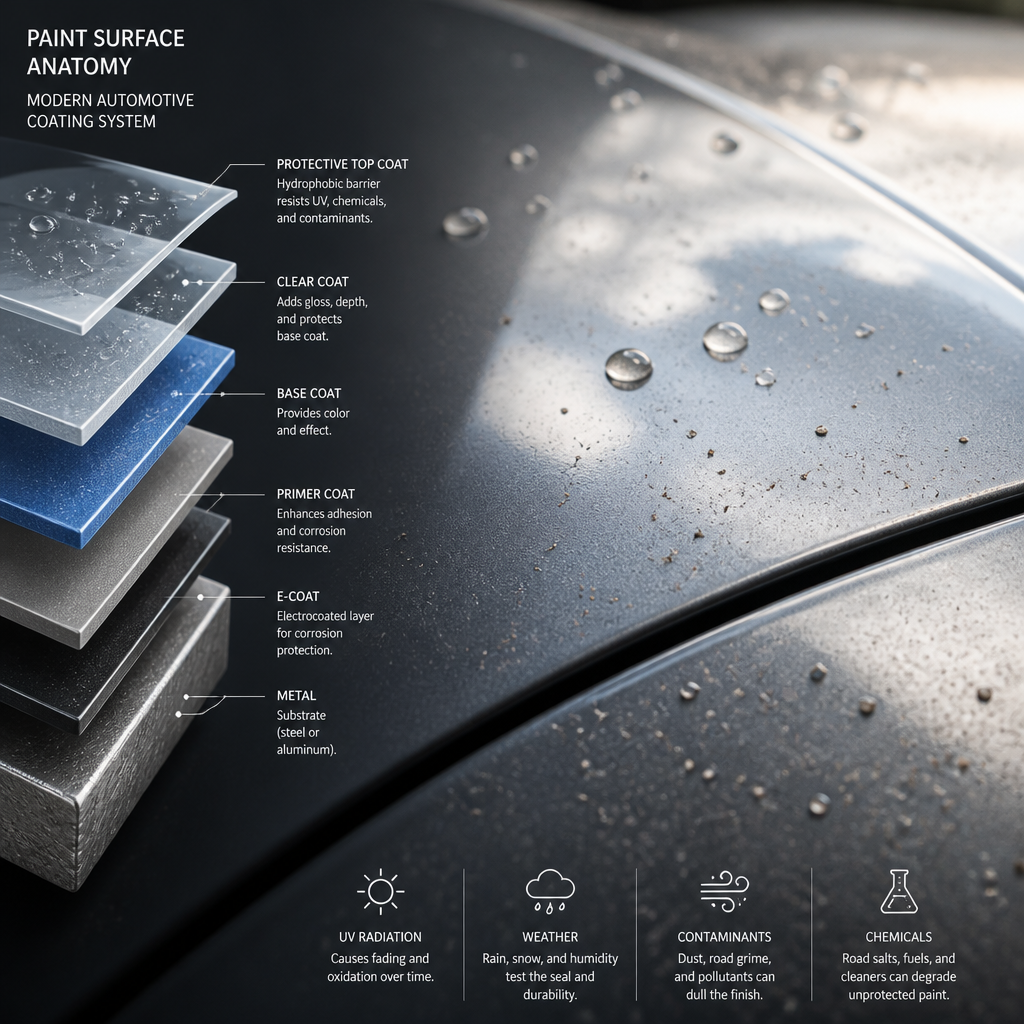
A ceramic coating preserves the condition beneath it. It does not hide swirl marks, etched water spots, or oxidation. If those defects remain before application, the coating can actually make them more noticeable by adding gloss and clarity.
Decontamination as a First Step
Before any polishing begins on a show-quality job, the vehicle goes through a full decontamination sequence: a thorough pre-wash, a dedicated iron fallout remover that chemically dissolves brake dust and rail dust embedded in the paint, and a clay bar or clay mitt treatment to physically extract surface-bonded contaminants. Polishing over contaminated paint introduces new defects. The decontamination step is not optional for show-level work.
Interior Show Prep
Show car interior preparation goes well beyond a standard interior detail. It includes complete disassembly of accessible trim panels to clean behind and beneath them, deep extraction cleaning of carpets and upholstery, conditioning and protection of every leather surface, ceramic coating of interior glass, and detailing of engine bay components where the vehicle requires it. The result is a vehicle that presents flawlessly from every angle, not just from ten feet away.
Pro tip: If you are preparing a vehicle for a show, schedule the full correction and coating service at least two to three weeks before the event date. Coating cure times and any needed touch-up work require a buffer that a last-minute booking cannot accommodate.
Detailing Level Comparison
| Feature | Daily Driver Maintenance Detail | Show Car Preparation Detail |
|---|---|---|
| Primary objective | Remove contamination, restore protection, prevent long-term damage | Achieve a defect-free, mirror-quality finish for inspection-level scrutiny |
| Paint correction stage | Single-stage light polish or enhancement | Multi-stage correction: cutting compound followed by finishing polish |
| Decontamination process | Iron fallout removal, clay treatment | Full multi-step decontamination including chemical and mechanical stages |
| Paint protection applied | Carnauba wax, synthetic sealant, or coating maintenance spray | Professional-grade SiO2 nano-ceramic coating with 5-8 year warranty |
| Interior scope | Vacuum, wipe-down, glass, leather condition | Deep extraction, trim removal, full leather restoration, glass coating |
| Recommended frequency | Every 3-4 months for daily drivers in Illinois | Full correction as needed; typically before events or when paint demands it |
| Time investment | 4-8 hours depending on vehicle condition | 1-3 days for full show-quality preparation |
How Illinois Conditions Change the Equation
Detailing advice written for Arizona or California does not translate directly to suburban Illinois. The environmental aggression that Chicago-area vehicles face is genuinely different, and it shifts what "adequate" maintenance looks like.
Road Salt and Iron Fallout
Illinois municipalities apply road salt heavily from November through March. Salt accelerates oxidation of bare metal surfaces and chemically attacks paint sealants, shortening their effective life significantly compared to warmer climates. Iron fallout from brake dust and railway contamination is also elevated in dense suburban traffic corridors. A vehicle driving daily in Bloomingdale or along Route 355 accumulates iron contamination faster than the same vehicle would in a rural environment.
This contamination is not visible to the naked eye until it is already causing damage. The orange rust speckling you occasionally see on white and silver vehicles is iron contamination that bonded to paint and began oxidizing. A proper decontamination wash with a pH-reactive iron remover turns this contamination purple-red on contact and neutralizes it before it etches the clear coat.
UV Exposure and Seasonal Temperature Swings
Illinois gets meaningful summer UV intensity despite its northern latitude, and the freeze-thaw cycles between seasons stress paint coatings and sealants through repeated thermal expansion and contraction. A sealant applied in October is not performing the same function in February that it was when it was fresh. Planning a detail cycle that accounts for both the pre-salt season and the post-salt season is the correct approach for this climate, not a once-a-year wash.
Ceramic Coating: Where Daily Driver and Show Car Worlds Meet
Professional ceramic coating is one area where daily driver owners and show car owners share a common solution. For a daily driver, a professionally applied SiO2 nano-ceramic coating with a 5 to 8-year warranty fundamentally changes the maintenance equation. Contaminants bond less aggressively to the hydrophobic surface, maintenance washes remove more effectively, and the UV resistance built into the coating protects clear coat integrity through multiple Illinois winters.
For show car preparation, the ceramic coating is applied after a full multi-stage correction, locking the corrected finish in place and making it easier to maintain between events. At Hersheys Detailing, both their 5-year and 8-year ceramic coating packages include a full 2-step paint correction as part of the service. This is not an add-on. It is a requirement, because coating over uncorrected paint permanently amplifies every defect beneath it.
What a Coated Daily Driver Changes About Your Maintenance Routine
A coated daily driver does not eliminate the need for maintenance. What it changes is the nature of that maintenance. Rather than repeated heavy decontamination and re-sealing cycles, a coated vehicle primarily needs proper pH-neutral maintenance washes and periodic coating booster treatments. The correction cycle extends significantly. For Illinois daily drivers, this translates directly to reduced long-term paint correction costs, because you are protecting the investment rather than repeatedly repairing it.
How to Choose the Right Level for Your Vehicle
The right detailing level is determined by four factors: how the vehicle is used, where it is parked, what condition the paint is currently in, and what the owner's realistic maintenance commitment looks like after the service. These are practical questions, not aspirational ones.
If You Drive the Vehicle Daily
If your vehicle is your primary transportation, the correct starting point is a professional maintenance detail that includes paint decontamination, a light enhancement polish, and a durable protective layer. If the paint already shows visible swirl marks, oxidation, or water spot etching, a one-stage correction before protection is the right call. For vehicles with significant paint degradation, a multi-stage correction followed by ceramic coating provides the best long-term outcome even on a daily driver, because it sets a clean baseline that maintenance can actually maintain.
If Your Vehicle Attends Shows or Is Display Quality
Show car preparation is not just about what you apply. It is about inspection. A true show car detail from Hersheys Detailing in Glendale Heights involves working under professional lighting to identify and correct every defect before any protection layer goes on. The process is methodical and time-intensive. If your vehicle will be scrutinized under competition lighting or simply represents a significant investment in its appearance, there is no shortcut that produces the same result.
The Vehicles That Need Both
Some vehicles are both daily drivers and show participants. A luxury SUV that commutes to the Loop on weekdays and attends Cars and Coffee events on weekends needs a strategy that accounts for both roles. The answer is typically a full show-quality correction and ceramic coating service as the foundation, followed by a disciplined maintenance wash schedule and periodic coating booster applications. This is the maintenance program model, and it is the most cost-efficient approach for owners who care about appearance without accepting constant degradation between correction cycles.
Frequently Asked Questions
What is the difference between a single-stage polish and multi-stage paint correction?
A single-stage polish uses one product pass to improve paint clarity and remove very light surface oxidation or fine swirl marks. Multi-stage correction uses a sequence of products, typically starting with a cutting compound to remove deeper defects and finishing with a polishing compound to refine the surface to maximum clarity. Show car results require multi-stage work. A single-stage polish is appropriate for daily driver maintenance enhancement, not show preparation.
How often should a daily driver in Illinois be professionally detailed?
For a vehicle driven daily in the Chicago suburbs, a full professional maintenance detail every three to four months is a solid baseline. At minimum, a post-winter decontamination detail in early spring, after the salt season ends, is essential. Vehicles parked outdoors year-round or driven in heavy traffic need more frequent attention than garage-kept vehicles with light daily use.
Can a daily driver get a show car level detail?
Yes, and for many luxury vehicle owners it makes complete sense. A multi-stage correction followed by a professional ceramic coating on a daily driver raises the baseline condition of the paint and makes ongoing maintenance significantly easier. The investment pays back over time by reducing the frequency and cost of future corrections. The owner does need to commit to proper pH-neutral maintenance washes to protect that investment on the road.
Does ceramic coating eliminate the need for detailing?
No. A ceramic coating reduces how aggressively contaminants bond to the paint and makes maintenance washes more effective, but it does not replace detailing. A coated vehicle still needs regular maintenance washes, periodic decontamination to remove iron fallout and bonded contamination, and occasional coating booster treatments. What it eliminates is the repeated heavy correction cycle that uncoated vehicles require when protective layers degrade.
How long does a professional ceramic coating last on a Chicago suburbs vehicle?
At Hersheys Detailing, professional SiO2 nano-ceramic coatings are available with 5-year and 8-year warranties. Real-world durability depends on maintenance habits, exposure conditions, and whether the vehicle is garage-kept or parked outdoors. A properly maintained coated vehicle driven daily in Illinois can realistically maintain coating performance across multiple winter seasons when the owner follows a proper maintenance wash schedule.
What should I do to my car before bringing it in for a show car detail?
Bring the vehicle in as-is. Do not attempt to wash, wipe, or polish the vehicle yourself before your appointment. Well-meaning pre-cleaning using improper towels or products often introduces new swirl marks that the professional team then needs to correct. A professional detailer starts with their own controlled wash process precisely to avoid this. The best thing you can do is drive in with the vehicle in whatever condition it is currently in.
We would love to hear from you: do you drive your vehicle daily or keep it primarily for shows, and how has that shaped your detailing approach over the years?
References
- Practical guide to detailing schedules for daily drivers, garage queens, and show cars
- What ceramic coating results actually look like on real daily driver vehicles
- Ceramic coating versus traditional detailing: a cost and maintenance comparison
- Complete guide to the paint correction process, tools, and techniques
- Forum discussion on achieving show car finishes on daily-driven vehicles