If you drive a candy red Corvette, a midnight blue BMW, or a deep navy Escalade through the Chicago suburbs, you already know the feeling: you pull out of the driveway after a wash, the sun hits the hood at an angle, and suddenly every swirl mark, water spot, and micro-scratch screams back at you. That is not bad luck. That is physics. Dark colored car detailing in Illinois is a fundamentally different discipline than working on silver or white vehicles, and most owners of deep-colored cars find this out the hard way after years of automated car washes, improper washing technique, and unprotected paint surviving brutal Midwest winters. This guide explains exactly why deep colors betray every defect, what Illinois-specific conditions accelerate the damage, and what a proper correction and protection plan actually looks like.
Table of Contents
- Quick Takeaways
- Why Dark Paint Shows Defects First
- Red Paint: The Unique Challenge
- Dark Blue Paint: Swirl Magnets and UV Victims
- Illinois Conditions That Destroy Dark Paint
- Paint Correction for Dark Vehicles
- Ceramic Coating: The Right Protection for Deep Colors
- Comparison: Protection Options for Dark Paint
- Frequently Asked Questions
- References
Quick Takeaways
| Key Insight | Explanation |
|---|---|
| Dark paint amplifies every surface defect | Swirl marks and scratches scatter light against the dark background, making pale lines visible that would disappear on silver or white paint. |
| Red pigments are the most UV-vulnerable | Red paint fades and oxidizes faster than almost any other color because red pigments degrade rapidly under ultraviolet exposure, turning chalky and dull without protection. |
| Illinois road salt compounds the problem | Chicago-area winters deposit corrosive salt that dulls paint, causes microscopic surface contamination, and forces more frequent washing, which introduces more swirl marks on dark vehicles. |
| Automatic car washes are the number-one source of swirl damage | Brush-style automatic washes grind contamination into dark paint. On a red or dark blue car, the resulting haze is immediately visible. |
| Paint correction must come before any coating | A ceramic coating locks in whatever surface condition exists underneath. Coating over swirl marks and oxidation permanently seals those defects in place. |
| Multi-stage machine polishing gives the best results on dark paint | A single-stage polish removes roughly 50-60% of defects. Multi-stage correction can achieve 95%+ removal, which matters enormously on high-contrast dark paint. |
| Nano-ceramic SiO₂ coatings slow UV degradation on red and dark blue | A properly bonded SiO₂ ceramic layer reflects UV radiation before it reaches the pigment layer, dramatically slowing the fading and oxidation cycle on vulnerable deep colors. |
Why Dark Paint Shows Defects First
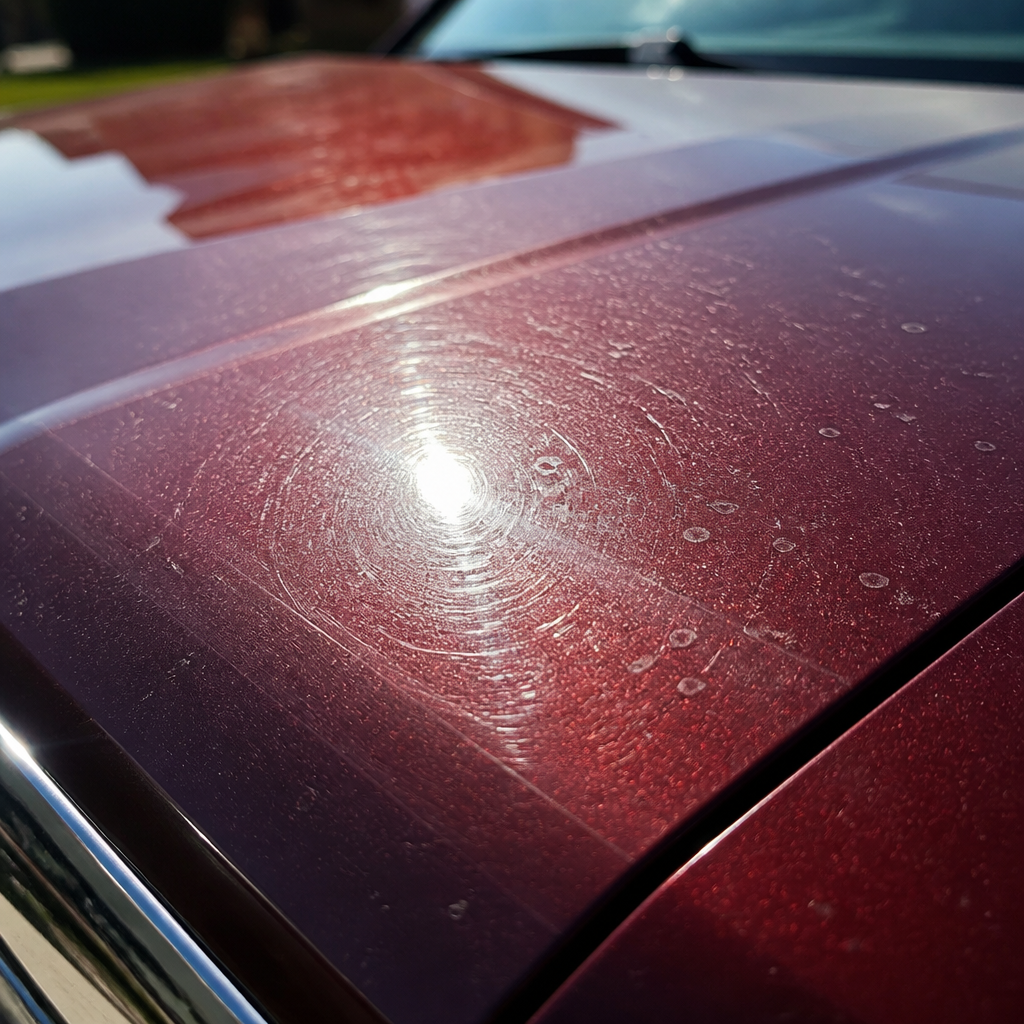
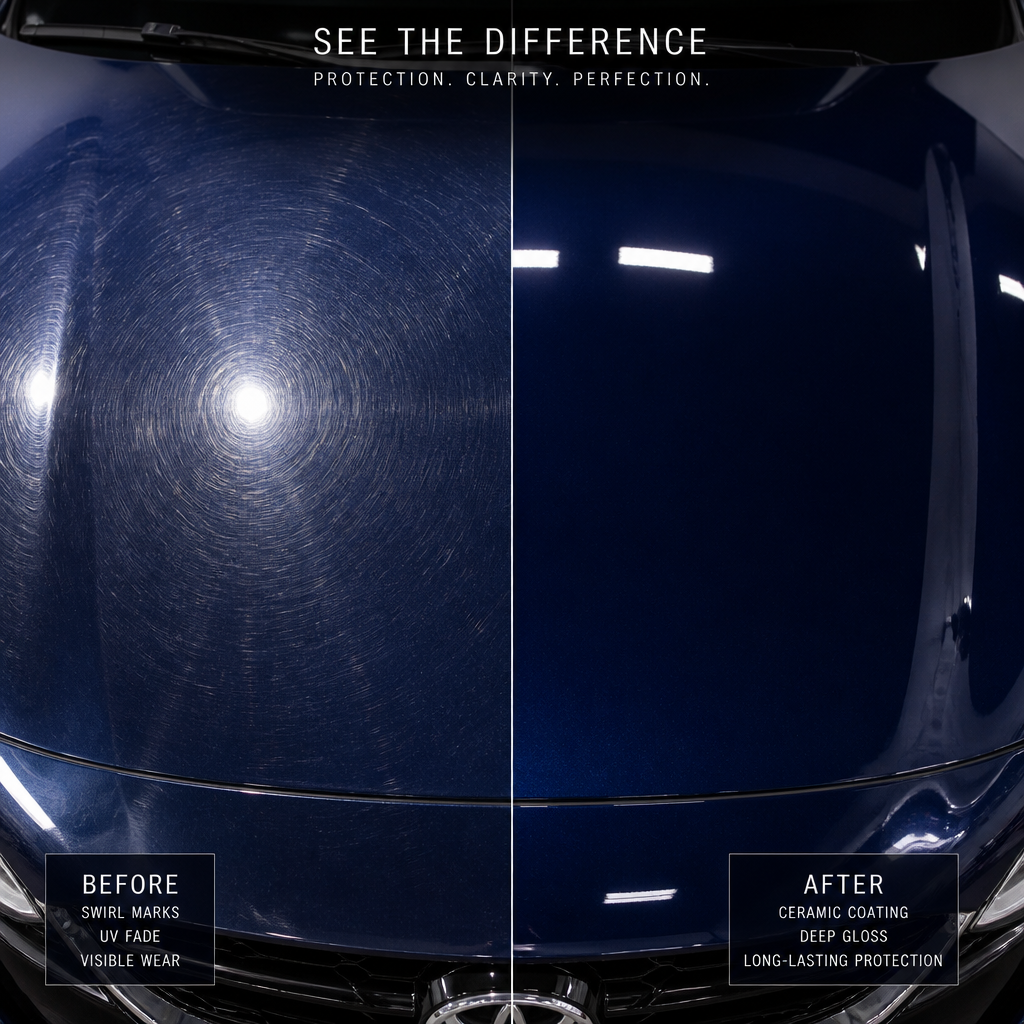
The physics here are straightforward once you understand how your eye reads a painted surface. The clear coat on any modern car is transparent. When that surface is smooth and flat, light bounces off it uniformly and you perceive depth and color saturation. When a swirl mark or fine scratch cuts through the clear coat, it scatters light in multiple directions instead of reflecting it cleanly. On a light-colored car, that scattered light is close in tone to the paint itself, so the defect blends in. On a dark car, the scattered light reads as a pale, bright line against the dark background. The contrast is stark, and the eye catches it immediately, especially under direct sunlight or bright parking lot lighting.
This is why a dark blue or red car can look immaculate in a dim garage but reveal a web of fine marks the moment you pull into daylight. The defects are not worse than what exists on a comparable silver car. They are just visible in a way that silver never allows. This is also why dark-colored vehicle owners tend to be far more particular after a wash, and rightly so.
Water spots behave the same way. When mineral-laden water evaporates on dark paint, it leaves calcium and magnesium deposits that etch the surface. On a white car, these spots blend in. On a deep red or midnight blue hood, they appear as a constellation of white rings. The car is technically clean, but it looks damaged.
Pro tip: Inspect your dark-colored vehicle under a single high-intensity LED or halogen work light held at a low angle to the panel. This is how professional detailers at Hersheys Detailing assess paint condition before any correction work. Defects that are invisible under diffuse garage lighting will stand out clearly under a raking single light source, giving you an honest picture of what your paint actually looks like.
Red Paint: The Unique Challenge
Red paint has a reputation in the detailing industry, and it is entirely earned. Beyond the light-contrast problem that affects all dark colors, red has a pigment-specific vulnerability that no other common automotive color shares at the same severity. Red pigments are among the most UV-sensitive of any automotive paint color. Without consistent protection, the clear coat degrades and the pigment beneath it begins to oxidize. The result is paint that appears chalky, hazy, and faded rather than showing crisp individual scratches.
How Red Paint Defects Actually Look
On a black car, swirl marks show up as bright white spider webs. On red paint, the damage pattern is different. Swirl marks on red tend to present as a milky, flat haze that drains color saturation from the entire panel. The paint looks tired and dull rather than sharp and scratched. This means owners sometimes underestimate the severity of the damage because there is no obvious single scratch to point to. In practice, that chalky film is often oxidation, meaning the UV degradation has already worked its way into the pigment layer, not just the clear coat surface.
Single-Stage vs. Modern Clear-Coat Red Paint
Older red vehicles, particularly those from the 1980s and early 1990s, were often painted with single-stage paint that has no separate clear coat layer. The color and protection are one compound. Correction products calibrated for modern clear-coat systems can cut too aggressively into single-stage red, removing more paint than intended. Any serious red car paint correction in the Chicago suburbs should begin with a paint thickness gauge measurement and a test spot on an inconspicuous panel before full correction proceeds. This is standard practice at Hersheys Detailing and the difference between a careful job and a destructive one.
Modern red paint with a clear coat is more forgiving to machine polish, but the UV vulnerability remains. Once corrected and properly coated, a deep candy red finish delivers a color depth and visual pop that no light-colored car can match. The reward for getting it right is significant.
Dark Blue Paint: Swirl Magnets and UV Victims
Metallic dark blue sits in the same problematic tier as black for swirl mark visibility. The metallic flake in many dark blue paints creates a layered visual depth that looks spectacular when the paint is in good condition, but that same depth makes surface contamination glaringly obvious. Dust and pollen seem to adhere more visibly to dark blue surfaces, and water spots against a near-black navy panel can look almost white by contrast.
The UV Problem on Dark Blue
Like red, dark blue paint absorbs a significant amount of solar radiation rather than reflecting it. This contributes to paint surface heating, which accelerates UV-driven oxidation of the clear coat. Over time, an unprotected dark blue car develops a faint purple or grayish cast in the midtones of heavy panels like the hood and roof, where UV exposure is most concentrated. This is clear coat degradation, and once it is visible to the naked eye, it has already progressed to a stage that requires machine correction rather than a simple polish.
Metallic Flake and Polish Selection
Dark blue paint with metallic flake requires a finishing stage during correction that leaves the flake oriented correctly in the paint. An aggressive compound used as a final step can leave fine marring visible in the metallic layer itself. A proper multi-stage approach uses a cutting compound to remove the bulk of the defects and then a finer finishing polish to refine the surface and ensure the metallic elements read as a uniform shimmer rather than a scratched-looking scatter. This is not optional on a high-end dark metallic vehicle. It is the difference between a corrected finish and a compromised one.
Illinois Conditions That Destroy Dark Paint
Owning a dark-colored vehicle in Glendale Heights, Carol Stream, Bloomingdale, or Wheaton means contending with a specific set of environmental conditions that are genuinely hostile to deep paint. Understanding what these conditions do to your vehicle is the first step toward protecting it properly.
Road Salt and Winter Grime
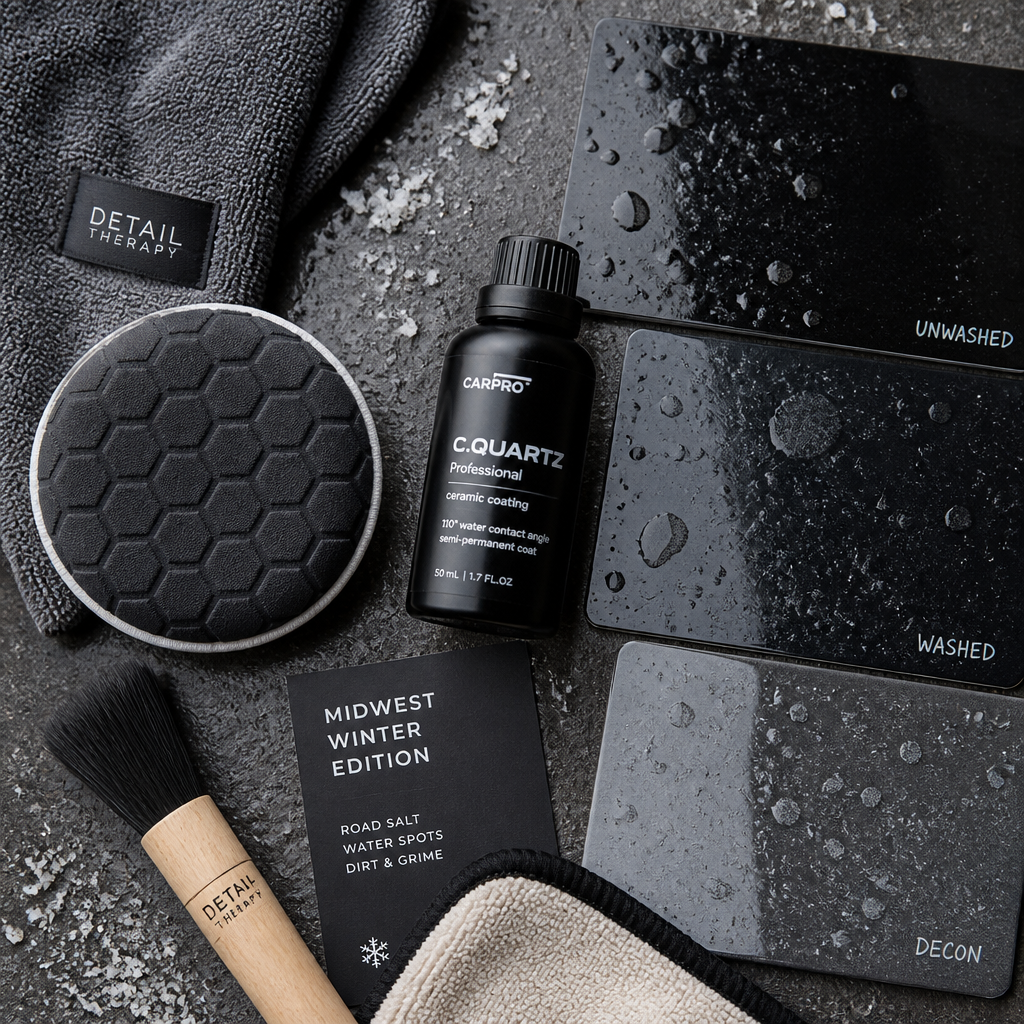
Illinois winters are hard on every vehicle, but the damage is most visible on dark paint. Road salt is corrosive. Beyond the well-documented undercarriage rust risk, salt-laden slush creates a contaminated film on painted surfaces that accelerates surface dullness and can produce micro-etching if left in contact with the clear coat. Every trip to the grocery store in February means a new layer of salt contamination settling onto your paint. The urge to wash frequently is correct, but frequent washing with improper technique is itself a primary source of swirl marks on dark vehicles. Paint defects on dark paint in Illinois accumulate faster in winter than at any other time of year, driven by the combination of salt contamination and repeated washing.
Every wash is an opportunity to improve your paint or degrade it. On dark paint, the technique matters more than the frequency. A single abrasive wash with a dirty mitt can undo months of careful maintenance.
Automatic Car Washes: The Invisible Enemy
This deserves direct emphasis: brush-style automatic car washes are damaging to any car, but on dark vehicles the resulting swirl marks are immediately and permanently visible. The brushes collect abrasive contamination from every vehicle that passes through before yours and drag it across your clear coat. A red or dark blue car that has been through a brush wash regularly will have a hazy, swirled clear coat that no amount of hand waxing can fix. Only machine correction removes those marks. Touchless washes are far better, but even they leave water spots on unprotected dark paint if the rinse is incomplete.
Tree Sap, Bird Droppings, and Pollen Season
The Chicago suburbs have no shortage of trees, and spring through summer brings a cycle of oak pollen, tree sap, and bird droppings that are acidic and enzymatic. On dark paint, these contaminants etch the clear coat visibly and quickly, especially in direct sun where the heat accelerates the chemical reaction. A bird dropping left on a dark hood in summer sun for more than a day can leave a permanent etch mark that requires machine correction to remove. These are not cosmetic inconveniences. They are irreversible chemical damage to a surface that shows everything.
Pro tip: Keep a dedicated quick detailer spray and a clean microfiber towel in your vehicle during pollen and sap season. On dark paint, removing a fresh bird dropping or sap spot within hours is always easier than removing the etch it leaves behind after baking in the sun.
Paint Correction for Dark Vehicles
Paint correction is the process of using machine polishing to safely remove a controlled amount of clear coat, leveling the surface and eliminating the physical scratches, swirl marks, and oxidation that cause light to scatter. It is not a product application. It is a subtractive process that permanently removes defects by removing the material around them until the surface is smooth.
Why Stage Count Matters on Dark Paint
A single-stage correction uses one polishing step and removes roughly 50-60% of surface defects. For a silver car with light swirling, that may be entirely adequate. For a red or dark blue vehicle that has been through years of automated washes and Illinois winters, a single-stage pass leaves visible defects that remain obvious against the dark background. A two-stage approach, cutting compound followed by finishing polish, achieves 80-90% defect removal. A full multi-stage correction, which is standard practice at Hersheys Detailing, can achieve 95% or greater defect removal. On high-contrast dark paint, that final 30-40% difference in defect removal is the difference between paint that looks improved and paint that looks flawless.
Paint Thickness Measurement
Machine polishing removes clear coat material. A paint thickness gauge tells the detailer how much clear coat is present before correction begins and how much is being removed during the process. On a vehicle with a thinner or previously corrected clear coat, the approach needs to be calibrated accordingly. Skipping this measurement is one of the most common ways that aggressive correction causes irreversible damage. At Hersheys Detailing, this measurement step is non-negotiable on any correction service, because there is no reversing an over-corrected clear coat.
Decontamination Before Correction
Polishing over embedded contamination grinds those particles into the paint surface. A proper correction job begins with a thorough decontamination process: a full wash, an iron remover to dissolve metallic brake dust and rail dust particles embedded in the clear coat, and a clay bar treatment to remove bonded surface contamination. On Illinois vehicles, iron contamination from road brake dust is significant, and it is invisible to the eye on dark paint until a chemical iron remover turns it purple on contact. Skipping decontamination before machine polishing causes more defects than it removes.
Ceramic Coating: The Right Protection for Deep Colors
Once dark paint has been properly corrected, the single most important decision the owner makes is what goes on it next. Wax and paint sealants are not adequate for dark-colored vehicles in Illinois. They degrade in weeks to months, offer minimal UV protection, and provide no meaningful resistance to the chemical contamination that dark vehicles face year-round.
A professional nano-ceramic SiO₂ coating chemically bonds to the clear coat at the molecular level, filling the microscopic pores in the paint surface and creating a dense, hard layer that is fundamentally more durable than anything sitting on top of the paint. The SiO₂ layer reflects UV radiation before it reaches the paint pigment, which is the protection mechanism that matters most for red and dark blue vehicles. For a red car, this UV reflection is the difference between paint that retains its depth and saturation for years versus paint that begins fading and oxidizing within a single season.
Why Coating Must Follow Correction, Not Precede It
A ceramic coating bonds to whatever surface is underneath it. It does not fill scratches or mask swirl marks. A coating applied over damaged paint locks those defects in place permanently under a hard, durable barrier that is now much harder to remove than the original clear coat. This is the most important sequencing principle in dark vehicle care. The coating makes the paint permanent in its current condition. If that condition is corrected and clean, the result is spectacular. If that condition is swirled and oxidized, the result is a permanently sealed defect.
Warranty and Longevity on Dark Vehicles
The nano-ceramic SiO₂ coatings applied at Hersheys Detailing carry 5-8 year warranties, which is meaningful for dark vehicle owners because the alternative, annual wax applications, provides almost no UV defense and requires the owner to maintain their own protection schedule without any guarantee. A properly applied ceramic coating on a corrected dark paint surface also makes ongoing maintenance dramatically easier. The hydrophobic properties mean contaminants from Illinois roads, bird droppings, and tree sap sheet off the surface rather than bonding to it, reducing the risk of etch damage on the high-contrast paint that would otherwise make every environmental insult visible.
Comparison: Protection Options for Dark Paint
| Protection Method | Durability and UV Defense | Suitability for Dark Paint in Illinois |
|---|---|---|
| Carnauba Wax | 4-8 weeks of protection. Minimal UV blocking. No chemical resistance. Washes off and degrades quickly in Midwest freeze-thaw cycles. | Poor. Requires reapplication too frequently to provide meaningful defense against Illinois conditions. Does nothing to prevent the oxidation cycle on red and dark blue paint. |
| Paint Sealant (Polymer) | 3-6 months of protection. Better chemical resistance than wax. Some UV filtering but not comparable to ceramic. Bonds better than wax but still sits on the surface. | Acceptable for short-term protection between professional services. Not a long-term answer for dark vehicles exposed to salt, UV, and heavy contamination. Requires annual reapplication at minimum. |
| Nano-Ceramic SiO₂ Coating (Professional Grade) | 5-8 year protection with proper maintenance. Chemically bonds to clear coat. Strong UV reflection. Hard surface resists chemical etching, salt contamination, and surface marring. | Excellent. The only long-term solution for red and dark blue vehicles in Illinois. Preserves corrected paint, reflects UV to prevent pigment degradation, and makes routine maintenance far less damaging to dark surfaces. |
The comparison above is not close. For any owner of a red or dark blue vehicle in the Chicago suburbs who has already invested in proper paint correction, applying a carnauba wax or basic sealant afterward is counterproductive. The correction work is permanent in the sense that it removes material that cannot be replaced. Protecting that corrected surface with a product that lasts six months or less means the investment in correction will need to be repeated sooner than necessary, and each correction removes a small amount of clear coat that the vehicle only has a finite supply of.
Frequently Asked Questions
How often does a red or dark blue car need paint correction in Illinois?
There is no fixed schedule because it depends entirely on how the vehicle is maintained between corrections. A dark-colored car protected by a professional ceramic coating and washed with proper two-bucket hand-wash technique may need only a light single-stage polish every few years to address minor new defects before a maintenance coating is refreshed. A dark vehicle that goes through brush car washes regularly and lives outside through Illinois winters without protection can accumulate correction-worthy swirl damage within a single season. The coating and the washing method are the variables that determine the interval, not the calendar.
Can I remove swirl marks from my dark car at home with store-bought products?
Over-the-counter swirl removers and one-step polish products are formulated for light correction and safe DIY use, which means they are designed to be non-aggressive. On a white or silver car with light swirling, they can produce a noticeable improvement. On dark paint with moderate to heavy swirl damage, they will not remove the defects at the depth that a professional machine correction achieves. They can improve the gloss slightly, but the underlying marks that are catching light on your dark clear coat require machine polishing at a speed and pressure that a hand-applied product cannot deliver. For display-quality results on dark paint, professional correction is the only route.
Is red paint harder to detail than black paint?
They present different challenges rather than one being universally harder. Black paint makes every individual swirl mark starkly visible and shows water spots and dust immediately. Red paint shares that high-visibility characteristic but adds the UV and oxidation vulnerability that black does not have at the same severity. Red pigment degrades under UV exposure faster than any other common automotive color, meaning an unprotected red car in Illinois will develop a chalky, faded appearance noticeably faster than a comparable black car. The detailing process on red also requires attention to whether the vehicle has a single-stage or clear-coat paint system, which is less of a concern with black.
Does a ceramic coating make dark paint easier to keep clean?
Significantly, yes, and this matters more on dark vehicles than any other color. The hydrophobic properties of a ceramic coating cause water and contaminants to bead and sheet off the surface rather than bonding to it. Bird droppings, tree sap, road salt film, and pollen all have far less grip on a coated surface than on bare clear coat or a waxed surface. On dark paint, where every contaminant is immediately visible, this property reduces both the frequency of washing needed and the damage potential of each wash cycle. A coated dark vehicle is genuinely easier to maintain to a high standard than an uncoated one.
What is the decontamination process and why does my car need it before correction?
Decontamination removes two categories of contamination that a standard wash cannot address: chemically bonded contaminants like iron particles from brake dust and rail dust, and physically bonded surface contamination like industrial fallout, tree resin, and road tar that embeds into the clear coat. In the Chicago suburbs, iron contamination from road traffic is significant on any vehicle driven regularly. If a machine polisher is run over a surface with embedded iron or abrasive particles still present, those particles are dragged across the clear coat by the pad, creating new scratches in the surface being corrected. The decontamination step, using a chemical iron remover and then a clay bar, is not optional for dark vehicles. It is the foundation that makes the correction work produce a genuinely improved surface rather than a differently scratched one.
Why does my freshly washed dark car still look dull or hazy?
If your red or dark blue vehicle looks dull or hazy immediately after washing, the cause is almost certainly existing swirl marks and micro-scratches in the clear coat that are now more visible because the surface is clean and unobscured by a layer of dirt. Washing removes the dirt but does nothing to the surface scratches that scatter light. On dark paint, this haze can appear as a milky film, particularly on high-exposure panels like the hood and roof. It is not something washing will fix. It requires machine paint correction to remove the physical defects that are causing the light scatter.
If you own a red or dark blue vehicle in the Chicago suburbs, we would love to hear about your experience keeping the paint looking sharp. Drop a comment with what has worked or what you have struggled with.
References
- Common paint damage causes for Chicago-area vehicles, including road salt and winter grime
- How ceramic coatings interact with red and dark-colored car paint and the physics of light reflection on dark surfaces
- Paint correction techniques and oxidation patterns specific to red automotive paint
- How car paint color affects defect visibility and maintenance requirements across different color categories
- Paint correction stages and defect removal percentages for Illinois vehicles exposed to salt and snow