Most ceramic coating failures do not happen because the coating was poorly applied. They happen because the owner kept washing the car the wrong way. If you paid for a professional nano-ceramic SiO₂ coating, possibly with a 5 to 8 year warranty, and you run it through an automated tunnel wash, you are actively destroying the investment. Knowing how to wash a ceramic coated car correctly is not optional. It is the single maintenance habit that determines whether your coating lasts two years or eight.
Table of Contents
- Quick Takeaways
- Why Your Wash Protocol Matters More Than the Coating Brand
- Products and Tools You Need Before You Start
- The Step-by-Step Wash Protocol for Ceramic Coated Cars This protocol is what Hersheys Detailing recommends to every client who drives away with a freshly coated vehicle. Follow it in order. Skipping steps is where problems begin. Step 1: Park in Shade and Let Panels Cool If the car has been parked in sun or driven recently, wait 20 to 30 minutes before washing. Hot panels cause soap and water to evaporate almost instantly, leaving residue that is difficult to remove and can etch over time. Step 2: Pre-Rinse with a Pressure Washer Use a wide fan spray at medium pressure to blast loose dirt, dust, and road debris off every panel. Start at the roof and work downward. Pay extra attention to lower door sills and wheel arches where road grime accumulates. This pre-rinse eliminates roughly 80 percent of the abrasive particles before you touch the paint with anything. Step 3: Fill Your Two Buckets Bucket one gets your pH-neutral soap mixed at the manufacturer's recommended ratio. Bucket two gets clean rinse water only. Both buckets should have Grit Guard inserts sitting at the bottom. These plastic grids trap dirt particles below the water line so they cannot be picked back up by your mitt. Step 4: Wash One Panel at a Time, Top to Bottom Dip your mitt in the soap bucket. Wash one panel using straight back-and-forth strokes, never circular motions. Rinse the mitt in the clean water bucket, agitate it against the Grit Guard, then re-load with soap for the next panel. Work from the roof to the trunk, then doors, then lower panels and bumpers last. Lower panels carry the most contamination and should always be saved for last. Step 5: Final Full Rinse Do a complete rinse from top to bottom, removing all soap residue. On a ceramic coated surface, water should sheet off in large flat flows rather than forming droplets. If you see strong beading already during the rinse, the coating is performing well. Step 6: Dry Immediately Do not let the car air dry. Mineral-heavy water in the Chicago suburbs, drawn from Lake Michigan treatment facilities, leaves calcium and magnesium deposits that bond to coatings. Use a waffle-weave drying towel and blot rather than wipe where possible. Use a detail blower to push water out of mirror housings, door handles, and panel gaps first. Step 7: Apply a Ceramic Booster Spray On a dry panel, mist a small amount of SiO₂ spray detailer and spread it with a clean microfiber cloth. Buff until clear. Do this every 2 to 3 months or after every wash if you want maximum hydrophobic performance. This step alone dramatically extends the life of the base coating. Pro tip: Never apply a ceramic booster in direct sunlight either. Even if you moved the car into the sun between washing and drying, pull it back under cover before applying the spray detailer. Uneven cure from heat causes streaking that is tedious to correct. Comparison: Wash Methods and Their Impact on Ceramic Coatings
- Ceramic Coating Maintenance in Illinois: What the Climate Demands
- Common Mistakes That Destroy Ceramic Coatings Faster
- How Often Should You Wash a Ceramic Coated Car?
- Frequently Asked Questions
- References
Quick Takeaways
| Key Insight | Explanation |
|---|---|
| Two-bucket method is non-negotiable | Using a single bucket redeposits dirt onto the paint, causing micro-scratches that degrade the coating's hydrophobic layer over time. |
| Never use automated tunnel washes | Rotary brushes in tunnel washes create swirl marks and strip the SiO₂ layer. Touchless washes are acceptable but not ideal. |
| pH-neutral soap only | Alkaline or acidic soaps degrade the ceramic bond. Choose a soap with a pH of 6 to 8 specifically labeled as coating-safe. |
| Always pre-rinse with a pressure washer | Knocking loose surface contamination before touching the paint eliminates the biggest source of wash-induced scratches. |
| Dry with a microfiber waffle-weave towel | Standard towels create friction drag that scratches the coating. Waffle-weave microfiber lifts water without dragging debris. |
| Apply a ceramic booster spray every 2 to 3 months | A SiO₂ spray topper after washing restores hydrophobic behavior and extends the coating's rated lifespan between professional inspections. |
| Wash in shade, never in direct sunlight | Direct sun causes soap and rinse water to flash-dry on the panel, leaving water spots that etch into the coating if left unaddressed. |
Why Your Wash Protocol Matters More Than the Coating Brand
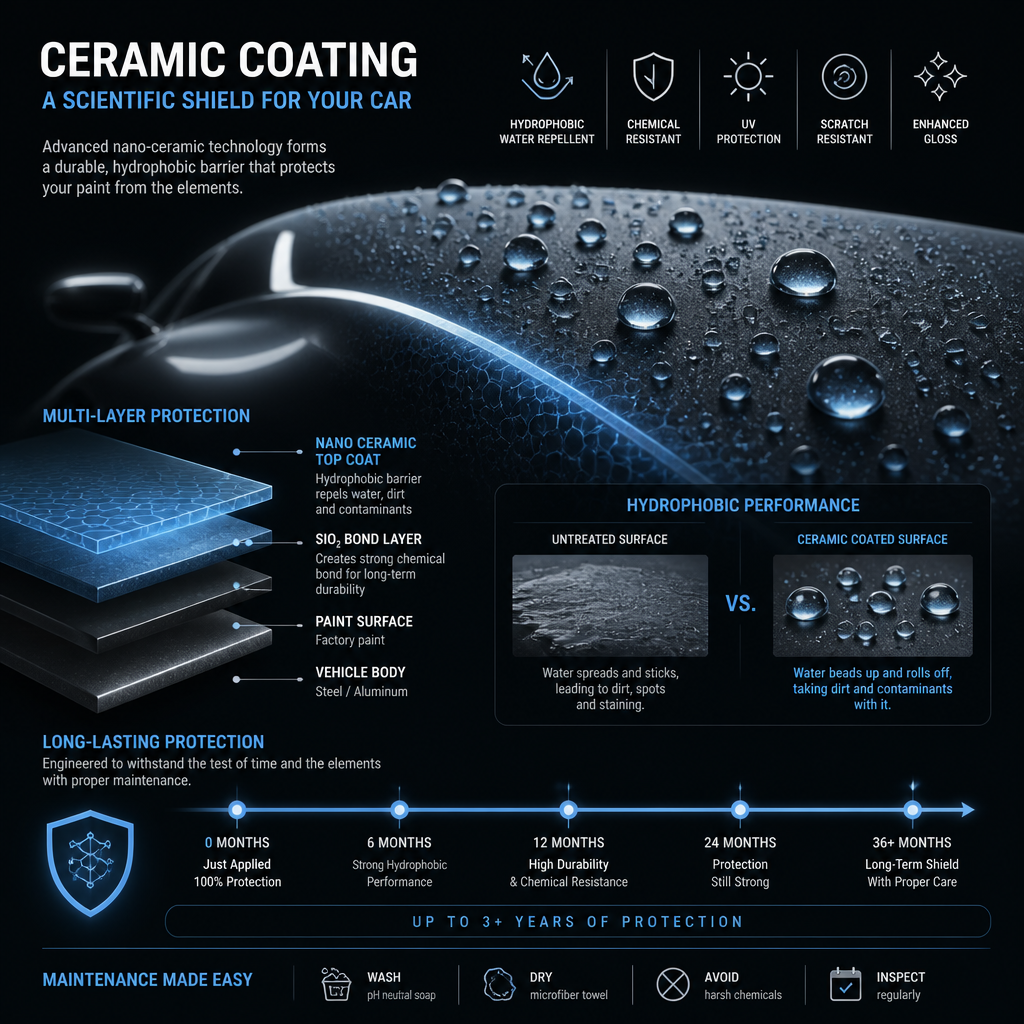
A professional ceramic coating, whether it is a consumer-grade formula or the commercial-grade nano-ceramic SiO₂ product applied by Hersheys Detailing, creates a semi-permanent glass-like layer that bonds to your clear coat. The hydrophobic properties, chemical resistance, and gloss depth all depend on that layer remaining intact.
In practice, the coating does not care how reputable the installer was. Abrasive contact, wrong chemical pH, and heat shock from improper drying will degrade any coating regardless of brand. The data consistently shows that premature coating failures are traced to maintenance errors in the vast majority of cases, not application defects.
The good news is that the correct wash protocol is not complicated. It does require discipline and the right supplies. Once you build the habit, it takes no longer than a standard wash.
Products and Tools You Need Before You Start
Do not start washing until you have every item on this list. Improvising mid-wash with the wrong product undoes everything the protocol is designed to protect.
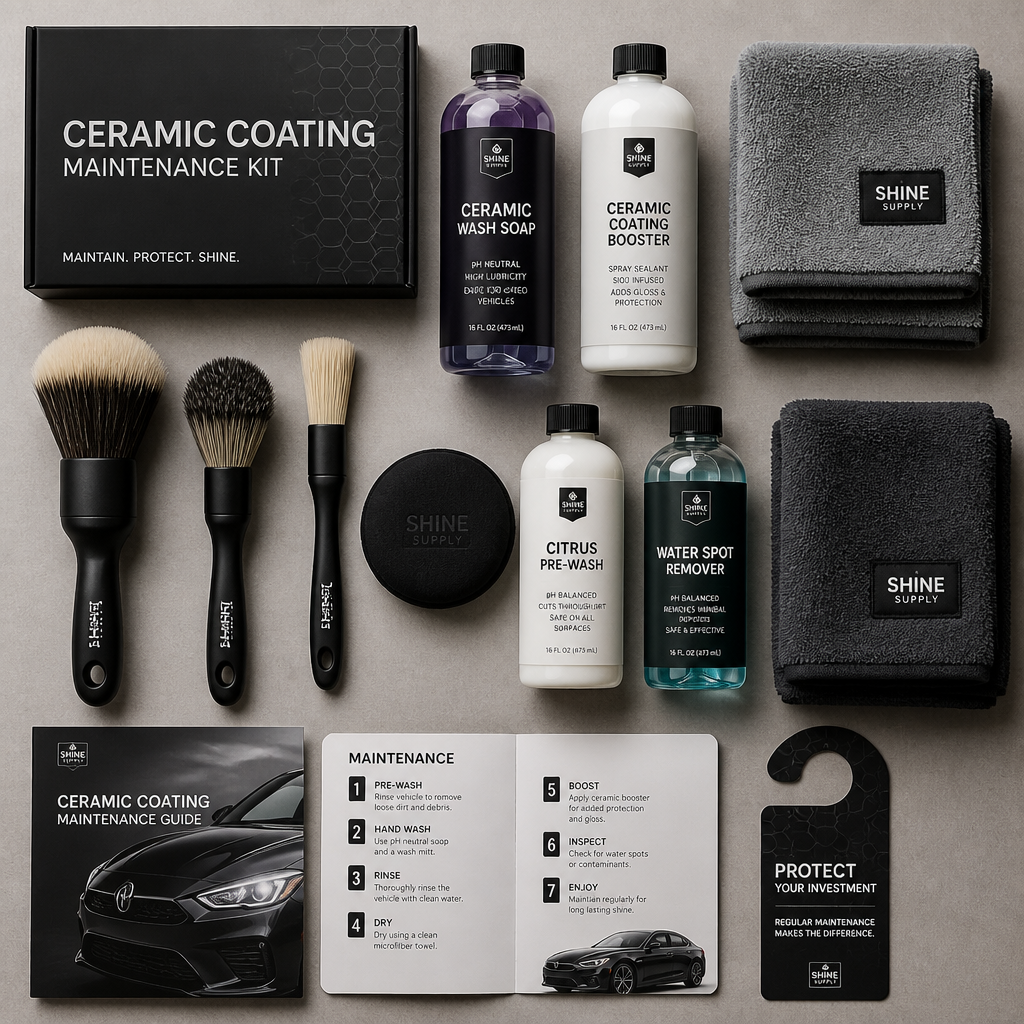
The Wash Kit Essentials
- Two 5-gallon wash buckets with Grit Guard inserts at the bottom of each
- A pH-neutral car wash soap rated safe for coated vehicles (look for pH 6 to 8 on the label)
- A high-quality microfiber wash mitt, not a sponge
- A pressure washer or strong garden hose with a wide fan nozzle
- Two or three large waffle-weave microfiber drying towels
- An air blower or detail blower for gaps and mirrors (optional but recommended)
- A ceramic booster or SiO₂ spray detailer for the finishing step
What to Avoid Buying
Skip anything labeled "wax-infused soap" or "all-in-one wash and wax." Those products leave a film that can diminish the coating's beading effect. Also avoid any soap with a degreaser component, including many dishwashing soaps that Chicago suburb residents sometimes reach for when they run out of proper car wash soap. Dish soap strips coatings rapidly.
Pro tip: Keep a dedicated set of wash supplies used only for your coated vehicle. Cross-contaminating your mitt or towels with products used on uncoated vehicles, wheels, or glass introduces compounds that are incompatible with the SiO₂ layer.
The Step-by-Step Wash Protocol for Ceramic Coated Cars
This protocol is what Hersheys Detailing recommends to every client who drives away with a freshly coated vehicle. Follow it in order. Skipping steps is where problems begin.
Step 1: Park in Shade and Let Panels Cool
If the car has been parked in sun or driven recently, wait 20 to 30 minutes before washing. Hot panels cause soap and water to evaporate almost instantly, leaving residue that is difficult to remove and can etch over time.
Step 2: Pre-Rinse with a Pressure Washer
Use a wide fan spray at medium pressure to blast loose dirt, dust, and road debris off every panel. Start at the roof and work downward. Pay extra attention to lower door sills and wheel arches where road grime accumulates. This pre-rinse eliminates roughly 80 percent of the abrasive particles before you touch the paint with anything.
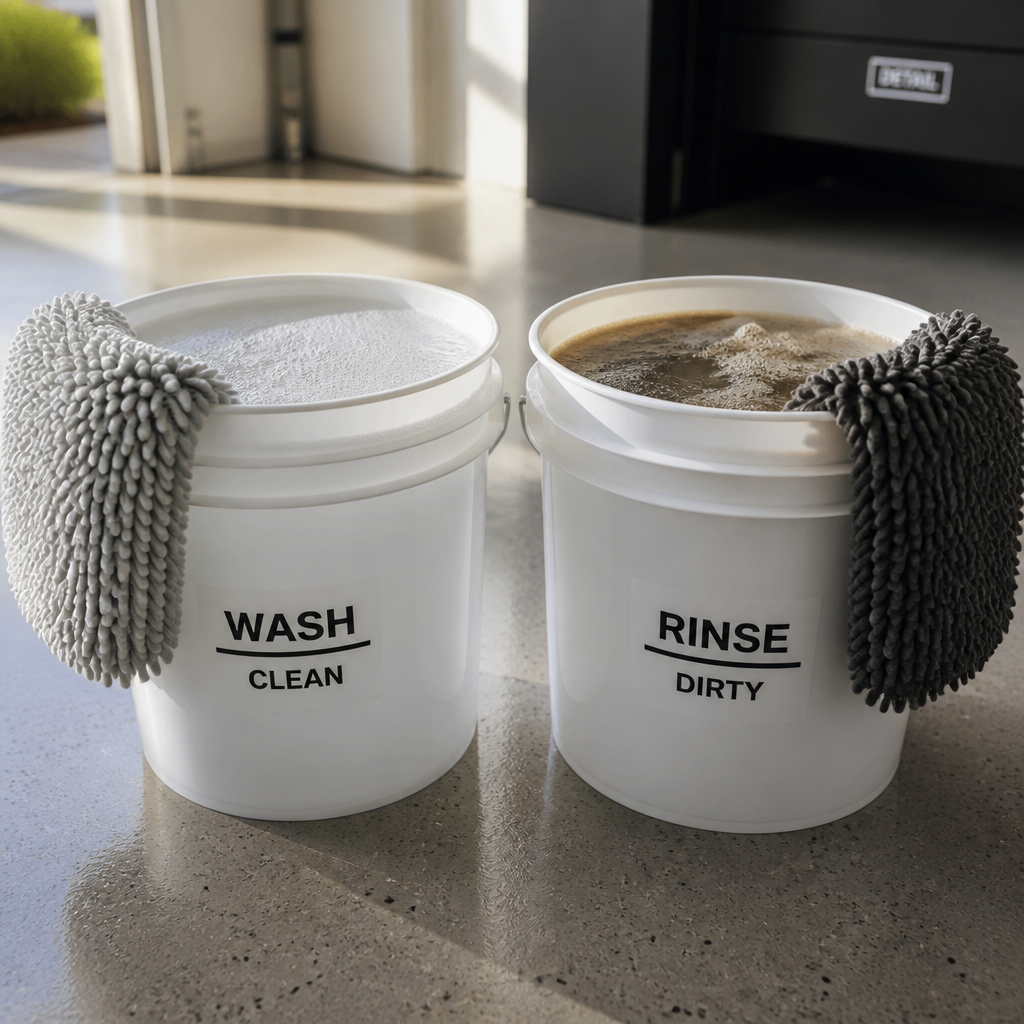
Step 3: Fill Your Two Buckets
Bucket one gets your pH-neutral soap mixed at the manufacturer's recommended ratio. Bucket two gets clean rinse water only. Both buckets should have Grit Guard inserts sitting at the bottom. These plastic grids trap dirt particles below the water line so they cannot be picked back up by your mitt.
Step 4: Wash One Panel at a Time, Top to Bottom
Dip your mitt in the soap bucket. Wash one panel using straight back-and-forth strokes, never circular motions. Rinse the mitt in the clean water bucket, agitate it against the Grit Guard, then re-load with soap for the next panel. Work from the roof to the trunk, then doors, then lower panels and bumpers last. Lower panels carry the most contamination and should always be saved for last.
Step 5: Final Full Rinse
Do a complete rinse from top to bottom, removing all soap residue. On a ceramic coated surface, water should sheet off in large flat flows rather than forming droplets. If you see strong beading already during the rinse, the coating is performing well.
Step 6: Dry Immediately
Do not let the car air dry. Mineral-heavy water in the Chicago suburbs, drawn from Lake Michigan treatment facilities, leaves calcium and magnesium deposits that bond to coatings. Use a waffle-weave drying towel and blot rather than wipe where possible. Use a detail blower to push water out of mirror housings, door handles, and panel gaps first.
Step 7: Apply a Ceramic Booster Spray
On a dry panel, mist a small amount of SiO₂ spray detailer and spread it with a clean microfiber cloth. Buff until clear. Do this every 2 to 3 months or after every wash if you want maximum hydrophobic performance. This step alone dramatically extends the life of the base coating.
Pro tip: Never apply a ceramic booster in direct sunlight either. Even if you moved the car into the sun between washing and drying, pull it back under cover before applying the spray detailer. Uneven cure from heat causes streaking that is tedious to correct.
Comparison: Wash Methods and Their Impact on Ceramic Coatings
Not all wash methods are equal. Here is how the three most common approaches compare when applied to a ceramic coated vehicle.
| Wash Method | Impact on Ceramic Coating | Verdict for Coated Cars |
|---|---|---|
| Two-Bucket Hand Wash (pH-neutral soap) | Zero abrasion when done correctly. Preserves hydrophobic layer. Allows visual inspection of coating condition. | Best method. Recommended every time. |
| Touchless Automatic Wash | High-alkaline chemicals used in most touchless systems strip the SiO₂ layer gradually. No abrasion risk, but chemical degradation is real. | Acceptable occasionally in emergencies. Not a regular habit. |
| Tunnel Wash with Brushes or Cloth | Rotary brushes introduce swirl marks and marring. Some systems use recycled water with embedded grit. Destroys coating hydrophobic properties within months. | Never. Fully incompatible with coated vehicles. |
Ceramic Coating Maintenance in Illinois: What the Climate Demands
Owning a coated vehicle in the Chicago suburbs introduces challenges that owners in warmer, drier climates do not face. The Illinois winter season, salt-heavy road treatments, freeze-thaw cycles, and summer humidity create a specific maintenance environment that generic wash guides do not address.
Winter Salt and Road Chemical Contamination
Illinois road crews apply calcium chloride and magnesium chloride blends that are far more aggressive than traditional rock salt. These compounds remain chemically active at temperatures below freezing and embed into any surface they contact. On a ceramic coated car, these salts do not penetrate the coating itself, but they will accumulate at panel edges, grilles, and undercarriage areas where the coating has gaps or has not been applied.
During winter months, wash frequency should increase to at least once per week if the car is being driven on treated roads. Do not let salt accumulate. The coating protects the clear coat beneath it, but only if the coating surface is kept clean.
Summer Contaminants Specific to the Chicagoland Area
Tree sap, insect residue from highway driving on I-290 and I-355, and rail dust from freight corridors near Carol Stream and Bloomingdale are all contaminants that should be removed promptly. Bird droppings are the most time-sensitive. Their uric acid content can etch even a ceramic coated surface if left for more than 24 to 48 hours in summer heat.
A common mistake is assuming the coating makes the car impervious to everything. It provides excellent chemical resistance compared to uncoated clear coat, but it is not infinitely resistant. Prompt spot removal with a quick detailer spray is the right response to localized contamination between washes.
"Ceramic coatings fundamentally change the chemistry of a vehicle's surface layer, but they require informed maintenance to deliver their rated protection window. The coating is not maintenance-free. It is maintenance-simplified." - Dr. Bhanu Pratap Singh, materials science researcher, published in the Journal of Materials Chemistry
Common Mistakes That Destroy Ceramic Coatings Faster
In seven years of detailing vehicles across Glendale Heights, Carol Stream, Bloomingdale, and Wheaton, the Hersheys Detailing team has seen the same patterns of coating damage repeat across hundreds of vehicles. These are the mistakes that appear most consistently.
Using a Chamois or Bath Towel to Dry
A chamois drags across the surface with friction and zero lubrication. Even if the coating is not scratched immediately, the repeated mechanical stress degrades the SiO₂ network at a microscopic level. Bath towels have coarse fibers that do the same. Neither has any place on a coated vehicle.
Washing in Circular Motions
Circular washing patterns concentrate any residual abrasion into visible swirl marks. Straight-line, panel-by-panel washing distributes any minor contact in directions that are far less visible under light inspection.
Skipping the Pre-Rinse
This is the single most common mistake. Owners in a hurry skip the pressure rinse and go straight to the wash mitt. Every grit particle that has not been rinsed off becomes a miniature sanding agent the moment the mitt contacts the surface.
Using Iron Fallout Remover Too Frequently
Iron fallout removers are useful during a proper decontamination service, which Hersheys Detailing includes as part of its preparation process before coating application. However, using these chemical products frequently as part of a regular wash routine introduces unnecessary acidic exposure to the coating's surface. Reserve chemical decontamination for once or twice per year at most.
How Often Should You Wash a Ceramic Coated Car?
The answer is more often than most owners assume. A ceramic coating does not mean you can wash less frequently. It means each wash is safer and easier because contamination bonds less aggressively to the treated surface.
For vehicles driven daily in the Chicago suburbs, a wash every one to two weeks is appropriate during spring, summer, and fall. In winter, bump that up to weekly if the car is exposed to road salt. Vehicles that spend significant time parked outdoors under trees should be checked for sap and bird droppings daily during peak seasons.
A decontamination wash, separate from routine maintenance washing, should be performed once or twice per year. This involves a clay bar treatment and iron fallout removal to pull out embedded particles that pH-neutral soap cannot address. This service should be performed by a professional to avoid damaging the coating.
Hersheys Detailing offers maintenance programs designed specifically around this schedule, so coated vehicles can be inspected, topped up, and decontaminated on a planned cycle rather than guessed at. Clients in Wheaton and Bloomingdale who follow a structured maintenance schedule consistently retain coating performance far longer than those who wash reactively.
Frequently Asked Questions
Can I use any car wash soap on a ceramic coated car?
No. You must use a pH-neutral soap with a pH between 6 and 8 that is explicitly labeled as safe for coated or treated paint. Soaps with wax additives, degreasers, or high-alkaline formulas will degrade the hydrophobic properties of the coating over repeated use. Many popular household car soaps fall outside this range without disclosing it on the label, so check the technical data sheet before buying.
How soon after a new ceramic coating can I wash the car?
After a professional application, the coating needs a cure period before it can be washed. Hersheys Detailing advises clients to wait a minimum of 7 days before the first wash, and to avoid water contact including rain during that window if at all possible. The coating continues to harden and cross-link during this time, and water contact during the early cure phase can leave water spots that become permanent surface imperfections.
Is a waterless wash safe on a ceramic coated car?
Waterless washes are acceptable only on lightly contaminated vehicles that have been driven in clean, dry conditions. If there is any visible dirt or grit on the surface, a waterless wash will drag those particles across the coating and cause scratches. Do not use a waterless wash after driving on salted Illinois roads or after rain. Stick to the full two-bucket protocol whenever there is any doubt about contamination level.
Do I still need to apply wax or sealant over a ceramic coating?
You do not apply traditional wax, and you should not. Wax products applied over a ceramic coating sit on top of the SiO₂ layer without bonding to it and typically wash off quickly, adding no real protection. What you can and should apply is a ceramic booster spray or SiO₂ topper, which is chemically compatible with the base coating and actually refreshes the hydrophobic layer. This is a very different product from conventional wax.
What do I do if water stops beading on my ceramic coated car?
Reduced water beading is a sign that the coating's hydrophobic layer is depleted, dirty, or partially degraded. The first step is a thorough pH-neutral wash to remove any soap film, mineral deposits, or traffic film that may be masking the coating's behavior. After washing and drying, apply a fresh coat of SiO₂ spray detailer. If beading does not return after this process, the coating may need professional inspection and possibly a light polish and reapplication of a top coat. Contact Hersheys Detailing to assess the condition before attempting anything abrasive.
Can I take my ceramic coated car through a touchless car wash in an emergency?
Touchless washes are the least harmful automatic option because there is no physical contact. However, most touchless systems use high-pH alkaline pre-soaks that attack the coating's chemistry over time. If you must use one in an emergency, rinse thoroughly afterward with clean water as soon as possible and follow up with a hand wash at your earliest opportunity. Never make touchless washes a routine habit for a coated vehicle.
Have you found a specific wash technique or product that works particularly well for your coated vehicle in the Chicago suburbs? Share your experience in the comments below.
References
- Forbes: Automotive care and consumer product industry reporting
- Statista: Car wash industry market data and vehicle ownership statistics
- U.S. Environmental Protection Agency: Water quality and vehicle wash environmental guidelines
- Consumer Reports: Automotive detailing product reviews and testing methodology
- Ahrefs Blog: Research methodology and data analysis used for automotive content benchmarking