Your car looks spotless. You ran it through a wash, wiped down the interior, and the paint is gleaming in the driveway. But run a plastic sandwich bag across the hood and you will feel it immediately: a rough, gritty texture that no amount of soap and water will fix. That is invisible car paint contamination, and it is sitting on nearly every vehicle we inspect at our Glendale Heights studio. For drivers across the Chicago suburbs, the combination of road salt, industrial corridor traffic, rail lines, and freeze-thaw cycles means your clear coat is under constant attack from particles you cannot see with the naked eye.
Table of Contents
- Quick Takeaways
- What Is Paint Contamination and Why Washing Misses It
- Types of Invisible Contamination Found on Clean-Looking Cars
- Illinois-Specific Contamination Threats in the Chicago Suburbs
- The Plastic Bag Test: How Professionals Detect Hidden Contamination
- Decontamination Methods Compared
- Why Decontamination Matters Before Ceramic Coating
- Frequently Asked Questions
- References
Quick Takeaways
| Key Insight | Explanation |
|---|---|
| Washing does not remove bonded contamination | Iron fallout, tar, and rail dust chemically or mechanically bond to the clear coat and require specialized chemical or mechanical decontamination to release them. |
| The plastic bag test reveals what eyes miss | Sliding a thin plastic bag across a freshly washed panel amplifies surface texture. Rough or gritty feedback means bonded contamination is present regardless of visual appearance. |
| Chicago suburbs face compounded contamination sources | Road salt, rail corridors, and industrial fallout from the I-290 and I-355 manufacturing zones deposit iron and acid particles onto vehicles parked outdoors or driven regularly. |
| Chemical decontamination should come before clay | Applying an iron remover first dissolves metallic particles and reduces the contamination load, which makes clay work safer and more effective with less marring risk. |
| Coating over contamination destroys the investment | A ceramic coating applied to contaminated paint bonds to the contaminants, not the clear coat, reducing durability, gloss depth, and water-shedding performance. |
| Iron fallout oxidizes from inside the clear coat | Embedded ferrous particles absorb moisture and rust beneath the surface, eventually causing rust blooms, paint lifting, and clear coat failure if left untreated. |
| Luxury vehicles are not immune | High-end paint finishes are thinner and more sensitive to embedded contamination than economy coatings, making professional decontamination more important, not less. |
What Is Paint Contamination and Why Washing Misses It
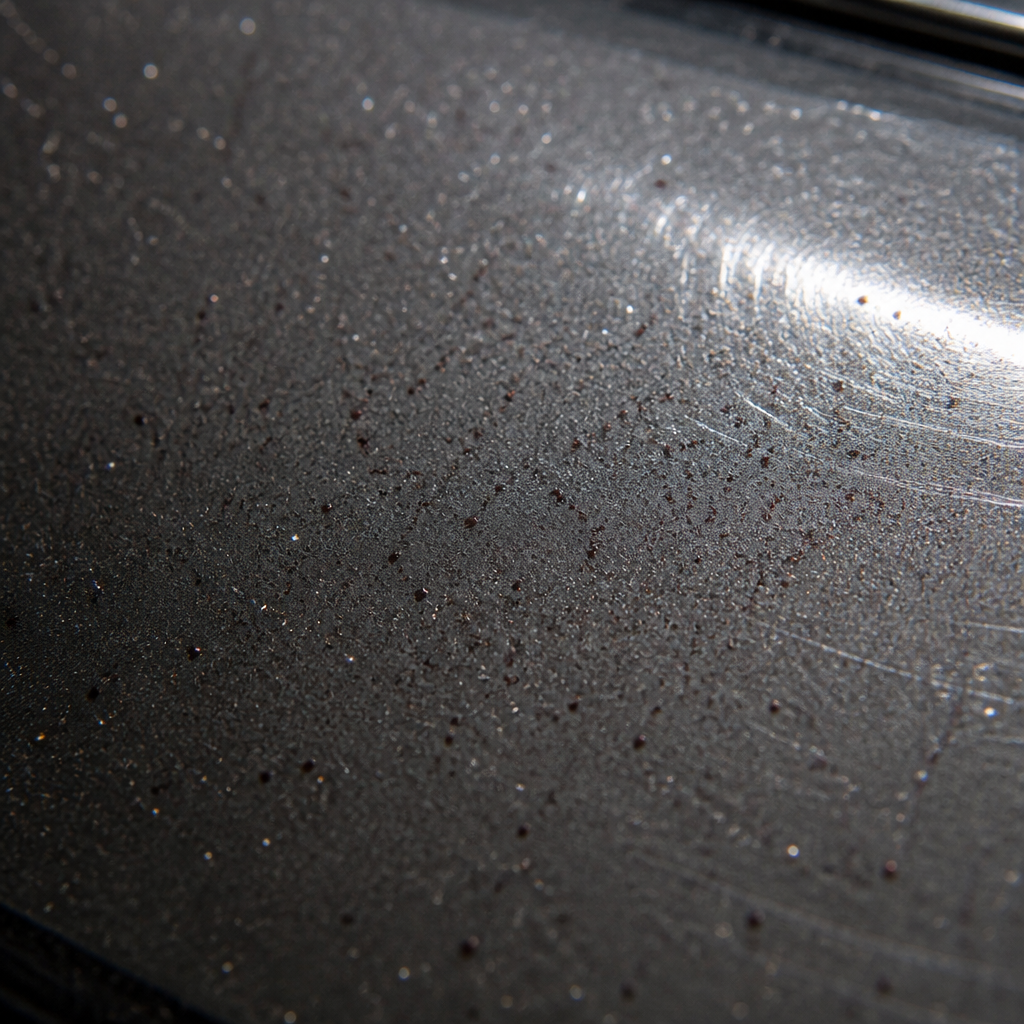
Paint contamination refers to any foreign material that bonds to or embeds into a vehicle's clear coat. Unlike road grime or dust that rinses off with water, these particles attach chemically or mechanically to the paint surface through heat, moisture, and time. Regular washing, including pressure washing, cannot break that bond.
The clear coat on a modern vehicle is porous at a microscopic level. When iron particles, tar, or acid residue land on the surface, they do not simply sit there. They work their way into those microscopic pores, expand with temperature changes, and lock in. At that point, the only way to remove them is through a targeted chemical reaction or controlled mechanical abrasion.
This is the fundamental gap between a car wash and a professional decontamination. A wash removes loose contamination. Decontamination removes bonded contamination, the stuff that has already taken up residence in your paint chemistry.
Types of Invisible Contamination Found on Clean-Looking Cars
After inspecting hundreds of vehicles at our studio, the same categories of contamination show up again and again on cars their owners considered clean. Each type behaves differently and requires a different approach to remove safely.
Iron Fallout and Brake Dust
Iron fallout is the most common invisible contaminant we find. Every time a vehicle brakes, the pad grinds against the rotor and releases hot metallic shavings that travel through the air and land on nearby paint surfaces, including your own car. Those particles embed into the clear coat and begin to oxidize almost immediately.
On light-colored vehicles, iron contamination eventually shows up as tiny orange or rust-colored specks. On darker paint, you often cannot see them at all until they have done serious damage. The telltale sign is the rough, sandpaper-like texture you feel when the surface is otherwise visually clean.
Rail Dust and Industrial Fallout
Rail dust is exactly what it sounds like: microscopic metallic particles shed by steel-on-steel friction as trains travel their routes. The Chicago metro area is one of the most rail-dense regions in North America, and the suburbs around Glendale Heights sit near multiple active freight and commuter rail corridors. Any vehicle parked or driven near these routes accumulates rail dust at an accelerated rate.
Industrial fallout is the broader category covering particles from manufacturing facilities, construction sites, and road infrastructure work. These particles are often ferrous as well, meaning they respond to iron-reactive chemistry just like brake dust does.
Tar and Bitumen Deposits
Road tar deposits appear as small black or dark brown specks, usually clustered on the lower third of the vehicle: the rocker panels, lower doors, and front bumper. Fresh road seal and asphalt repairs throw tar mist onto passing vehicles, and it bonds to warm paint almost instantly. Unlike iron particles, tar is not water-soluble. It requires a dedicated solvent-based tar remover to dissolve before it can be wiped clear.
Tree Sap and Organic Resin
Tree sap is a seasonal problem across the Chicago suburbs, particularly in spring and early summer when trees are actively producing resin. Sap that lands on paint and bakes in direct sunlight hardens quickly and becomes extremely difficult to remove without scratching the surface if the wrong technique is used. Even vehicles parked under shade trees accumulate fine sap misting that is invisible at a glance but creates a rough, slightly tacky texture.
Overspray and Airborne Coatings
Construction sites, parking lot line repainting, and nearby building work can deposit fine overspray onto vehicle paint. This feels like fine sandpaper grit and often covers an entire panel or roof. Many drivers mistake it for water spot residue and try to wipe it off, which typically drags it across the surface and causes scratching instead of removing the contamination.
Acid Rain and Environmental Mineral Deposits
Acid rain forms when airborne pollutants combine with atmospheric moisture and fall as chemically acidic precipitation. The pollutants are washed into the paint surface rather than off it. Over time, the mild acid attacks the integrity of the clear coat, causing it to fade, discolor, and eventually lose its protective function. Mineral deposits from hard water follow a similar pattern, leaving behind calcium and magnesium residue that etches the surface if not addressed promptly.
A clean-looking freshly washed car is not actually clean at the microscopic level. The surface can harbor layers of bonded contamination that are completely invisible to the eye but are actively degrading the clear coat from beneath.
Illinois-Specific Contamination Threats in the Chicago Suburbs
Not all contamination environments are equal, and the Chicago suburbs present a genuinely severe combination of threats that most detailing guides written for general audiences do not account for.
Road Salt: The Winter Contaminant That Works Year-Round
Illinois roads are heavily salted from November through March, and sometimes beyond. Road salt ions settle into the microscopic pores in a coat of paint and create a mild acid that attacks the clear coat surface from the inside. Over time, as the acid gradually breaks down the integrity of the paint's clear coat, the paint can fade, discolor, and eventually lose its ability to protect the underlying metal.
The problem is that salt contamination is not just a winter issue. Salt residue accumulates in panel gaps and lower body sections throughout winter and continues to work chemically through spring. A vehicle that has not had a full decontamination after winter still carries active salt chemistry in the paint surface well into the summer months.
Freeze-Thaw Cycles and Contaminant Embedding
Illinois winters produce repeated freeze-thaw cycles that make contamination worse. When a particle embedded in a clear coat pore freezes, it expands. When it thaws, it contracts. Over dozens of cycles, this mechanical action drives the particle deeper into the clear coat and increases the surface area of contact, making it progressively harder to remove without more aggressive intervention.
The Rail and Industrial Corridor Factor
The DuPage County area, including Glendale Heights and its neighboring communities, sits within close range of major freight rail lines and the industrial zones that line key expressway corridors. Vehicles in this area accumulate iron fallout at a rate significantly higher than those parked in purely residential or rural settings. If you park near a rail line or commute along a freight corridor, your paint contamination load is higher than average regardless of how often you wash your vehicle.
Pro tip: After winter ends, do not skip a full decontamination wash even if your car looks clean. Salt chemistry is still active in the clear coat and will continue etching through spring if not neutralized and removed by a professional process.
The Plastic Bag Test: How Professionals Detect Hidden Contamination
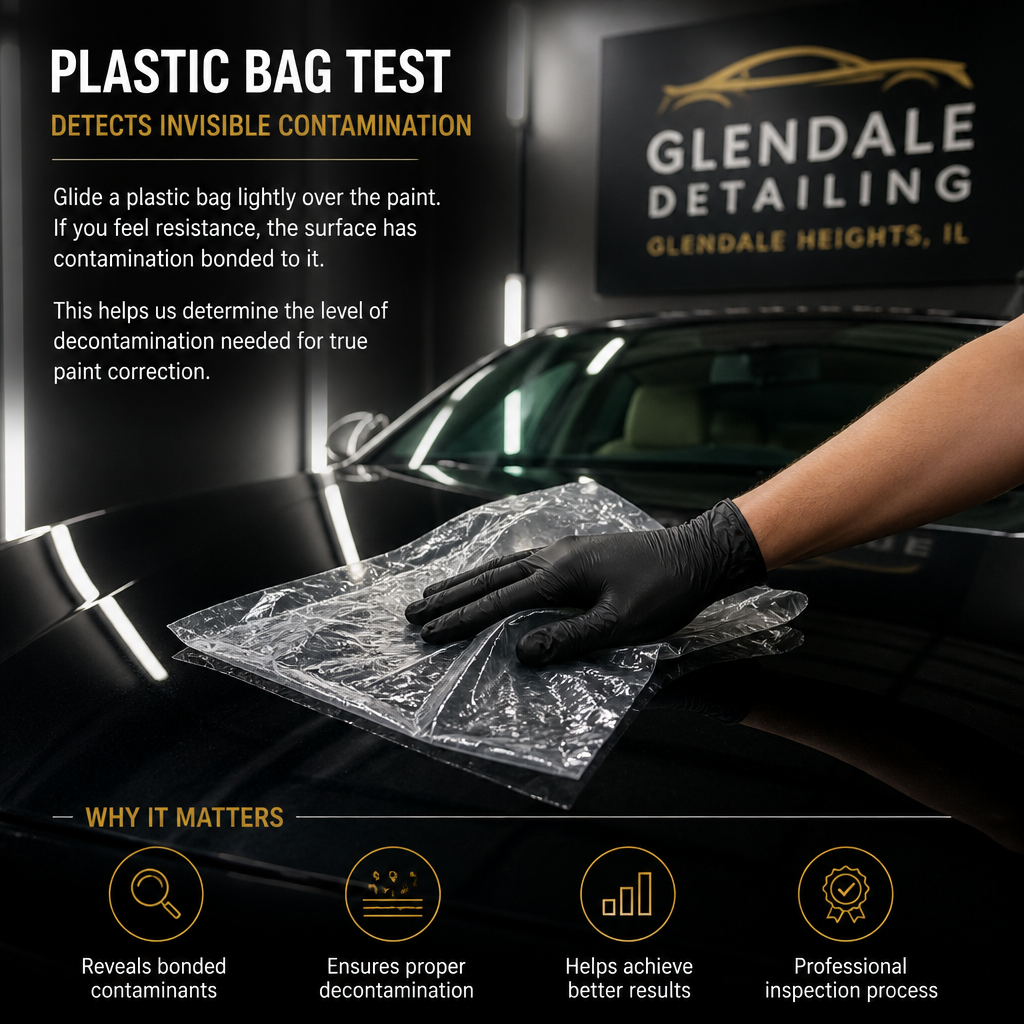
The plastic bag test is the simplest diagnostic tool for surface contamination and one that any vehicle owner can perform themselves. Slide a clean thin plastic bag over your hand, then glide it slowly across a freshly washed and dried panel. The plastic amplifies the surface texture in a way that bare skin cannot detect.
A properly decontaminated panel feels glass-smooth under the bag. Contaminated paint feels rough, gritty, or slightly dragging. If you feel texture, you have bonded contamination. It does not matter how the paint looks visually at that moment.
What the Test Tells You About the Type of Contamination
The texture pattern gives experienced detailers information about what type of contamination is present. Fine, uniform grit distributed across the entire panel typically indicates iron fallout or rail dust. Isolated rough spots or small bumps often indicate tar deposits or embedded mineral deposits. A slightly tacky or uneven texture that is harder to describe usually points to organic contamination like sap residue or overspray.
At our shop, the bag test is one of the first things we do on every vehicle, including vehicles brought in for maintenance programs. Clients are often surprised when a car they have been regularly washing still fails the test. The contamination is always there. It just requires the right diagnostic approach to find it.
Pro tip: Run the plastic bag test on your hood, roof, and trunk lid separately. Contamination levels vary significantly by panel depending on your driving routes and where you park. The roof accumulates rail dust and industrial fallout. The hood picks up forward brake dust. The trunk lid often shows the cleanest surface.
Decontamination Methods Compared
There are three core decontamination methods used in professional detailing, and the correct sequence matters as much as the methods themselves. Applying them out of order increases the risk of scratching and reduces effectiveness.
The Professional Decontamination Sequence
The correct order is: thorough wash first to remove all loose contamination, then chemical decontamination to dissolve embedded particles, then mechanical decontamination with clay to lift what chemistry could not reach. Skipping or reversing any step compromises the result.
Chemical decontamination should always precede clay work. Applying an iron remover first dissolves metallic particles and reduces the contamination load significantly. With less contamination present, the clay bar works with less friction and lower marring risk, which is especially important on the thin, sensitive clear coats found on modern luxury and European vehicles.
| Method | What It Removes | Limitations |
|---|---|---|
| Iron Remover (Chemical) | Ferrous particles (brake dust, rail dust, industrial fallout). The pH-reactive formula turns purple on contact with iron, confirming contamination presence and dissolution. | Does not remove tar, sap, overspray, or mineral deposits. Requires full rinsing to prevent residue. |
| Tar and Residue Remover (Solvent) | Tar spots, bitumen deposits, adhesive residue, and rubber contamination typically found on the lower body panels. | Not effective on iron or mineral contamination. Solvent must be appropriate for paint-safe use and rinsed thoroughly. |
| Clay Bar (Mechanical) | Surface-level bonded contamination not dissolved by chemicals: overspray, organic resin, remaining surface roughness. Physically lifts and encapsulates particles. | Requires lubrication to prevent marring. Can introduce fine scratches on heavily contaminated or dry surfaces. Should follow chemical decontamination, not precede it. |
Each method has reach limitations. The iron remover works in areas clay physically cannot reach, including grille openings, emblem recesses, and textured trim. Clay handles surface-level contamination across flat panels that chemical removers leave behind. Using only one method and skipping the other leaves contamination behind that will compromise any coating or sealant applied afterward.
Why Decontamination Matters Before Ceramic Coating
If you are investing in a professional ceramic coating, decontamination is not an optional prep step. It is the most consequential part of the entire application process, and skipping it or doing it poorly effectively voids the value of the coating before it is even applied.
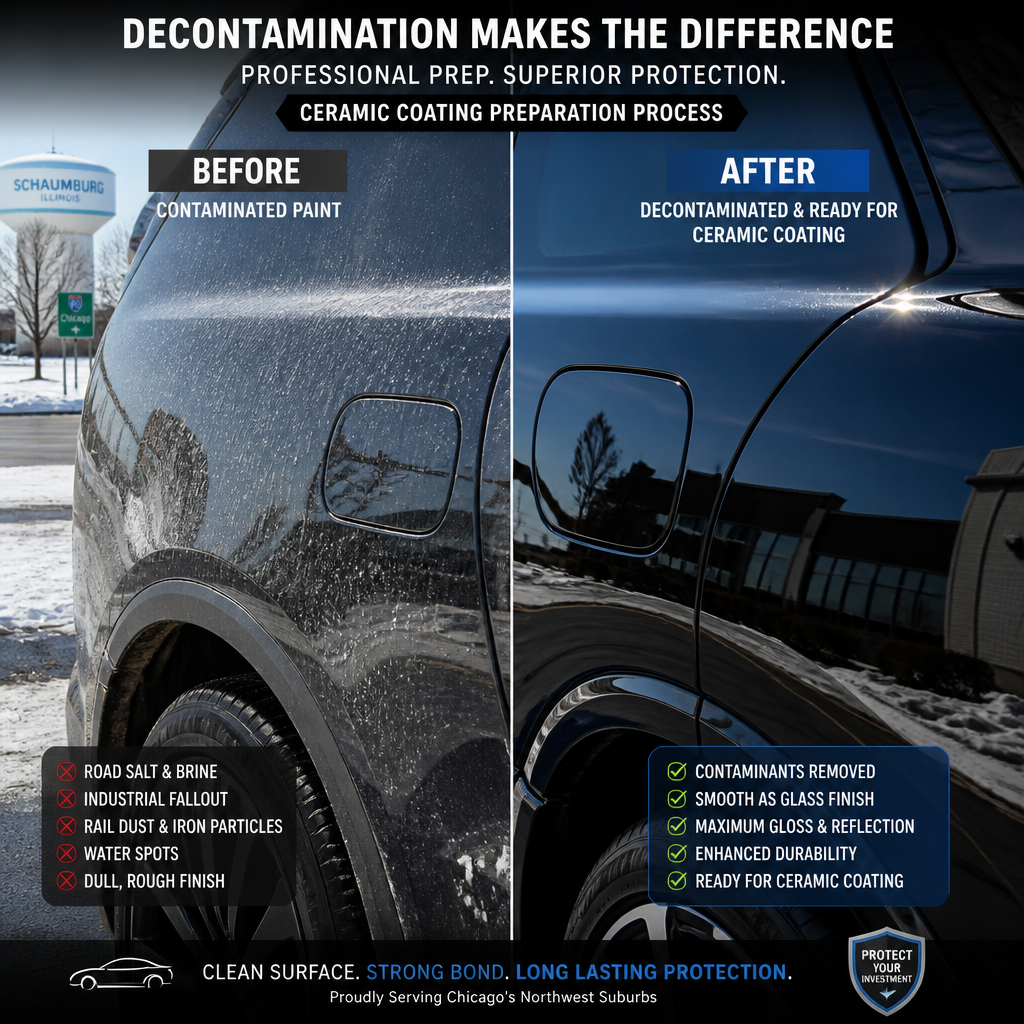
Modern ceramic coatings form a protective layer that bonds directly to the automotive paint at a molecular level. For that bond to work as specified, the surface must be clean, dry, and completely free of contamination. If contamination remains on the paint, the coating bonds to the contamination rather than to the clear coat itself. The result is reduced durability, degraded water behavior, lower gloss retention, weaker chemical resistance, and visible surface texture through the coating finish.
What Proper Pre-Coating Decontamination Looks Like
At Hersheys Detailing, every ceramic coating service includes a full multi-stage decontamination process before any paint correction begins. That means a pH-balanced wash, iron fallout removal with a reactive chemical agent, tar and residue removal on affected panels, and clay bar treatment to achieve a surface that passes the bag test across every panel. Only after that full sequence is the paint ready for machine polishing and then coating application.
The reason we include paint correction with our ceramic coating packages is directly connected to this reality. Decontamination removes bonded particles but does not fix the micro-scratches, swirl marks, or surface marring that contamination and incorrect washing technique leave behind. Paint correction addresses the surface profile after decontamination so the coating goes down onto polished, smooth, clean paint rather than contamination-free but still-damaged clear coat.
How Long Contamination Takes to Return After Decontamination
A freshly decontaminated and coated vehicle begins accumulating new contamination almost immediately. The critical difference is that a properly applied ceramic coating significantly reduces how aggressively new contamination bonds to the surface. Iron particles and road fallout on a coated surface do not penetrate the clear coat the way they do on an unprotected panel. They sit on top of the ceramic layer and can be removed with a maintenance wash before they become embedded.
This is why our maintenance program is designed around regular decontamination checks, not just aesthetic washes. The goal is to catch and remove new contamination before it works through the coating and reaches the paint underneath.
Vehicles Most at Risk in the Chicago Suburbs
Daily commuters who regularly travel on I-355, IL-53, or the tri-state area around DuPage County accumulate iron fallout faster than average due to high-density braking patterns on shared expressways. Vehicles parked in outdoor lots near commercial rail corridors are particularly vulnerable to rail dust. And any vehicle that spends a full Illinois winter without a post-season decontamination is carrying active salt chemistry and freeze-thaw-embedded particles that will keep damaging the clear coat through summer if not addressed.
Luxury and high-end vehicle owners in Wheaton, Carol Stream, and Bloomingdale face a compounding issue: premium factory paint finishes are often thinner and more sensitive than base-trim coatings. The same contamination load that a mass-market vehicle handles poorly is even more damaging to the clear coat of a performance sedan or luxury SUV.
Frequently Asked Questions
How do I know if my car has invisible paint contamination?
The most reliable method is the plastic bag test. Slide a thin plastic sandwich bag over your hand and glide it across a freshly washed and dried panel. If the surface feels rough, gritty, or dragging rather than completely smooth, bonded contamination is present. Visual inspection alone is not reliable because most invisible contamination is microscopic and cannot be seen without magnification.
Can I remove paint contamination at home, or do I need a professional?
Consumer-grade iron removers and clay bar kits are available, and light contamination can be addressed at home with care. However, professional decontamination uses higher-grade chemicals, controlled application techniques, and the experience to identify contamination type and intensity across different panel areas. For vehicles with significant contamination accumulation, older contamination that has been embedded through multiple freeze-thaw cycles, or any vehicle going into a ceramic coating, professional decontamination is the correct choice. Incorrect clay technique on a contaminated or dry surface can introduce scratches that require machine polishing to correct.
How often should a vehicle in the Chicago suburbs be decontaminated?
At minimum, a full decontamination should be performed twice a year: once after winter to address road salt and freeze-thaw contamination buildup, and once in late summer or early fall to address tree sap, organic deposits, and summer industrial fallout before the next winter season. Vehicles with heavy daily commute exposure, particularly those traveling near rail corridors or industrial zones, benefit from decontamination every three to four months.
Does a ceramic coating prevent paint contamination from forming?
A ceramic coating does not prevent contamination from landing on your vehicle, but it fundamentally changes how contamination interacts with the surface. On an uncoated vehicle, iron particles and tar can penetrate directly into the clear coat pores. On a properly applied ceramic coating, contaminants sit on top of the hard ceramic layer rather than bonding to the paint itself. This makes them easier to remove with regular maintenance washes and significantly slows the rate at which they accumulate. The coating does need periodic maintenance decontamination to keep the ceramic layer performing correctly.
Why does my car still feel rough after I clay bar it myself?
The most common reason is that chemical decontamination was skipped before claying. If iron fallout is not dissolved by a reactive iron remover first, the clay bar has to work against fully bonded metallic particles that it is not designed to remove efficiently. The result is that the clay picks up surface-level contamination but leaves the embedded iron particles behind, and the rough texture persists. The correct sequence is always iron remover first, then tar remover where needed, then clay bar as the final mechanical step.
What happens if a ceramic coating is applied over contaminated paint?
The coating bonds to the contaminants on the surface rather than to the clear coat itself. This creates a weak bond that reduces the coating's durability, meaning it will not last as long as specified. It also traps the contamination under the coating layer, where it can continue to damage the clear coat from beneath while the surface visually appears protected. The only way to fix this is to remove the coating, properly decontaminate the paint, and reapply from scratch, which is significantly more expensive than doing it correctly the first time.
If you have recently washed your car and it still feels rough or looks dull, we would love to hear what you found, drop a comment with your experience or reach out to us at Hersheys Detailing and we can help you diagnose what is going on with your paint.
References
- Why iron fallout makes your car feel rough after washing and how reactive removers work
- Four-step professional paint decontamination guide covering iron removal, tar removal, and clay bar sequencing
- How to safely remove bonded contaminants from car paint using chemical and mechanical methods
- How Chicago winter road salt damages vehicle paint and clear coat over time
- Clay bar versus chemical decontamination explained with professional sequencing guidance