Most luxury vehicle owners in the Chicago suburbs have made the same mistake at least once: grabbing an all-purpose interior cleaner and going to work on every seat surface in the car. The result is cracked leather, matted Alcantara nap, or product residue jammed into perforated holes that took hours to clear. Leather car seat cleaning in Illinois demands a different approach from, say, a fabric seat in a commuter car, and that gap widens further when you add Alcantara or perforated leather into the mix. This guide breaks down exactly what each material needs, what will damage it, and how to handle each type correctly the first time.
Table of Contents
- Quick Takeaways
- Understanding the Three Seat Materials
- How to Clean Leather Car Seats Correctly
- Alcantara Cleaning: The Synthetic Suede That Punishes Mistakes
- Perforated Seat Cleaning: The Holes Change Everything
- Seat Material Cleaning Comparison
- When DIY Is Not Enough
- Frequently Asked Questions
- References
Quick Takeaways
| Key Insight | Explanation |
|---|---|
| Never spray product directly onto perforated leather | Liquid forced into the perforations soaks the foam padding underneath and creates a long-term odor and mold risk. Always spray onto a microfiber towel first. |
| Alcantara hates alcohol and acetone | Both solvents dissolve the polyester microfiber binder that gives Alcantara its texture, causing permanent matting or discoloration. Use only pH-neutral, Alcantara-specific cleaners. |
| pH-balanced cleaners are non-negotiable for leather | Harsh detergents strip the natural oils from leather, accelerating cracking. A pH-balanced leather cleaner lifts dirt and oils without breaking down the surface. |
| Condition leather after every deep clean | Cleaning removes surface oils along with dirt. Conditioning immediately afterward restores moisture and prevents the brittleness that leads to cracking, especially in Illinois winters. |
| Brush direction matters for Alcantara | Always brush Alcantara nap in one consistent direction after cleaning to restore the raised texture. Scrubbing in circles flattens the fibers permanently. |
| Vacuum before you apply any product | Loose grit and crumbs become abrasive particles the moment you start scrubbing. Vacuuming first prevents surface scratches on leather and fiber damage on Alcantara. |
| Over-conditioning perforated leather clogs the holes | Apply conditioner sparingly on perforated sections. Heavy application pushes product into the perforations, blocking airflow and leaving a sticky residue that attracts more dirt. |
Understanding the Three Seat Materials
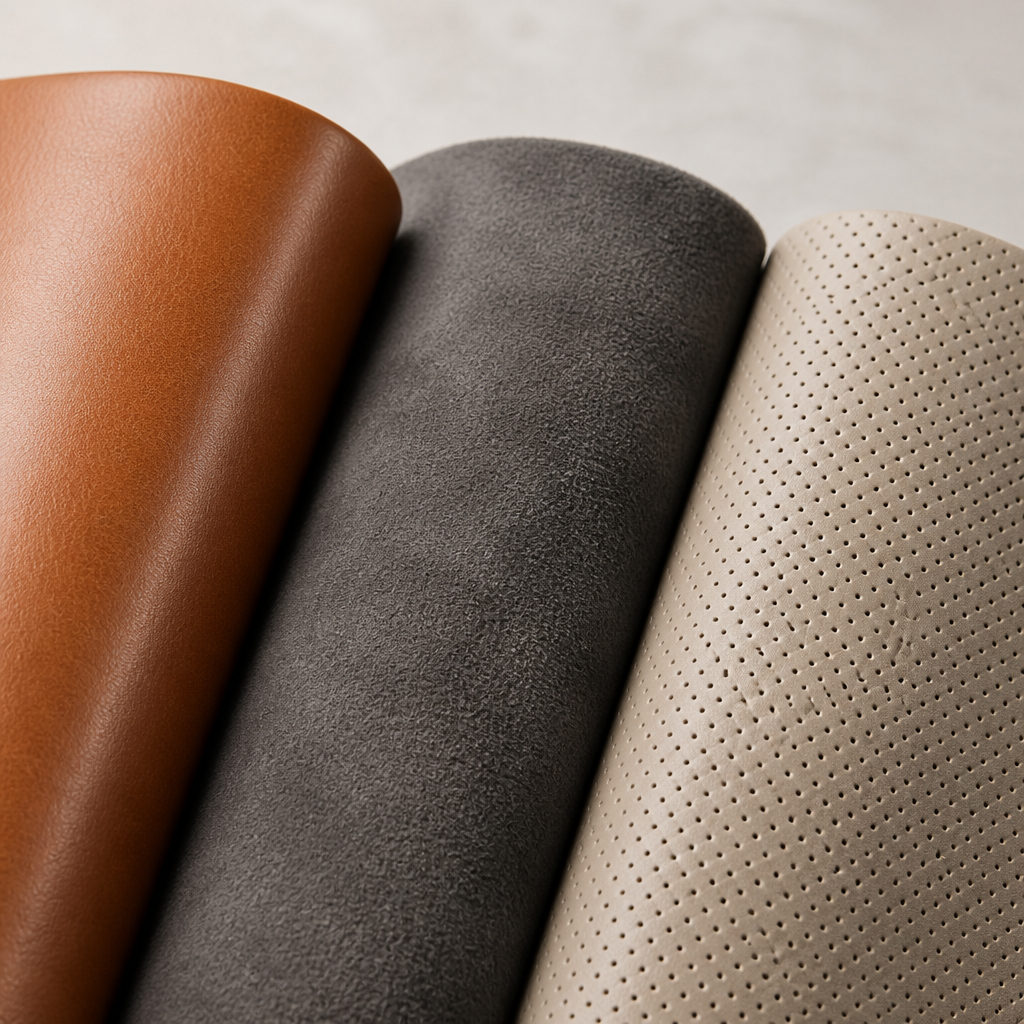
Before reaching for any product, you need to know what you are actually dealing with. The three seat materials commonly found in luxury and performance vehicles each behave differently under moisture, friction, and chemical exposure. Treating them identically is where damage begins.
Genuine leather is a tanned animal hide. It is porous, it breathes, and it holds oils, both its own and those transferred from clothing and skin. The surface coat on automotive leather varies by manufacturer, but most modern automotive leather carries a protective topcoat that you should not strip away with aggressive solvents.
Alcantara is a branded synthetic microfiber designed to replicate the look and feel of suede. It is made from polyester and polyurethane, and it is widely used in European performance and luxury cars for seat inserts, steering wheels, headliners, and door panels. It looks premium and feels soft, but it degrades quickly under incorrect cleaning.
Perforated leather is genuine leather with small holes punched through it, usually tied to ventilated seat systems found in vehicles like a BMW 7 Series or Mercedes S-Class. The perforations introduce a complication that flat leather does not have: any liquid or product applied too heavily will enter those holes and reach the foam beneath the surface.
How to Clean Leather Car Seats Correctly
For most leather seats on luxury vehicles coming through the Chicago suburbs, the cleaning process should follow a strict sequence. Skipping steps or reversing them almost always produces a worse result than starting over.
Step 1: Vacuum First, Always
Use a vacuum with a soft brush attachment before touching the leather with any product. Work the brush attachment along seams, piping, and seat folds. Dirt that sits in those seams becomes a grinding paste once moisture is introduced, and it will abrade the leather surface during the cleaning phase.
On rear bench seats and bolsters, pay particular attention to where thighs and lower backs contact the leather. Those are the areas where body oils and dye transfer from clothing accumulate fastest.
Step 2: Apply a pH-Balanced Leather Cleaner
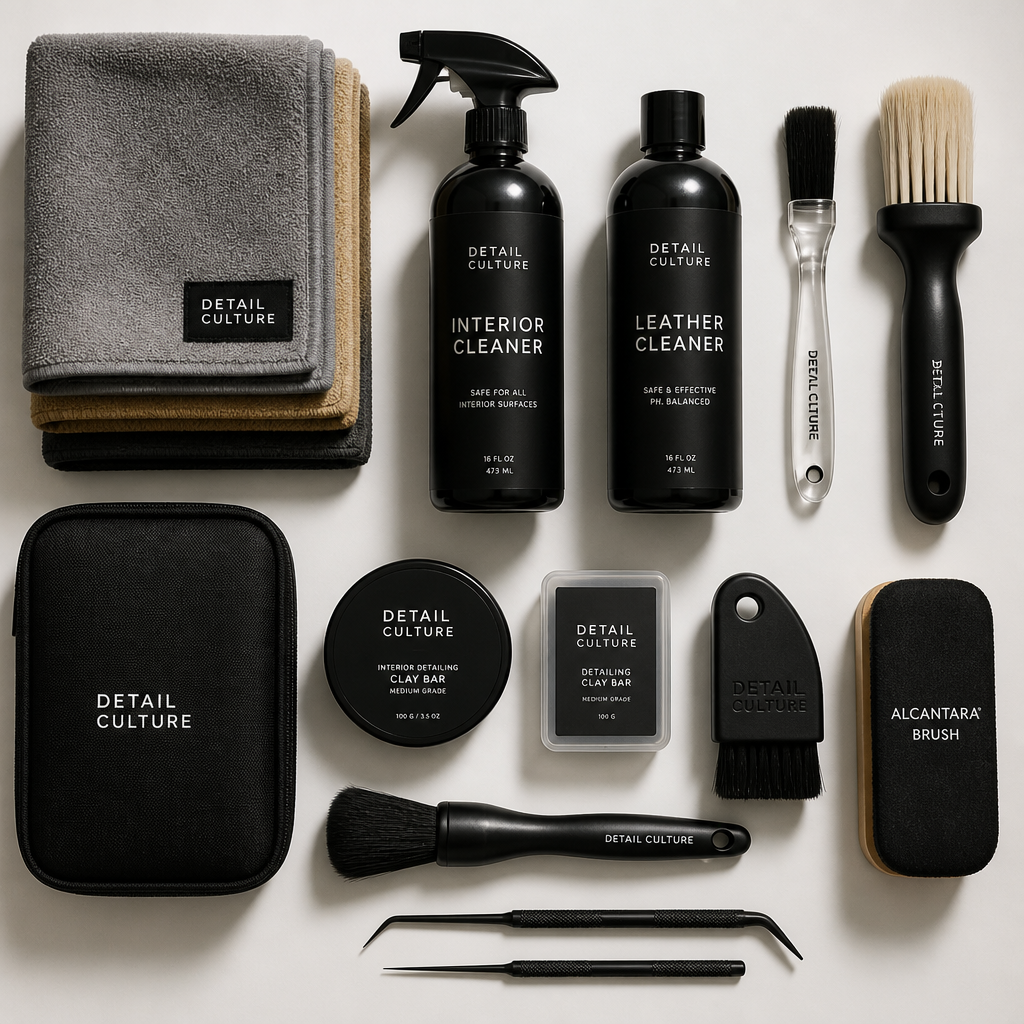
Spray a pH-balanced leather cleaner onto a microfiber cloth, not directly onto the seat. Work in small sections, using a soft-bristled brush or the damp cloth in light, overlapping strokes. Avoid hard scrubbing, which can abrade the surface coat on the leather.
The best approach to leather care combines a pH-balanced cleaner to lift dirt and oils with a quality conditioner applied immediately after, keeping the surface hydrated and protected against cracking and UV exposure.
A common mistake is using an all-purpose cleaner or diluted dish soap on leather. Both are typically alkaline, and repeated use strips the surface oils that keep leather supple. In the Chicago area, where winters are dry and summers send UV intensity through glass sunroofs, leather that has been stripped of its oils cracks within one to two seasons.
Step 3: Condition Immediately After Cleaning
Do not let cleaned leather sit without conditioning. Apply a quality leather conditioner while the surface is still slightly damp from cleaning. Work it in with a clean microfiber applicator, using circular motions. Buff off any excess with a dry cloth before it sets.
The conditioning step is especially important for owners in Carol Stream, Bloomingdale, and Wheaton who park outdoors regularly. Sun and dry air are the fastest paths to leather degradation, and a well-conditioned seat resists both considerably better than a cleaned-but-dry one.
Pro tip: On black or dark leather seats, buff the conditioner fully before it dries. Any residue left on dark leather tends to show as a whitish film that is difficult to remove without re-cleaning.
Alcantara Cleaning: The Synthetic Suede That Punishes Mistakes
Alcantara cleaning in a car interior requires a completely different mindset from leather. The material looks durable because it is dense, but the individual microfibers that make up its surface are vulnerable to solvents, heat, and abrasion in ways that leather is not.
What You Cannot Use on Alcantara
Do not use alcohol-based cleaners, acetone, solvent-based products, steam cleaners, or standard fabric cleaners on Alcantara. Alcohol and acetone dissolve the polyurethane binder that holds the microfiber structure together, causing the surface to lose its texture permanently. Steam can cause the same structural collapse by forcing moisture deep into the fiber matrix.
Do not use tinted or printed cloths on Alcantara either. Color can transfer from the cloth into the open microfiber structure of the material and is nearly impossible to reverse without professional treatment.
The Correct Cleaning Method
Start with a vacuum using an upholstery nozzle to remove dry debris from the surface. Move the nozzle gently, without pressing into the material. After vacuuming, use a dedicated Alcantara-specific cleaner with a pH between 5 and 7. Spray the cleaner onto a soft-bristled brush or a clean, undyed microfiber cloth, and work in short, unidirectional strokes rather than circular scrubbing.
Circular scrubbing is one of the most common mistakes made during alcantara cleaning in car interiors. It flattens the raised nap of the material and creates visible wear paths that look like scuff marks. Always work in one direction during the agitation phase.
After cleaning, use a dry soft-bristled brush to raise the fibers back to their original standing position. Brush all in one direction and allow the material to air-dry completely away from direct heat or sunlight.
Pro tip: If you are dealing with a fresh oil stain on Alcantara, blot it immediately with a dry white cloth to absorb as much as possible before applying any cleaner. Rubbing an oil stain spreads it laterally through the microfiber structure, making the affected area larger and harder to remove later.

Protecting Alcantara After Cleaning
Once the Alcantara is clean and dry, apply a purpose-built fabric protector formulated for synthetic suede. Spray it evenly, allow it to settle, then brush the surface lightly in one direction to work the protector into the fiber structure without flattening the nap. This step dramatically reduces how quickly the material picks up body oils and clothing dye on subsequent use.
Perforated Seat Cleaning: The Holes Change Everything
Perforated leather seat cleaning in the Chicago suburbs follows many of the same principles as standard leather care, with one critical constraint: moisture control. Every product you use has to stay on the surface and avoid being forced into the perforations.
Why Perforations Create Risk
The perforations in ventilated seats connect directly to the foam padding and the HVAC channels beneath the seat surface. Liquid that enters the perforations reaches the foam, and foam holds moisture. In a sealed car interior, that moisture becomes a source of odor and, in warm conditions, mold. This is not a hypothetical risk. It is a routine consequence of applying product directly to perforated leather without controlling the saturation level.
The Application Rule: Never Spray Directly
Spray your leather cleaner onto a microfiber cloth first, then apply it to the seat surface. The cloth should be damp but not wet. A cloth that drips when squeezed has too much product on it. Work in small sections, agitating the surface gently with a soft-bristled brush. Angle the brush to clean the edges of the perforations rather than pushing product down through them.
When conditioning perforated leather, use the same spray-to-cloth method and apply the conditioner in thin, even layers. Heavy application on perforated sections pushes conditioner into the holes, which creates a sticky surface film that attracts dust and debris and can eventually block airflow in ventilated seats. Use light pressure and buff away any excess before it has time to settle into the perforations.
Vacuuming Perforations
Before applying any product to perforated seats, vacuum the surface using a soft brush attachment. Move across the perforations rather than pressing into them. In vehicles used in sandy or dusty environments, a pass with compressed air (low pressure, from a distance) before vacuuming can help dislodge material that has packed into the holes from the top. This step is worth taking seriously, especially on rear seat perforations where fine debris accumulates from shoes and clothing.
Seat Material Cleaning Comparison
The differences between these three materials become clearest when you lay the cleaning requirements side by side. This comparison covers the most important decision points for each material type.
| Cleaning Factor | Genuine Leather | Alcantara | Perforated Leather |
|---|---|---|---|
| Cleaner type | pH-balanced leather cleaner | pH-neutral Alcantara-specific cleaner (pH 5-7) | pH-balanced leather cleaner, applied sparingly |
| Application method | Spray to cloth or soft brush, work in sections | Spray to brush or cloth only, unidirectional strokes | Spray to cloth only, never direct spray onto surface |
| Brush technique | Light circular or overlapping strokes | Unidirectional only, no circles | Angled strokes to clean perforation edges |
| Conditioning required | Yes, after every deep clean | No leather conditioner. Use fabric protector instead | Yes, but sparingly on perforated zones |
| Biggest risk | Stripping oils with alkaline cleaners | Solvent damage and nap flattening from scrubbing | Moisture entering perforations and soaking foam |
| Drying method | Air dry or light microfiber buff | Air dry away from heat, then brush nap upright | Air dry, ensure perforations are clear and dry |
| Frequency for daily-driven luxury vehicles | Full clean and condition every 3 months | Light maintenance monthly, deep clean every 3 months | Full clean every 3 months, lighter refresh monthly |
When DIY Is Not Enough
There is a clear line between maintenance cleaning and corrective work. Maintenance cleaning, which is what most of the above describes, is something an attentive owner can do with the right products and a careful approach. Corrective work is a different matter entirely.
Dye transfer from dark jeans onto light-colored Alcantara or leather, deep ingrained grime in perforations that has built up over several years, cracking leather that has gone past the conditioning threshold, and Alcantara nap that has been permanently matted by incorrect cleaning products: all of these require professional interior detailing with equipment and products that are not available in retail form.
At Hersheys Detailing in Glendale Heights, interior detailing services for luxury vehicles address exactly these situations. The multi-stage approach used for paint correction work translates directly to interior surfaces: assess the material condition first, choose the appropriate product and tool for that specific condition, and work methodically without shortcuts. Owners in Carol Stream, Bloomingdale, and Wheaton bringing in vehicles with neglected Alcantara or perforated leather seats consistently get better outcomes from a professional correction than from repeated aggressive attempts at home.
If a vehicle has been sitting through an Illinois winter with a small spill that soaked into perforated seats, the odor problem that results from that moisture reaching the foam is not solvable with surface cleaning alone. Extraction equipment and targeted odor treatments are required. That is not a product limitation, it is a physics limitation.
Frequently Asked Questions
Can I use baby wipes or household wet wipes on leather car seats?
No. Most household wet wipes, including baby wipes, contain ingredients like aloe vera, fragrance compounds, and preservatives that are not formulated for automotive leather. Some contain mild alcohols or detergents that strip the surface coat over time. Occasional use may not cause visible damage immediately, but regular use will degrade the leather's surface coating and shorten its lifespan. Use a product specifically formulated for automotive leather.
How do I remove a coffee stain from Alcantara without spreading it?
Act immediately. Blot the stain with a clean, dry white cloth using straight downward pressure, not a rubbing motion. Once you have absorbed as much liquid as possible, apply a small amount of Alcantara-specific cleaner to a clean cloth and work from the outer edge of the stain inward, using light unidirectional strokes. Let the area dry fully before brushing the nap back into position. Do not use hot air from a blower to speed drying, as heat can set the stain and damage the fiber structure.
Is there a safe way to clean perforated leather seat holes that have visible dirt in them?
A soft-bristled detailing brush is the right tool for clearing dirt from the edges and mouths of perforations. Apply cleaner to the brush, not to the seat, and use angled strokes to work around each perforation rather than pushing downward through them. A low-pressure pass with compressed air after brushing can help dislodge loosened material. For heavily clogged perforations where product or debris has built up inside the holes, professional extraction is the safest option.
How often should I condition the leather seats on a luxury vehicle in the Chicago area?
A full clean and conditioning cycle every three months is the standard recommendation for daily-driven luxury vehicles. Illinois winters are particularly hard on leather because interior air becomes very dry with extended heater use, pulling moisture out of the leather surface. If a vehicle sits parked for extended periods in an unheated garage during winter, condition the seats before storage and again when the vehicle returns to regular use. UV exposure during Chicago summers also warrants conditioning at the start of the warm season.
My Alcantara steering wheel looks matted and shiny in high-contact areas. Can it be restored?
Mild matting from body oils and hand contact can often be partially restored by cleaning the Alcantara with a pH-neutral cleaner and then using a dedicated soft-bristled brush to lift the fibers. Work in small sections and be patient, as the nap takes time to respond. Severe matting where the fibers have been compressed and flattened by repeated friction or solvent damage is more difficult to reverse and may require professional treatment or, in extreme cases, Alcantara replacement. Early intervention produces far better results than waiting until the damage is advanced.
Can I use the same leather conditioner on perforated seats and flat leather seats?
Yes, the same conditioner product works for both, but the application technique must differ. On flat leather, you can apply conditioner more generously and buff away the excess. On perforated leather, you need to apply much lighter coats and buff immediately after each pass to prevent product from settling into the holes. A cream conditioner is often easier to control on perforated sections than a spray, since it stays on the surface longer and gives you more time to work it in evenly.
Have you dealt with a stubborn stain or cleaning challenge on Alcantara or perforated leather in your vehicle? Share what worked or what you wish you had known before attempting it.
References
- AutoZone guide to cleaning leather car seats with pH-balanced cleaners and conditioning techniques
- SlashGear guide on cleaning perforated leather car seats safely without soaking the perforations
- Dr. Beasley's detailed instructions for cleaning leather seats with perforations and avoiding product clogging
- Bowden's Own guide to cleaning and protecting Alcantara, microsuede, and synthetic suede interior trim
- Capital One guide on cleaning suede and Alcantara car interiors with proper techniques and tools