If your car looks dull under direct sunlight, covered in fine scratches and hazy swirls, you are not imagining it. Automatic car washes, improper hand washing, and Illinois' hard water leave real, measurable damage on your clear coat. Paint correction in Glendale Heights IL is the only process that actually removes these defects rather than hiding them. This guide breaks down exactly how multi-stage machine polishing works, what distinguishes a professional correction from a quick wax job, and why Chicago suburb drivers with luxury vehicles should care about the difference between a restored finish and a covered-up one.
Table of Contents
- Quick Takeaways
- What Are Swirl Marks, Water Spots, and Buffer Trails
- How Multi-Stage Machine Polishing Works
- Paint Correction vs Ceramic Coating: What Comes First
- Remove Water Spots on Car Paint: What Actually Works
- Swirl Mark Removal Chicago Suburbs: Why Local Conditions Matter
- Paint Correction Stages Compared
- Frequently Asked Questions
- References
Quick Takeaways
Key Insight | Explanation |
|---|---|
Swirl marks are not surface dirt | They are micro-scratches in the clear coat caused by improper washing, automatic tunnels, and dry wiping. No wax or spray detailer removes them. |
Hard water spots etch into paint if left untreated | Illinois municipal water is moderately to highly hard. Mineral deposits bond chemically with the clear coat within days, especially in summer heat. |
Buffer trails come from the detailer, not the car | Holographic scratches left by a rotary buffer and the wrong pad or polish are a sign of poor technique. Machine polishing done correctly eliminates them. |
One-stage polishing is a shortcut, not a correction | Multi-stage polishing uses progressively finer compounds and pads to remove heavy defects first, then refine the finish. Skipping stages leaves haze. |
Paint thickness measurement is non-negotiable before polishing | A paint depth gauge reading below safe threshold means polishing must stop. Removing too much clear coat causes permanent damage. |
Ceramic coating applied over uncorrected paint locks in defects | SiO2 nano-coatings are transparent and extremely glossy. They amplify swirl marks rather than hiding them if the surface is not corrected first. |
Paint correction near Wheaton and Carol Stream requires decontamination first | Illinois road salt, rail dust from freight corridors, and tree sap all embed in paint and must be removed chemically and mechanically before any polishing begins. |
What Are Swirl Marks, Water Spots, and Buffer Trails
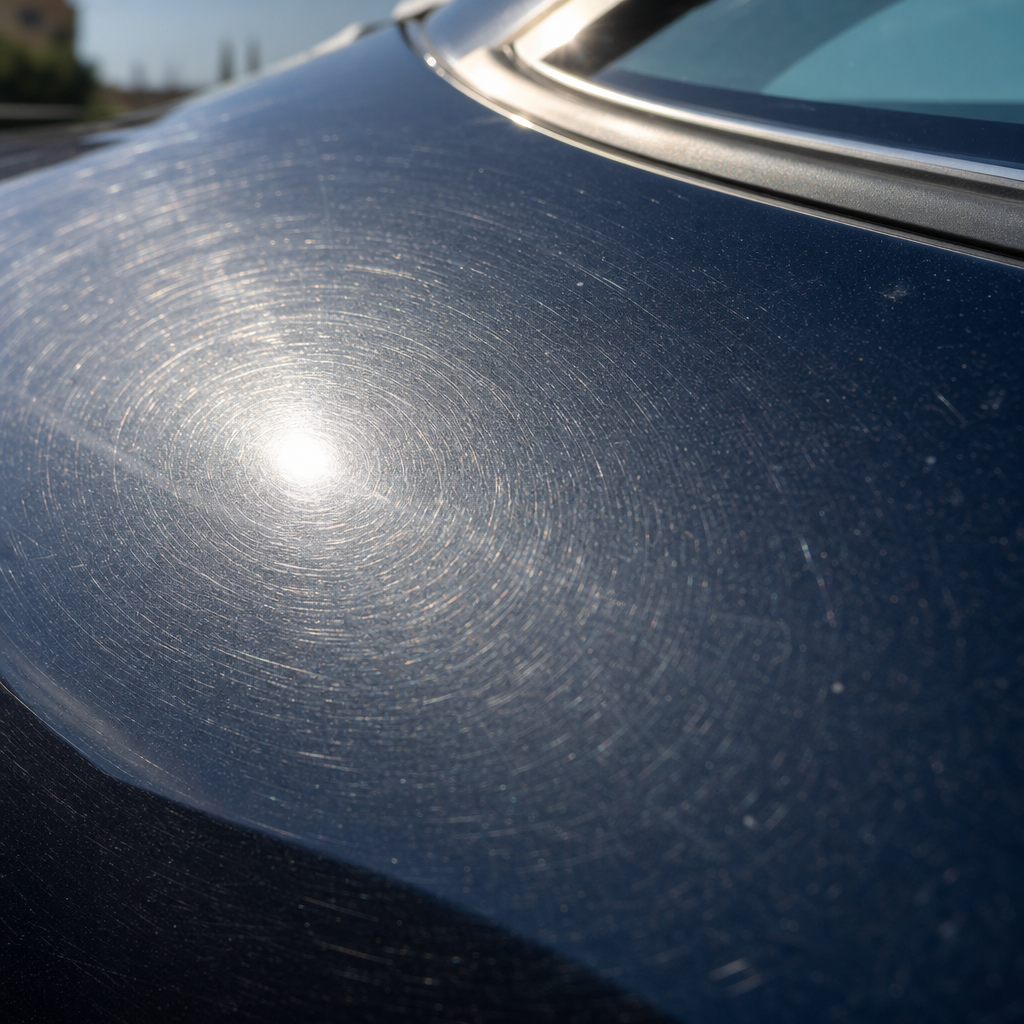
Swirl marks are circular or arc-shaped micro-scratches concentrated in the clear coat. They appear most visibly under direct sunlight or artificial light at a low angle. The source is almost always contact washing. Automatic tunnel car washes, gas station brushes, and even a dirty microfiber cloth dragged across dry paint all create them.
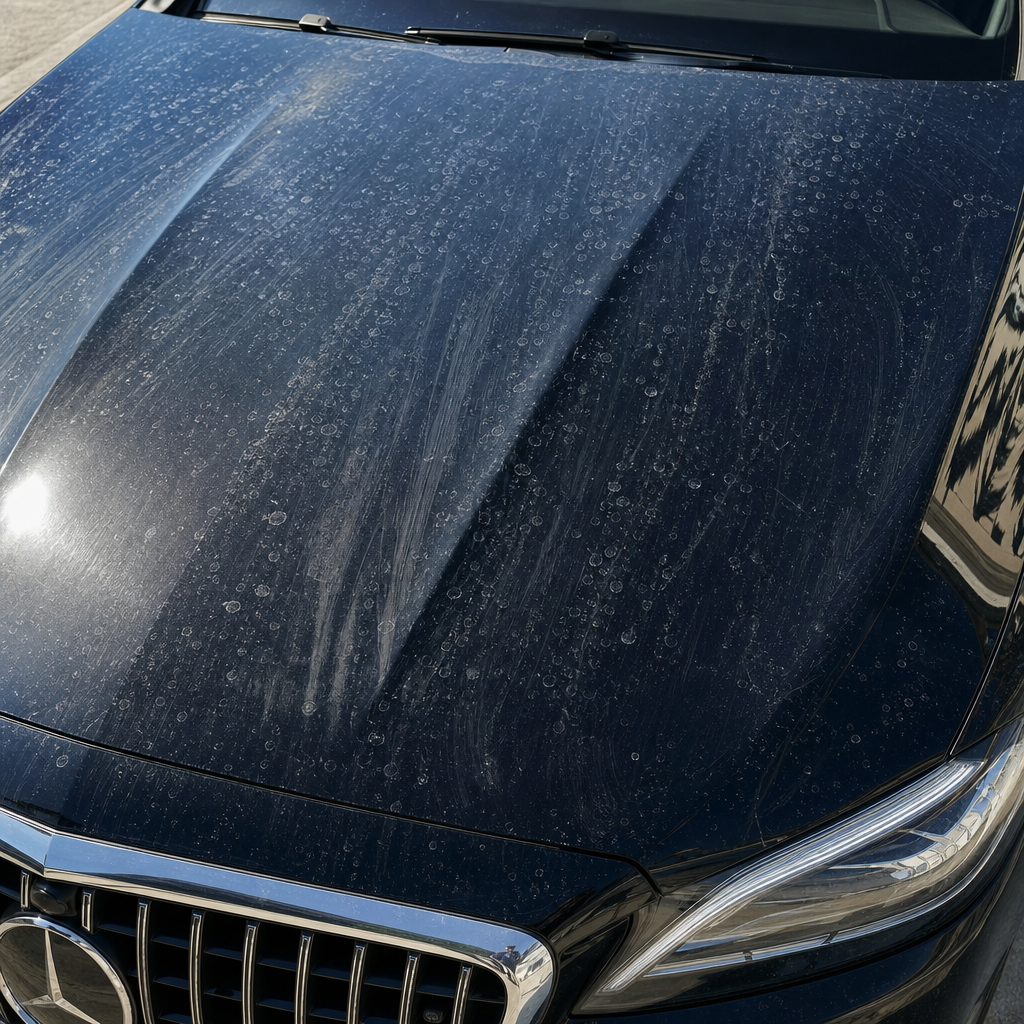
Water spots are a separate category of damage. They form when mineral-rich water evaporates and leaves calcium and magnesium deposits bonded to the paint surface. Type 1 water spots sit on top of the clear coat and can be removed chemically. Type 2 water spots have etched into the clear coat and require light polishing. Type 3 water spots have permanently altered the paint surface and may require wet sanding. Most vehicles in Glendale Heights and surrounding areas that have been sitting outside during summer months have at least Type 2 contamination.
Buffer trails, sometimes called holograms, are a specific pattern of fine scratches left behind by a rotary polisher operated without proper technique. They typically appear as swirling patterns visible under shop lights after a polish job. They are not a car problem. They are a technician problem, and they require additional polishing with the correct pad and product combination to remove.
How Multi-Stage Machine Polishing Works
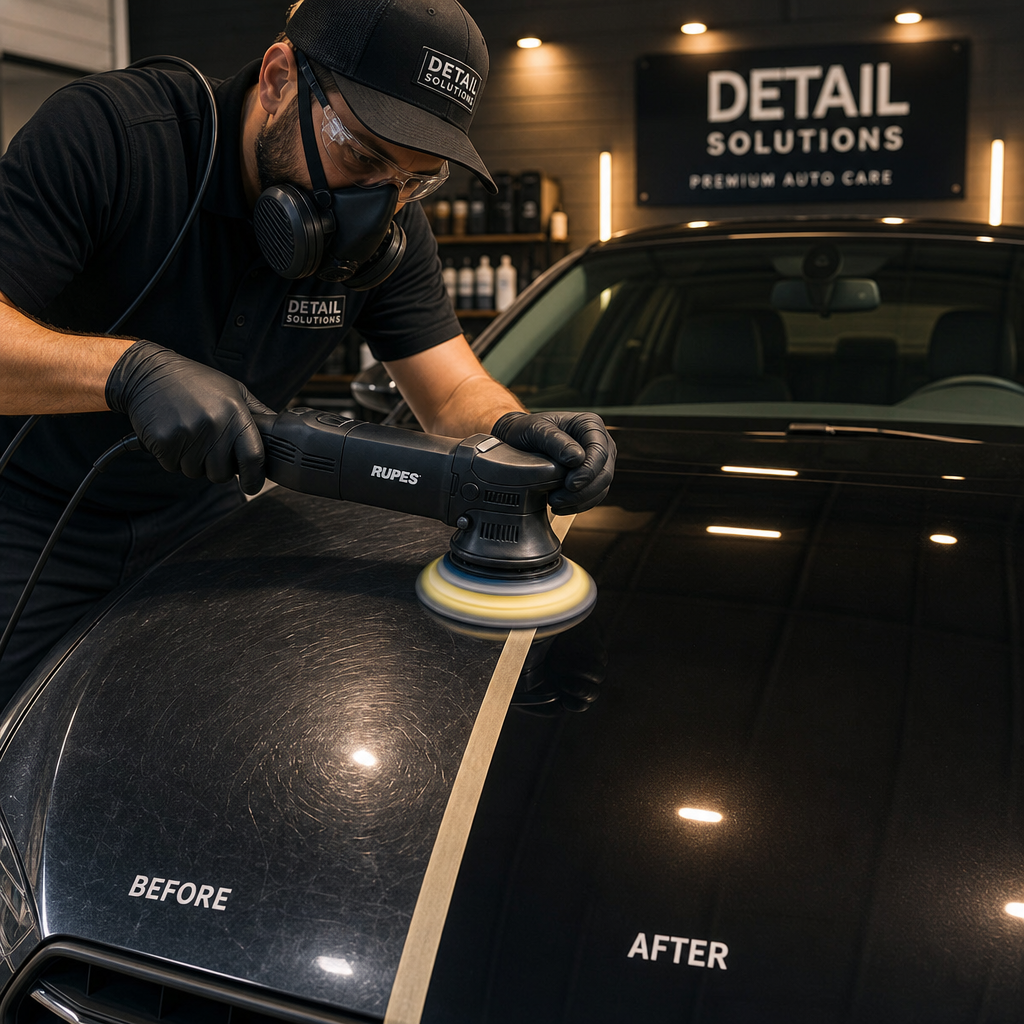
Multi-stage machine polishing is a sequenced process that addresses paint defects from most aggressive to most refined. It is not simply running a polisher over the car multiple times. The stage count, pad selection, compound abrasive level, and machine speed all change at each step based on what the paint requires.
Stage One: Heavy Cutting
Stage one uses a cutting compound with a firm foam or microfiber pad to remove deeper scratches, severe oxidation, and water spot etching. The abrasive particles in the compound physically abrade the top layer of clear coat to level the surface. On a vehicle with moderate to heavy defects, this stage removes the majority of visible damage.
A common mistake at this stage is using too aggressive a product on thin paint. At Hersheys Detailing, every vehicle is measured with a paint depth gauge before polishing begins. If the clear coat reads below 80 to 90 microns in any panel area, the approach is adjusted immediately. There is no recovering from polishing through the clear coat.
Stage Two: Polishing and Refining
Stage two uses a finer polish and a softer pad to remove the micro-scratches left by stage one. This is where the gloss begins to emerge. Many shops stop here and call it a two-stage correction. The difference is visible under high-intensity inspection lighting.
Stage Three: Finishing and Paint Clarity
Stage three uses an ultra-fine finishing polish or glaze with a soft foam pad to maximize clarity and depth. This is what separates a good correction from a flawless one. Dark-colored vehicles, especially black, navy, and dark grey, show every remaining imperfection at this stage. Rushing or skipping it shows immediately in the final result.
Pro tip: When evaluating a detailer's work, inspect the paint under a single overhead light source in a dark room. Buffer trails, remaining swirls, and haze invisible in daylight will appear clearly under these conditions. Ask any prospective detailer if they perform this final inspection before delivery.
Paint Correction vs Ceramic Coating: What Comes First
This is the question most luxury vehicle owners get wrong. Paint correction always comes before ceramic coating, without exception. A ceramic coating does not correct paint. It protects it.
"Ceramic coatings are optically clear and have a refractive index close to glass. They do not mask defects. Any swirl mark or scratch visible before coating will be more visible after coating because the coating amplifies the gloss and depth of whatever is beneath it." - Industry standard position held by professional detailing certification bodies including the International Detailing Association.
The correct sequence for a full paint protection program is: decontamination, paint correction, and then ceramic coating application. At Hersheys Detailing, nano-ceramic SiO2 coatings are applied only after the correction process is verified complete under inspection lighting. The result is a surface that is both defect-free and protected for five to eight years under warranty.
Drivers in Wheaton, Carol Stream, and Bloomingdale who are considering a ceramic coating but have not had a paint correction should understand that they are potentially sealing in every swirl mark, water spot, and buffer trail currently on their vehicle. Removing a ceramic coating to fix the paint underneath is an expensive and time-consuming process.
Pro tip: If you are budgeting for a ceramic coating, build the cost of a one or two-stage paint correction into that budget from the start. The correction is not optional if you want the coating to look exceptional rather than just protective.
Remove Water Spots on Car Paint: What Actually Works
The approach to water spot removal depends entirely on how deeply the minerals have bonded to the clear coat. Using the wrong method for the wrong stage of contamination either fails to work or causes additional damage.
Chemical Decontamination for Type 1 Spots
Fresh water spots that have not yet etched into the clear coat respond to pH-appropriate water spot removers. These are acidic formulations that dissolve the alkaline mineral deposits. The product is applied, allowed to dwell for the appropriate time, and then rinsed off. No abrasive contact is required if treated early enough. This is why washing a vehicle immediately after rain or sprinkler contact matters in Illinois, where municipal water hardness regularly exceeds 200 parts per million in communities like Carol Stream and Wheaton.
Machine Polishing for Type 2 Spots
Type 2 water spots have etched a ring or haze into the clear coat surface. Chemical removal alone will not fix them because the damage is physical, not just residue. Light machine polishing with a fine to medium abrasive is required. This is a targeted correction, not a full-panel polish, and it requires reading the paint carefully to avoid over-polishing thin areas.
Wet Sanding for Severe Etching
Type 3 water spot damage, where the mineral has literally etched a crater into the clear coat, may require wet sanding with 1500 to 3000 grit before any polishing begins. This is the most aggressive approach and is reserved for severe cases. In practice, vehicles left with water spots through an entire Illinois summer, especially dark-colored vehicles parked outdoors, frequently present with Type 2 to Type 3 damage by August.
Swirl Mark Removal Chicago Suburbs: Why Local Conditions Matter
The Chicago suburbs create a specific set of paint hazards that are not uniform across the country. Understanding them helps explain why vehicles in Glendale Heights, Bloomingdale, and Wheaton tend to accumulate paint damage faster than vehicles in drier or less industrialized regions.
Road salt applied from November through March is the most obvious factor. Salt residue left on paint and in panel gaps is corrosive and abrasive. When drivers wipe down a salt-covered vehicle with a microfiber towel without a proper wash, they drag salt crystals across the clear coat, creating fine scratches across every panel.
Rail dust and industrial fallout are less obvious but equally damaging. The Chicago area is a major freight rail hub, and iron particles from rail operations travel in the air and embed in automotive paint within a relatively large radius. These particles oxidize on contact with moisture and leave rust-colored contamination that bonds to the clear coat. No amount of washing removes them. A decontamination step using a pH-neutral iron fallout remover is required before any paint correction can begin.
Tree sap from the mature tree canopy common in Glendale Heights and surrounding suburbs bonds aggressively to clear coat in summer heat. Left for more than a few days in warm temperatures, sap can etch permanently into the paint surface.
The data consistently shows that vehicles in the Chicago suburbs that go more than six months without professional decontamination and correction carry a measurable accumulation of all three contamination types simultaneously. A proper paint correction process for these vehicles begins with a full chemical decontamination, clay bar treatment, and iron fallout removal before any machine polishing starts.
Paint Correction Stages Compared
Not every vehicle needs a full three-stage correction. The right level of correction depends on the current condition of the paint, the color, and what protection will follow. Here is a direct comparison of the three approaches used in professional detailing.
Correction Level | What It Addresses | Best For |
|---|---|---|
One-Stage Polish | Light swirl marks, minor oxidation, surface haze. Removes 50-70% of visible defects on lightly damaged paint. Leaves some micro-scratches from the cutting polish visible under inspection lighting. | Light-colored vehicles with minor surface defects, vehicles receiving wax protection rather than ceramic coating, budget-conscious maintenance corrections on newer paint. |
Two-Stage Correction | Moderate to heavy swirl marks, water spot etching, deeper scratches within the clear coat. Stage one heavy cutting followed by stage two refining removes 85-95% of visible defects. Industry standard for pre-coating preparation. | Dark-colored vehicles with moderate defect accumulation, vehicles receiving ceramic coating, vehicles that have never had a professional correction, paint with buffer trail damage from a previous poor polish job. |
Three-Stage Full Correction | All defects addressable without wet sanding. Heavy cut, medium refine, final finish with ultra-fine polish. Achieves maximum paint clarity and gloss. Removes 95-99% of correctable defects. Required for show-quality results. | Luxury and exotic vehicles where finish quality is paramount, black and deep dark paint colors that show every remaining imperfection, vehicles receiving premium multi-year ceramic coating warranty packages, paint with complex multi-layer defect accumulation. |
In practice, most vehicles coming to Hersheys Detailing for the first time after years without professional care require at minimum a two-stage correction before any coating is applied. A visual inspection combined with paint depth measurements determines the correct starting point for every vehicle without guessing.
Frequently Asked Questions
How long does a professional paint correction take in Glendale Heights?
A single-stage polish typically takes four to six hours for a standard-size vehicle. A two-stage correction takes one full day. A three-stage full correction on a luxury sedan or SUV commonly takes two full days when done correctly, including the decontamination, clay bar, correction stages, and inspection under lighting. Any detailer claiming to complete a full multi-stage correction in under four hours on a heavily defected vehicle is skipping steps.
Will paint correction remove deep scratches that go through the clear coat?
No. Paint correction works within the clear coat layer. Scratches that penetrate through the clear coat into the base coat or primer require touch-up paint application, not polishing. Machine polishing a scratch that goes to base coat will not make it disappear. It will only thin the surrounding clear coat while leaving the scratch visible. A paint depth gauge and visual inspection under strong lighting will tell you immediately whether a scratch is correctable by polishing or not.
Is paint correction near Wheaton worth it if I am keeping my car for only two more years?
Yes, and the reasoning is straightforward. A vehicle with corrected, protected paint retains significantly higher resale and trade-in value than one with a swirl-covered, oxidized finish. A two-stage correction followed by a one-year sealant or entry-level ceramic coating on a vehicle being sold or traded in two years is a rational financial decision, not an indulgence. Dealerships and private buyers will both pay more for a vehicle that presents with clean, glossy paint.
Can I remove swirl marks myself with an orbital polisher?
A consumer dual-action polisher with the correct pad and polish can remove light swirl marks from moderately soft clear coats. The limitation is cutting power. Consumer-grade machines and products lack the correction capability to address moderate to heavy defects efficiently, and most car owners lack the panel inspection setup to verify the results. The risk of burning through the clear coat is lower than with a rotary, but the risk of incomplete correction and wasted time is high. For a daily driver with light swirls, a DIY approach is reasonable. For a luxury or exotic vehicle, or any vehicle going under a ceramic coating, professional multi-stage correction is the right call.
How soon after paint correction should a ceramic coating be applied?
Ceramic coating should be applied within 24 to 48 hours of completed paint correction in a controlled environment. Once the correction is finished and the panel is wiped down with an IPA solution to remove polish oils, the paint surface is bare clear coat with no protection. Dust, water contact, or anything touching the paint before the coating cures recontaminates the surface. At Hersheys Detailing, correction and coating are scheduled as a continuous process specifically to prevent the gap between corrected bare paint and coating application.
What makes multi-stage polishing different from a standard car wash detailing add-on?
A detailing add-on sold at a car wash is almost always a spray wax or one-step all-in-one product applied by hand or with a random orbital on a single setting. It fills swirl marks temporarily with fillers and adds a thin protective layer that lasts weeks, not years. Multi-stage machine polishing physically removes the defects through controlled abrasion. The difference is the same as filling a crack in a wall versus repairing it. One hides the problem temporarily and the other fixes it.
Have you had paint correction done on your vehicle in the Chicago suburbs? Share what your experience was like and what condition the paint was in before and after the process.