Most owners wash their cars all summer and assume the paint is in good shape. Then the car goes into the garage for a few months, a brighter LED bulb goes in overhead, and suddenly the hood looks like it was brushed with fine sandpaper. Swirl mark detection in Illinois is largely a winter problem, because the cold season combines time off the road, controlled overhead light, and dust that settles on the finish. Here is what those marks are, why cold-season storage reveals them, and what to do before spring.
Table of Contents
- Quick Takeaways
- Why Winter Garage Lighting Exposes Swirls You Missed All Summer
- How Swirl Marks Form and Why They Look Different Under Low Light
- Swirl Mark Detection in Your Garage: A Practical Check
- What Cold Storage Actually Does to Your Paint
- Can You Correct Paint in Winter? Where Owners Get It Wrong
- Three Ways to Handle Winter-Revealed Swirls
- Protecting Luxury Paint Through the Cold Season
- Frequently Asked Questions
- References
Quick Takeaways
| Key Insight | Explanation |
|---|---|
| Swirls were probably there in October | Winter storage rarely creates swirls. It removes the distraction of daylight and gives you time to look closely at the paint under a single light source. |
| Use a single focused light at a low angle | Sweep a handheld LED across the hood and roof at a shallow angle. Swirls flash as the reflection shifts, while flat overhead garage lighting hides them. |
| Check dark paint and horizontal panels first | Black, deep blue, and dark gray finishes show marks fastest. The hood and roof collect the most dust and tend to carry the worst swirling. |
| Never wipe dusty paint dry | Dust sitting on a garage-stored car is abrasive. A dry towel drags it across the clear coat and creates new swirls before you have even noticed the old ones. |
| Check product temperature limits before any winter polishing | Polishes, compounds, and coatings have minimum application temperatures on their labels. A cold garage can make a product behave poorly even when the car looks ready to work. |
| Correct first, then protect | A ceramic coating locks in whatever surface you give it. Coating over unremoved swirls seals them in and makes them harder to fix later. |
Why Winter Garage Lighting Exposes Swirls You Missed All Summer
Swirl marks are fine, circular scratches in the clear coat, usually caused by a dirty wash mitt, a towel with grit in it, or an aggressive drying method. In summer, many owners drive in direct sun, park outside, and rarely stop to look at the paint under controlled light. The marks are there, but the sunlight and constant movement hide them.
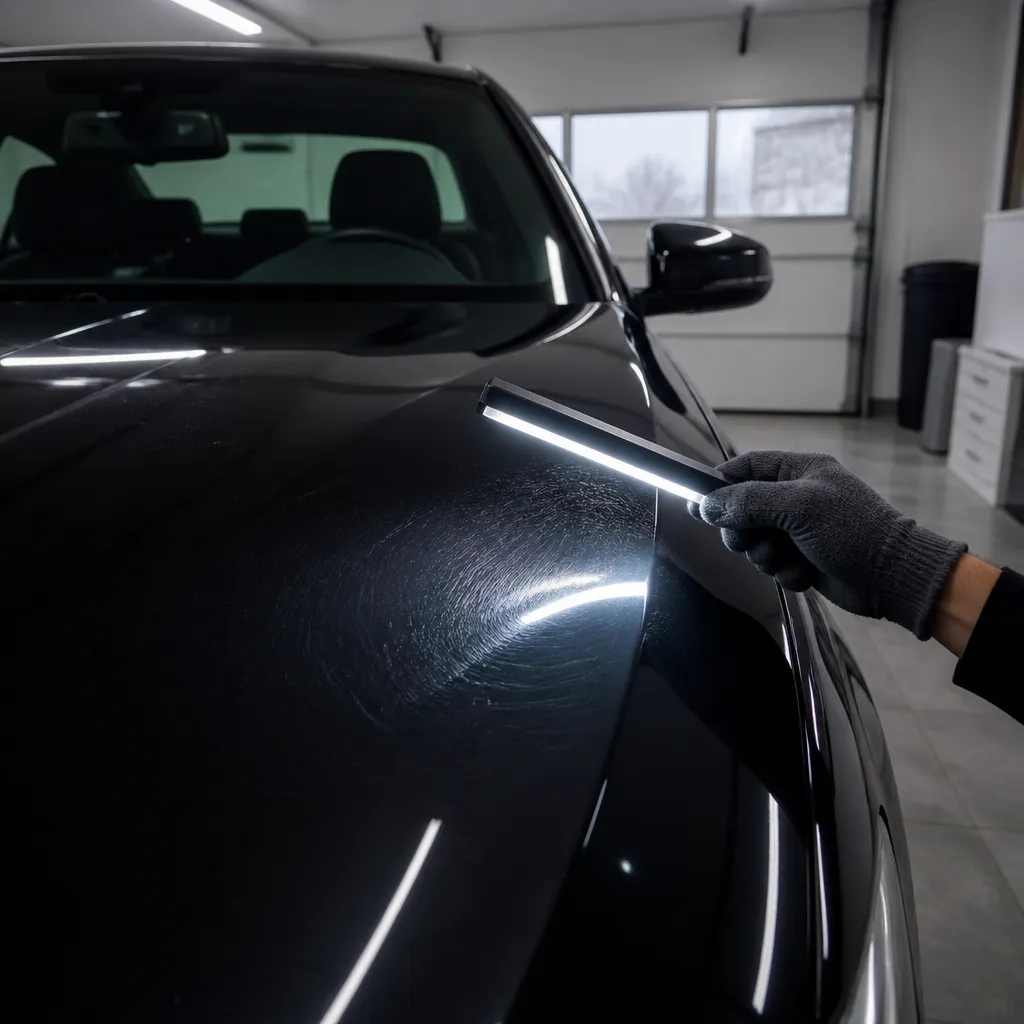
Garage storage changes that. Once the car sits for weeks, owners tend to walk around it under a single overhead LED, and that kind of light makes fine marks jump out. In our experience, the calls we get in November and December are rarely about new damage. They are about old damage that finally got noticed.
Swirls are rarely new. Winter lighting simply gives them a chance to be seen.
This matters most for luxury owners. A black sedan or a dark gray SUV hides nothing, and owners who paid for a deep, reflective finish notice a flaw faster than owners of a silver daily driver. The gap between what the paint looks like in daylight and what it looks like under a garage bulb can be large.
How Swirl Marks Form and Why They Look Different Under Low Light
Swirls sit in the top layer of the finish. They are not chips or deep scratches, which is why they usually respond well to machine polishing. Their circular or arcing pattern comes from a wash pad, mitt, or towel moving in a repeated motion across the panel while carrying grit.
Direct sunlight scatters across many angles, so the eye averages out the marks. A single point light reflects more uniformly, and each scratch catches that light differently. That is why a swirl you could not see in the driveway can be obvious in the garage at 6 p.m.
Cold weather adds its own concerns. One body shop's winter guidance notes that low temperatures can make paint more prone to chipping and cracking, and that road salt and de-icing chemicals speed up corrosion. For swirl detection, the more immediate issue is simpler: contamination left on the finish during winter gets dragged across the paint the next time someone washes the car.
Swirl Mark Detection in Your Garage: A Practical Check
You do not need a lab to check a car properly. You need a steady light, a clean panel, and a few minutes of patience. Here is the method we teach owners who want to know what they are dealing with before they book any work.
The Single Light Test
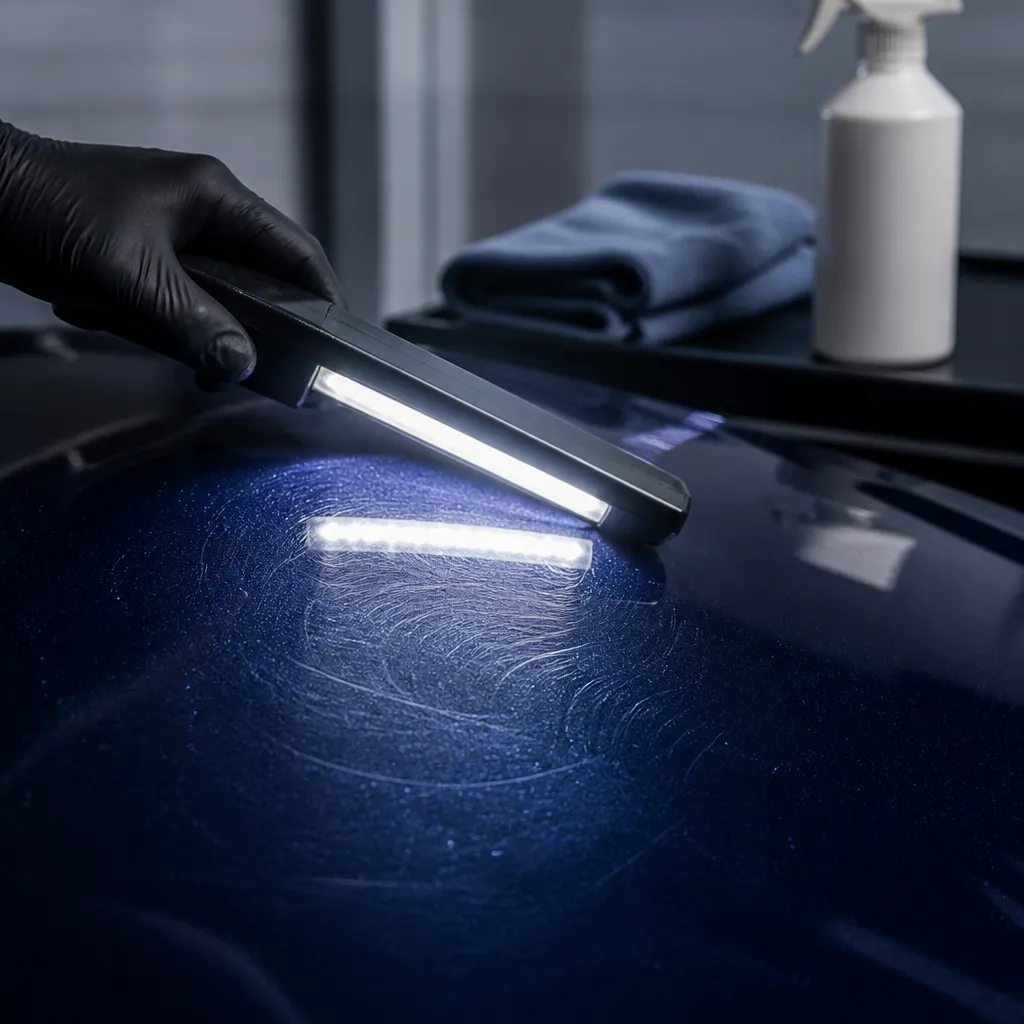
Turn off the overhead lights and hold a small LED flashlight at a shallow angle to the panel. Sweep it slowly across the hood, then the roof, then the driver's door. Swirls flash as the reflection shifts, and they are easiest to see when the light is close to the paint rather than shining straight down.
Keep the light unfiltered and avoid a phone screen as your only source. A bright, focused beam shows the pattern of the marks, which tells you whether you are looking at surface haze or a true swirl field.
Check Dark Panels and Horizontal Surfaces First
Black, deep blue, and dark gray paint shows marks faster than any other color. Start with those panels, then move to the hood and roof, which are horizontal and collect the most airborne dust in a closed garage. If the flat surfaces look clean but the door shows a fine web of marks, the problem is likely from the way the car was dried.
Walk the Car Twice
Do one pass with the garage lights on and one with your flashlight. Then take phone photos at a low angle with flash on. Mark the worst spots with a small piece of low-tack painter's tape so you can compare them after a correction. Owners who skip this step often forget which panels were worst and end up over-polishing the wrong area.
Pro tip: Use a light source you already own, like a headlamp or a small work light, and tilt it until you see the marks. If you can only see swirls when the light is almost touching the paint, the defect is likely light enough for a single-stage polish, but deep marks will need more work.
What Cold Storage Actually Does to Your Paint
Storage itself does not scratch paint. What it does is pause your washing routine and let dust, pollen, and fine grit settle on the finish. A car that sat for three months under a cover in an attached garage can carry more surface contamination than a car driven every day through a wet winter.
The most common mistake we see is an owner pulling a cover off a dusty car and wiping the hood with a dry microfiber. That dry wipe drags grit across the clear coat. The result is a fresh set of swirls on top of the old ones, and the owner blames the garage when the damage was caused by the cleaning.
Temperature swings in an unheated garage also create condensation on cold panels when the door opens. Moisture can trap grit against the paint and leave water spots that look like etching until they are washed and inspected. Your garage does not need to be heated to protect the finish, but it should be dry, and the car should be clean before it goes in.
Can You Correct Paint in Winter? Where Owners Get It Wrong
Enthusiast forums regularly ask how cold is too cold for paint correction. A common version of the question comes from owners with insulated but unheated garages in very cold weather, and the answer depends on what the car and the products are doing, not just the air temperature. The core issue is workability.
Why an Unheated Garage Limits Multi-Stage Work
Multi-stage machine polishing, where a cutting step is followed by a refining step and a finishing step, needs consistent product behavior and steady panel temperatures. In an unheated garage, compounds can thicken, pads can stiffen, and the panel can stay cold enough that your passes produce uneven results. Cold conditions also make it harder to judge what you have removed.
Most product labels list a minimum application temperature. Read that line before you start, because it is the one most owners ignore. If the product says not to use it below a certain temperature, the garage is not the place to try it, even if the bay feels fine.
What a Climate-Controlled Bay Changes
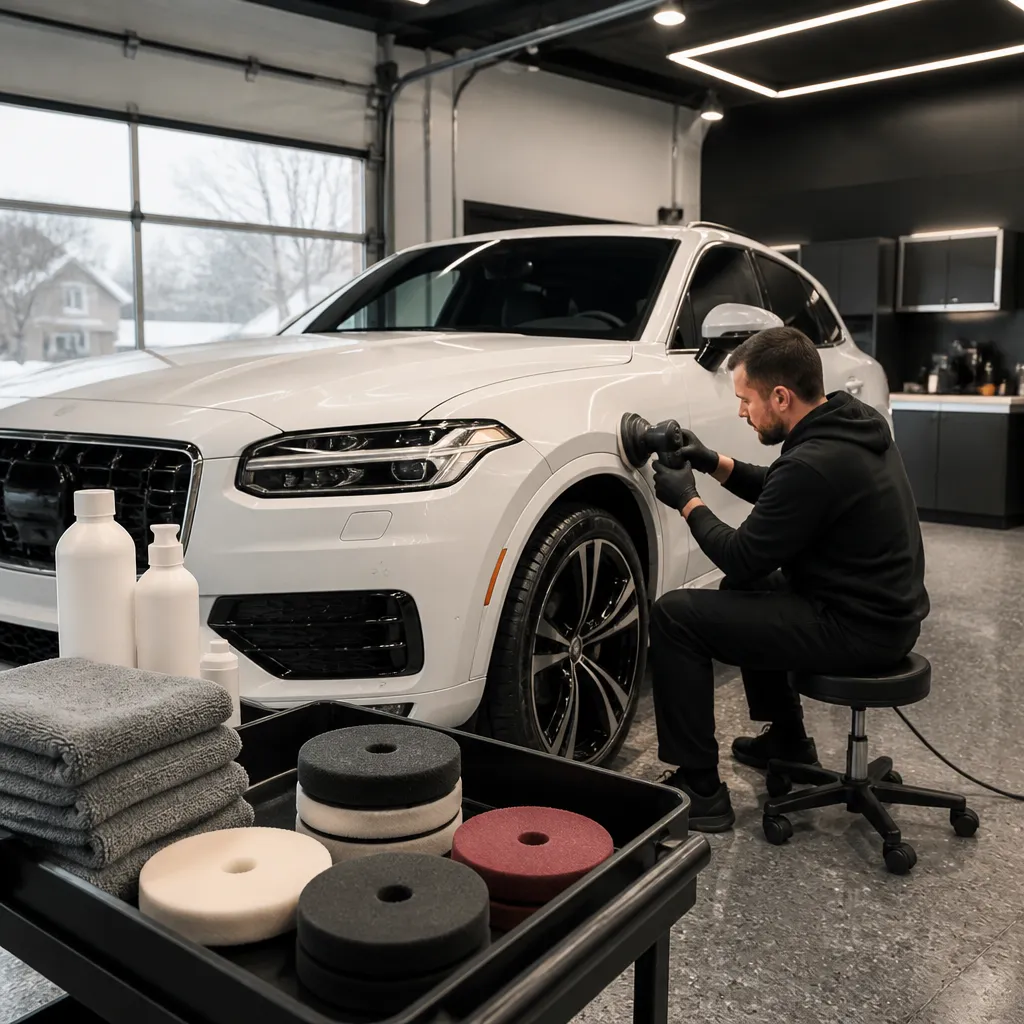
A heated, dry bay lets the paint, the product, and the tools reach working temperature together. That consistency is why we schedule the bulk of our correction work where the environment is controlled. The car can be inspected under proper lighting, corrected in stages, and checked again before anything is sealed.
Winter is also when the schedule is most flexible for owners who have been storing a car. Booking correction during the cold months means the paint is ready for spring rather than waiting until the first warm weekend, when every other owner in the suburbs wants the same appointment.
Three Ways to Handle Winter-Revealed Swirls
Owners usually choose between three paths when they find swirls in the garage. Each one has a clear use case and a clear limit, and choosing the wrong one wastes money. The table below lays out what each approach fixes and what it leaves behind.
| Approach | What It Fixes | What It Does Not Fix |
|---|---|---|
| Hand wash, dust removal, and spot wax in the garage | Surface dust, light haze, and water spots that appear after storage | Established swirl fields, deeper marks, and oxidation that has already settled into the clear coat |
| Single-stage polish in an unheated garage | Light swirls on a panel that is already clean and at a suitable product temperature | Heavy swirling, uneven results from cold product, and any panel where the label prohibits use in low temperatures |
| Multi-stage machine correction in a heated bay, followed by a protective coating | Deep swirl fields, mixed defects across multiple panels, and a finish that needs to look uniform under strong light | Damage that goes through the clear coat, which requires a different repair path and should be assessed before any polishing begins |
In practice, most luxury owners with a dark finish need the third option once they see the car under a proper light. The first option is fine for maintenance between correction visits, but it cannot erase a set of marks that have been building for a season.
Protecting Luxury Paint Through the Cold Season
Protection through winter starts before the car goes into storage and continues after it comes out. The goal is to stop new marks and new contamination from building up while the car is parked. A good plan costs far less than a correction, and it keeps the finish ready to inspect in spring.
Wash and Dry Before the Car Goes Away
A clean car going into storage is the single most useful step you can take. Wash with a pH-neutral shampoo, decontaminate if the paint feels rough, and dry with a soft towel or a blower rather than dragging a towel across the paint. Storing a car with road salt, bug residue, or brake dust on the lower panels invites etching and spotting that looks much worse after a few months.
Pro tip: Wash the car on a mild day, then drive it briefly to dry the underbody before storage. Remove dust from the cover before pulling it off, and lift the cover rather than sliding it across the paint.
Garage Placement and Covers
A garage keeps the car out of snow, ice, and direct weather, which is why it is the right place for storage. A breathable indoor cover adds a barrier against dust, while a cheap waterproof cover can trap moisture against the paint. Choose a cover designed for indoor use and check that it fits without being pulled tight across the panels.
A winter-specific maintenance guide from a Las Vegas luxury rental company makes a similar point about the exterior finish. Its advice centers on preventing damage from road salt, ice, and harsh elements before the damage starts, which is the same principle that applies to a garage-stored car.
Sealants and Ceramic Coatings
Synthetic paint sealants help protect against road salt, water, and chemicals during colder months, and a dealership's fall maintenance guide recommends them for the same reason. A sealant is a sensible seasonal layer, but it wears down. A professional ceramic coating is a longer-term option, and our nano-ceramic SiO₂ coatings come with 5-8 year warranties. Those warranties only mean something if the surface was properly corrected before the coating went on. Learn more about Hersheys Detailing and how we prepare paint before coating.
Frequently Asked Questions
Why do swirl marks look worse in winter than in summer?
Winter storage usually means the car sits under controlled overhead light rather than moving through daylight. A single focused light reflects off the clear coat more uniformly, which makes fine swirls easy to see. The marks were usually there before, but the lighting makes them obvious.
Can I check for swirl marks with a phone flashlight?
Yes, a phone flashlight works well if you hold it at a low, shallow angle and sweep it slowly across the panel. Dark paint and horizontal panels show the most detail. Phone photos taken with flash at a low angle also help you compare the finish later.
Is it safe to polish my car in an unheated garage?
It depends on the product and the temperature of the panel and the bay. Check the minimum application temperature on the product label before you start. If the garage is cold enough that the product thickens or the panel stays stiff, postpone the work and move it to a heated, dry space.
Does a ceramic coating hide existing swirl marks?
No. A ceramic coating adds gloss and makes the surface easier to clean, but it does not remove swirls that are already in the clear coat. Those marks can remain visible under the coating, so correction should come first. Coating over uncorrected defects locks them in place.
How often should I wash a car that is stored for the winter?
Wash it before storage so it goes in clean, and wash it again before you drive it out in spring. If the car stays in the garage for several months, check the cover and the surface every few weeks. Dust should be removed with a soft, dry blower or a gentle rinse, not a dry towel.
Have you noticed swirl marks in your garage this winter, and did you correct them before spring or wait until the car was back outside?
References
- Body shop guidance on how cold weather affects auto paint and how to prevent damage
- Winter maintenance steps for luxury cars, including protecting exterior finishes from road salt
- Dealership tips on using synthetic paint sealants against road salt and chemicals
- Enthusiast discussion on whether paint correction works in an unheated winter garage