If you own a vehicle in the Chicago suburbs and have never thought about tar removal for car paint in Illinois, your clear coat is almost certainly paying the price right now. Road tar flung up from freshly sealed pavement on I-355 or Route 53, iron fallout drifting from rail corridors that cut through DuPage County, and industrial particulate from the manufacturing corridor running through the western suburbs, these are not occasional nuisances. They are constant, cumulative, and chemically aggressive contaminants that bond to your paint at a microscopic level and begin destroying it from the inside out. What looks like a few small black spots or a rougher-than-usual finish is often the early stage of a process that, left unchecked, will require full paint correction to fix.
Table of Contents
- Quick Takeaways
- Why Chicago Suburbs Are Especially Harsh on Paint
- What Tar Actually Does to Your Clear Coat
- Industrial Deposit Car Paint Chicago: The Invisible Damage
- Paint Contamination Removal: The Professional Process
- Comparison: Decontamination Approaches
- When Decontamination Alone Is Not Enough
- Protecting Your Paint After Decontamination
- Frequently Asked Questions
- References
Quick Takeaways
| Key Insight | Explanation |
|---|---|
| Washing does not remove tar or industrial fallout | These contaminants bond chemically to the clear coat. A standard wash only removes loose surface dirt, leaving embedded deposits untouched. |
| Chicago suburb roads are a major tar source | Hot asphalt, road sealing operations, and highway expansion projects around DuPage County generate significant tar spray that coats lower panels and wheel arches year-round. |
| Iron fallout from rail corridors is a real threat | The freight and commuter rail lines that run through the western suburbs shed microscopic iron particles that embed in paint and oxidize, creating rust from within the clear coat. |
| Two-stage decontamination is the minimum standard | Professional decontamination requires a chemical iron remover followed by a dedicated tar remover, then clay bar treatment. Skipping any stage leaves contamination behind. |
| Polishing over contamination causes more damage | If iron or tar particles are still embedded when you polish, the machine grinds them deeper into the clear coat rather than removing them. |
| Ceramic coatings must be applied to clean, decontaminated paint | A coating bonded over contamination bonds to the contaminant, not the paint. This dramatically shortens coating life and creates adhesion failures. |
| The longer you wait, the worse the damage | Tar softens and penetrates deeper with heat cycles. Iron particles expand as they oxidize, physically disrupting the clear coat structure over time. |
Why Chicago Suburbs Are Especially Harsh on Paint
Living in Glendale Heights, Carol Stream, Bloomingdale, or Wheaton puts your vehicle at the intersection of several overlapping contamination sources that owners in quieter, less industrial areas simply do not face to the same degree.
The road network itself is a primary culprit. Illinois routes and county arterials throughout DuPage County are regularly repaved, sealed, and patched, especially in late spring and summer. Hot liquid asphalt and tar-based sealers get kicked up by tires in both directions, coating the lower half of any vehicle that follows close behind a resurfacing operation or drives over fresh sealing work. This is not theoretical. Anyone who has parked near freshly laid asphalt on a 90-degree July day knows how aggressively the material migrates.
Layered on top of that is the industrial fallout issue. The western Chicago suburbs carry significant rail traffic, both freight and commuter lines. Every time a steel wheel contacts a steel rail under load, microscopic metallic particles are released into the air. Those particles settle on every vehicle in the vicinity. The same applies near manufacturing facilities, construction zones, and even airport approach paths. PM2.5 particulate levels in Glendale Heights, as tracked by air quality monitoring services, regularly exceed WHO guidelines, and a meaningful fraction of that particulate is metallic and corrosive to automotive finishes.
Then there is the freeze-thaw cycle. Illinois winters drive municipalities to apply road treatments aggressively, and the salt and chemical compounds used in those treatments act as accelerants for paint contamination damage. Contamination that might stay dormant in a mild climate becomes chemically active faster in a surface that is repeatedly frozen, thawed, and soaked with brine.
What Tar Actually Does to Your Clear Coat
Tar is a petroleum-based hydrocarbon compound. When it contacts your clear coat, especially on a warm surface, it does not simply sit on top. It begins to soften the clear coat's outermost layer and chemically integrate with it. Over time, especially through the heating and cooling cycles of a Chicago summer, it migrates inward.
The Penetration Timeline
Fresh tar spots, typically the small black pinpricks you see on lower panels and behind wheel arches, are removable with the right solvent-based chemical without any paint damage if caught within days or weeks. Tar that has been baked through multiple heat cycles becomes much more deeply embedded and may leave a ghost stain even after chemical removal, one that requires paint correction to address fully.
A common mistake is attempting to remove tar spots with household solvents, rubbing alcohol, or general-purpose degreasers. These can attack the clear coat itself, strip existing paint protection, and leave the surface worse than before. The chemistry matters. A proper automotive tar remover is formulated to dissolve bitumen-based compounds specifically while remaining safe on cured clear coat finishes.
Pro tip: Before any tar removal attempt, always wash the vehicle first to eliminate loose grit. Wiping a tar remover over a dirty panel drags abrasive particles across the surface and introduces light scratches that defeat the purpose of careful chemical decontamination.
What Tar Deposits Look Like in Practice
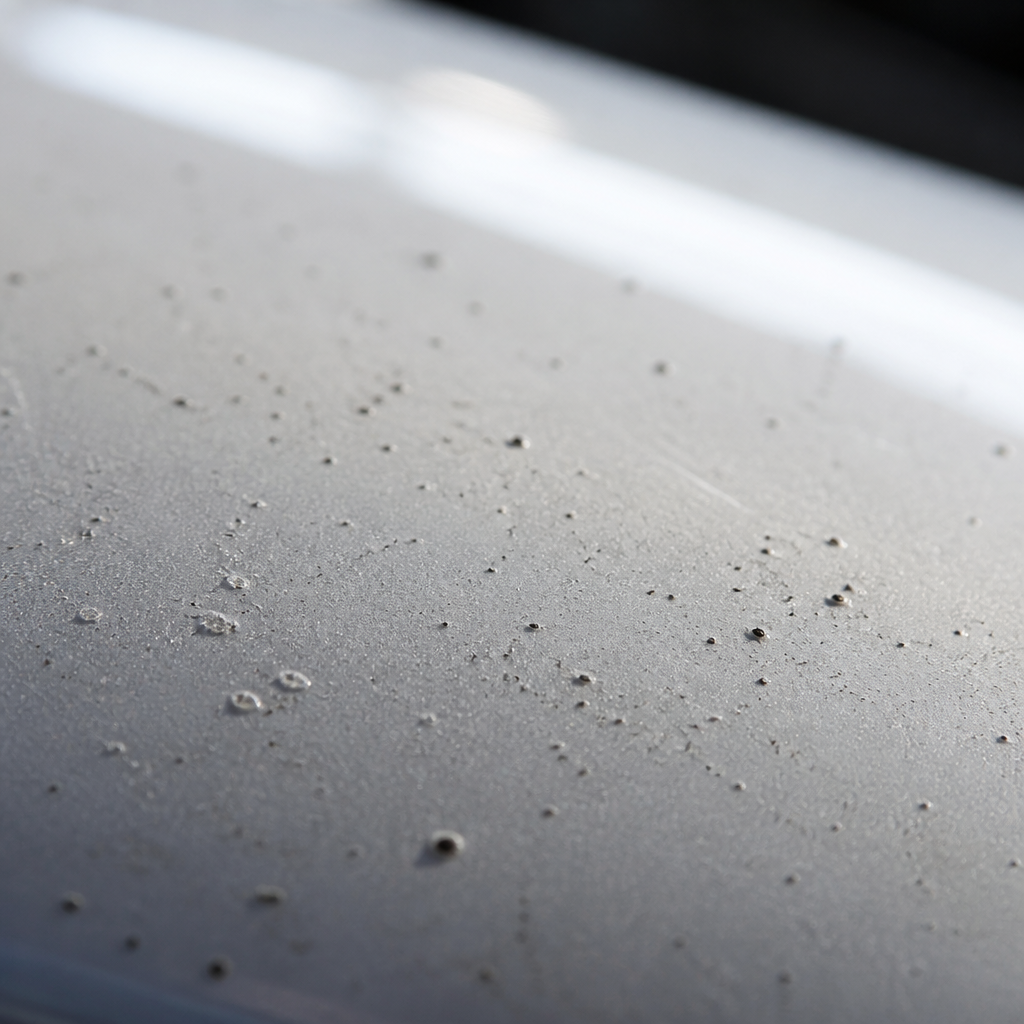
Most owners notice tar first on the lower door panels, rocker panels, and the leading edges of the front bumper. On lighter colored vehicles, the spots show as obvious dark brown or black dots. On dark vehicles, they often go unnoticed until you run your fingers across the surface and feel the raised, rough texture. If the paint feels like sandpaper even after washing, contamination, not surface dirt, is what you are feeling.
Industrial Deposit Car Paint Chicago: The Invisible Damage
Iron fallout is the contamination type that gets underestimated most consistently, because it is largely invisible until the damage is already done. The particles come from three main sources: brake dust released when pads grind against rotors, rail dust from wheel-to-track contact on freight and commuter lines, and industrial emissions from manufacturing and construction activity. Because the particles are microscopic, they are rarely visible individually on the paint surface.
What makes iron fallout particularly destructive is what happens after the particle embeds in the clear coat. Iron oxidizes. As it does, it expands physically, disrupting the clear coat structure from within. On lighter paint colors, this shows up as tiny rust-colored specks scattered across the surface. On dark paint, it is less visible but no less damaging. Left untreated, iron contamination causes pitting and eventually permanent clear coat failure that no amount of polishing will fully address.
Contamination is not just cosmetic. Iron particles oxidize and expand, causing tiny rust spots that polishing or waxing seals in rather than removes. The only correct response is chemical decontamination before any other correction or protection step.
A pH-reactive iron remover is the correct tool for this job. The chemistry works by dissolving the iron compounds, the product typically turns purple or deep red on contact with iron deposits, which gives you a visual confirmation of how much contamination is present. The reaction is striking on heavily contaminated vehicles. Watching the product bleed purple across a supposedly clean panel is a reliable indicator of how much damage was silently accumulating.
Pro tip: If you park within a few miles of a rail corridor or a manufacturing facility, treat your vehicle for iron fallout at minimum every three to six months, regardless of how clean it appears. The contamination builds invisibly and the damage is cumulative.

Paint Contamination Removal: The Professional Process
Paint contamination removal done properly is a staged process. Each stage addresses a different type or layer of contamination, and the order matters. Doing these steps out of sequence produces inferior results and can cause additional damage.
Stage One: Pre-Wash and Contact Wash
Contamination removal always begins with a thorough pre-wash to remove loose surface material. Attempting chemical decontamination on a vehicle carrying grit and road film means working the chemicals against a barrier of loose debris that dilutes their effectiveness. The contact wash that follows uses proper two-bucket technique and a pH-neutral shampoo that cleans without stripping existing protection or interfering with the chemical stages that follow.
Stage Two: Chemical Iron Removal
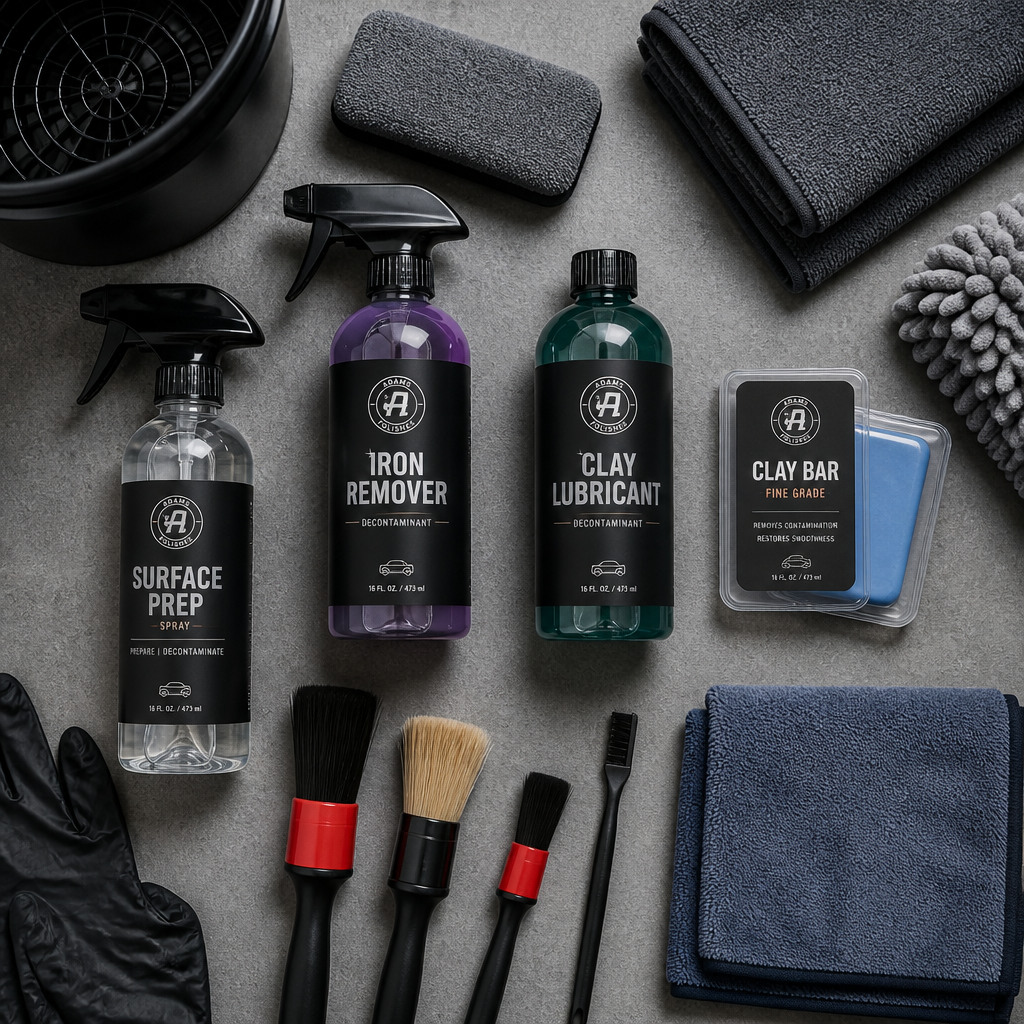
Iron remover is applied to all painted surfaces and alloy wheels and allowed to dwell. The reactive chemistry identifies and dissolves iron compounds, and the product's color change confirms the reaction is occurring. After the dwell period, the product is thoroughly rinsed. This stage does not remove tar or organic contaminants.
Stage Three: Tar and Adhesive Removal
A dedicated solvent-based tar remover is applied specifically to affected panels. The product softens and dissolves bitumen-based contaminants so they can be wiped away with a clean microfiber cloth. This step requires patience. Working too quickly or with insufficient product leaves residue behind.
Stage Four: Clay Bar Decontamination
Chemical decontamination removes the majority of bonded contamination, but a clay bar treatment is required to achieve a truly smooth, glass-like surface. Clay mechanically pulls out any remaining embedded particles that chemistry alone could not fully address. Proper clay work requires generous lubrication to prevent marring. After claying, a clean, decontaminated panel should feel as smooth as glass when a clean finger is drawn across it.
This four-stage sequence is the foundation of every professional correction and coating service performed at Hersheys Detailing. Skipping or combining stages is where quality falls apart, and it is a place where cutting corners has immediate, measurable consequences on the final result.
Comparison: Decontamination Approaches
| Approach | What It Addresses | Limitations and Risks |
|---|---|---|
| Washing only | Loose surface dirt and some fresh contamination | Does not remove bonded iron fallout, tar, or embedded industrial deposits. Leaves contamination in place. |
| Clay bar alone (no chemical prep) | Mechanically lifts some surface-bonded particles | Cannot dissolve chemical bonds created by tar or iron. Forces particles across the surface, risking scratches. Leaves most iron fallout behind. |
| Full chemical and physical decontamination (iron remover, tar remover, clay bar) | Bonded iron fallout, tar and bitumen deposits, embedded industrial particulate, adhesive residue | Requires proper product selection, correct dwell times, and professional technique to avoid paint or clear coat damage. Not suitable as a DIY process for inexperienced hands on a high-value vehicle. |
When Decontamination Alone Is Not Enough
Decontamination removes what is bonded to the surface. It does not repair damage that contamination has already caused inside the clear coat. If iron fallout has been present long enough to create micro-pitting, if tar penetration has left staining or etching, or if the paint surface shows oxidation, swirl marks, or haze from contamination being driven into the finish during previous wash attempts, decontamination must be followed by paint correction.
Paint correction using multi-stage machine polishing removes the damaged outer layer of clear coat to reveal the clean, undamaged material beneath. This is a precision process that requires professional equipment, the correct pad and compound selection for each vehicle's specific paint system, and the experience to know how much correction each panel can safely accept without compromising the clear coat's remaining thickness.
For vehicles with heavy contamination history or visible etching, a one-stage correction addresses lighter defects, while a two-stage process handles deeper scratches and more severe oxidation. At Hersheys Detailing, paint correction is included as part of every ceramic coating package because applying any long-term protective coating over uncorrected paint permanently seals those defects in place. That is not an acceptable result for a vehicle that deserves serious protection.
Protecting Your Paint After Decontamination
Once the paint surface is fully decontaminated and corrected, it is at its most vulnerable. Clean, bare clear coat has no barrier against the next round of tar spray, iron fallout, and industrial particulate. This is the window in which professional paint protection makes the most difference.
Why Ceramic Coating Is the Right Answer for Chicago Conditions
A nano-ceramic SiO2 coating bonds to the clear coat at a molecular level, creating a hard, hydrophobic barrier that resists chemical bonding from tar, iron, and industrial fallout. When a coated vehicle encounters tar spray, the contaminants cannot penetrate to the paint surface. They sit on top of the ceramic layer and are far easier to remove at the next wash without any chemical decontamination required.
For Chicago suburb conditions specifically, the durability of a professional ceramic coating matters more than in milder climates. Hersheys Detailing offers 5-year and 8-year ceramic coating packages that include full 2-step paint correction and decontamination as part of the service. The coating does not just protect against contamination bonding. It also resists the road salt, UV exposure, and freeze-thaw cycling that accelerates paint degradation in Illinois winters. Pricing for these packages starts at $999 for a sedan for the 5-year option and $1,099 for the 8-year option, with both packages including the full correction stage.
Maintenance Between Professional Services
Even a properly coated vehicle needs periodic maintenance to stay protected. A maintenance wash every few weeks using a pH-neutral shampoo preserves the ceramic layer. Annual or semi-annual professional maintenance inspections allow any compromise to the coating to be caught and addressed before the underlying clear coat is exposed to contamination again.
For uncoated vehicles, a maintenance schedule that includes chemical decontamination every three to six months is the realistic minimum for suburban Chicago driving conditions. Waiting until the contamination is visible means you have already missed the window for easy removal.
If your vehicle has never received a professional decontamination service, or if it has been more than a year since the last one, you can book a consultation with Hersheys Detailing to get an honest assessment of what your paint needs and what it will take to restore and protect it properly.
Frequently Asked Questions
How do I know if my car has tar or industrial fallout contamination?
Run a clean, dry hand across a freshly washed panel. If you feel roughness, grittiness, or raised spots that your fingernail catches on, that is contamination bonded to the surface. Small black or dark brown dots on lower panels are typically tar. Rust-colored speckles on lighter paint are usually iron fallout. On dark vehicles, iron fallout often goes undetected until a chemical iron remover reveals its presence through the purple color reaction.
Can I remove tar spots myself without damaging the paint?
A DIY tar removal attempt with automotive-specific tar remover and proper microfiber technique is possible for mild, fresh contamination on a vehicle with good paint condition. The real risk is using the wrong product, such as WD-40, rubbing alcohol, or general-purpose solvents, which can attack the clear coat or strip existing paint protection. For high-value vehicles, luxury finishes, or contamination that has been present through multiple heat cycles, professional decontamination is the only sensible approach. The cost of a professional service is a fraction of the cost of repainting a panel.
Does a ceramic coating prevent tar and iron fallout from bonding to paint?
Yes, and this is one of the most practical benefits of a quality ceramic coating for drivers in the Chicago suburbs. The hardened hydrophobic surface created by an SiO2 nano-ceramic coating significantly reduces the ability of tar, iron particles, and industrial deposits to chemically bond to the vehicle's surface. Contamination still lands on the car, but it sits on top of the ceramic layer rather than penetrating into the clear coat, making maintenance removal far simpler and less aggressive.
How often should a vehicle driven in the Chicago suburbs be decontaminated?
For an uncoated vehicle driven regularly in DuPage County or the western suburbs, a professional chemical decontamination every three to six months is a reasonable interval. Vehicles that park near rail corridors, construction zones, or manufacturing areas, or that are driven heavily on freshly paved roads in summer, may need attention more frequently. Ceramic-coated vehicles require far less frequent decontamination because the coating prevents most bonding, but they should still receive an annual professional inspection to confirm the coating's integrity.
Is paint correction always required after decontamination?
Not always, but it is required whenever contamination has caused damage that extends below the surface or when defects from contamination-driven wash marring are present. Decontamination removes what is on and in the clear coat's outer layer. It cannot repair etching, micro-pitting from iron oxidation, or the swirl marks caused by previous attempts to remove contamination with improper techniques. If a ceramic coating is being applied, paint correction before the coating is not optional. Sealing defects permanently under a multi-year coating is a result that cannot be undone without stripping and recoating.
What makes the Chicago suburb environment worse for paint than other areas?
The combination of heavy rail traffic through DuPage County, significant highway construction and road sealing activity in warmer months, industrial corridor particulate from the manufacturing areas of the western suburbs, and the freeze-thaw cycling of Illinois winters creates a multi-front contamination environment that most other regions do not experience simultaneously. The same vehicle driven in a mild, lower-traffic, non-industrial area would accumulate a fraction of the contamination it collects in the Carol Stream, Bloomingdale, and Glendale Heights area over the same period.
Have you noticed rough paint texture or tar spots on your vehicle, and what has worked best for you when dealing with Chicago suburb road contamination? Share your experience below.
References
- Complete four-step paint decontamination guide covering iron remover, tar remover, and clay bar process
- How iron fallout from brake dust and rail particles damages clear coat from within
- Professional decontamination detailing guide covering chemical and physical contamination removal
- Exterior paint decontamination guide covering iron fallout, tar removal, and clay bar treatment
- Why iron contamination damages automotive paint and the correct removal process