Most vehicles that pull up for a detail in the Chicago suburbs are carrying a problem their owners cannot see. The wheels look clean after a rinse, but embedded in the finish are microscopic iron particles, brake dust fragments, and road fallout that no amount of soap and water will dissolve. Proper wheel decontamination in Illinois is the step that separates a true professional detail from a glorified car wash, and it is the step that gets skipped more often than any other. At Hersheys Detailing in Glendale Heights, this process is non-negotiable, and this guide explains exactly why that matters for your vehicle.
Table of Contents
- Quick Takeaways
- Why Brake Dust Is More Dangerous Than It Looks
- The Illinois Factor: Why Chicago Suburb Vehicles Suffer More
- What Proper Wheel Decontamination Actually Involves
- Comparing Wheel Decontamination Approaches
- Why Skipping Decontamination Destroys Coating Performance
- How Hersheys Detailing Handles Wheel Decontamination
- Frequently Asked Questions
- References
Quick Takeaways
| Key Insight | Explanation |
|---|---|
| Brake dust is primarily iron | Metallic particles from pad and rotor wear bond chemically to wheel finishes and cannot be removed with soap alone. A dedicated iron remover is required. |
| Illinois winters compound the problem | Road salt and freeze-thaw cycles accelerate oxidation of embedded iron particles, etching alloy wheel surfaces faster than in milder climates. |
| The purple reaction is your proof | Iron removers turn purple on contact with ferrous contamination. Wheels typically produce the most intense reaction on any vehicle, revealing the scale of contamination. |
| Ceramic coatings fail without decontamination | Coating over contaminated wheels bonds the ceramic to iron particles, not to the wheel finish. The result is premature delamination and poor hydrophobic performance. |
| Dwell time is not optional | Iron remover needs 3 to 5 minutes to break down ferrous bonds. Rushing the rinse defeats the purpose of the chemical step entirely. |
| Physical decontamination follows chemical | Even after iron remover, silica fallout and bonded road grime require clay bar or clay mitt work to physically extract what the chemical step cannot dissolve. |
| Frequency matters on Chicago suburb roads | Stop-and-go traffic on roads like North Avenue and Gary Avenue generates heat cycles that increase brake dust output. Wheels in this environment need decontamination more often than the national average. |
Why Brake Dust Is More Dangerous Than It Looks
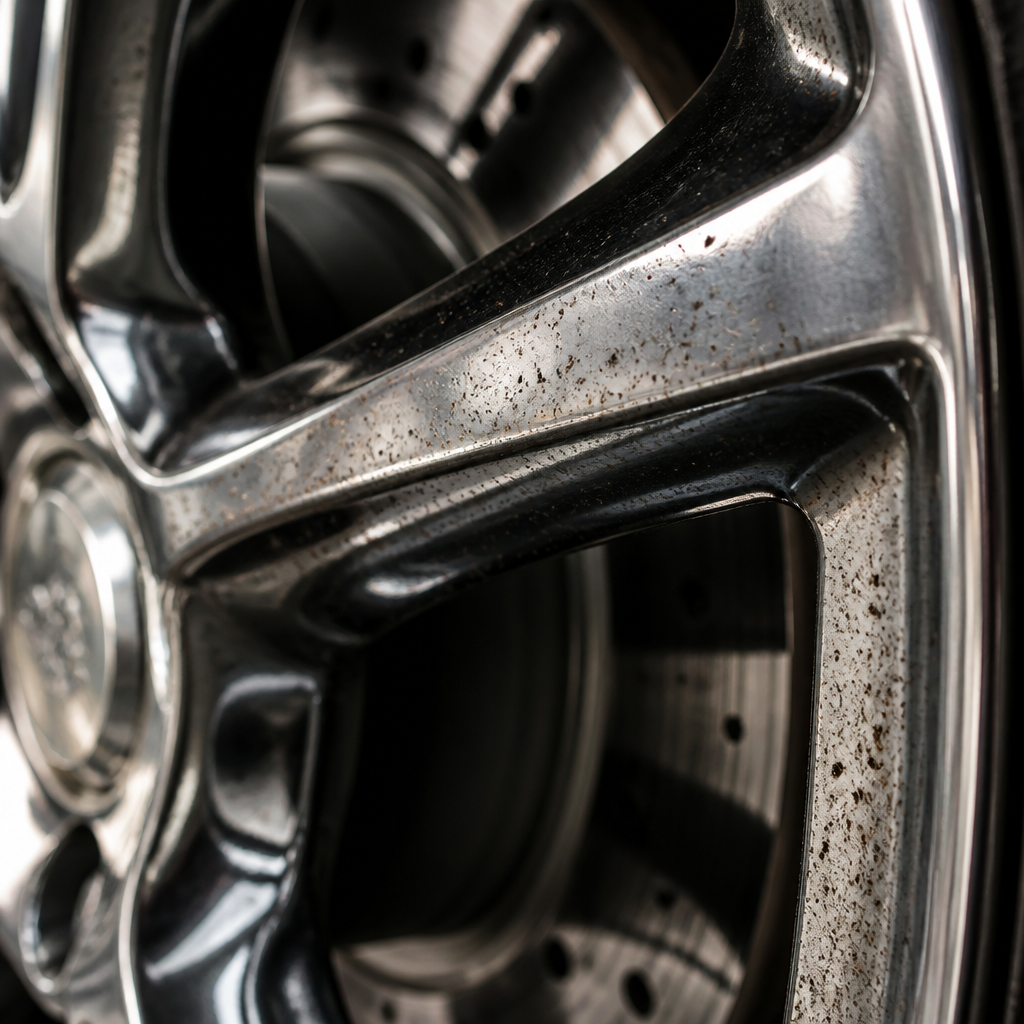
The dark residue that coats your wheels between washes is not simple dirt. Brake dust consists of small metallic particles shed from the friction between your brake pads and rotors. These particles are hot when they leave the rotor, and that heat causes them to embed themselves into the wheel surface at a microscopic level, where they begin to oxidize almost immediately. Once oxidized, they are bonded, not resting on the surface.
This composition is particularly harmful to the finish on alloy wheels, which are the standard on most luxury and performance vehicles. The iron particles react with the aluminum alloy and any clear coat protecting the wheel, creating micro-pitting that dulls the finish over time. A wheel that looks dirty may actually have permanent surface damage forming beneath the contamination.
Brake dust does not travel far from the rotor. It mixes with other road contaminants and sits directly on the wheel surface, making the wheel the single most contaminated component on any vehicle at any given time.
Standard wheel cleaners handle loose surface dirt. But embedded iron particles need a chemical decontamination step to break down. This distinction matters enormously when you are paying for a professional detail. A wash that skips iron decontamination leaves the underlying contamination untouched, regardless of how clean the surface looks after drying.
The Illinois Factor: Why Chicago Suburb Vehicles Suffer More
Vehicles in the Glendale Heights, Carol Stream, Bloomingdale, and Wheaton area face a specific combination of conditions that accelerates wheel contamination faster than most parts of the country. Road salt applied through Illinois winters does not just affect paint. It attacks the metal components of a vehicle and accelerates the oxidation process, meaning iron particles already embedded in your wheel finish corrode at an accelerated rate when salt is present.
Stop-and-go commuter traffic on routes through the Chicago suburbs generates far more brake heat than highway cruising. More heat at the rotor means more brake dust per mile, and more dust per mile means faster contamination buildup. A vehicle that sits through multiple freeze-thaw cycles with iron contamination already embedded is facing a compounding threat to its wheel finish.
The practical implication is that vehicles in this region need wheel decontamination more frequently than those in milder climates. Waiting until contamination is visible to the naked eye means you are already dealing with bonded iron, not fresh surface dust. Catching it at the two-to-three week mark before it has time to oxidize and embed is the difference between a chemical decontamination step and a polishing correction job.
Pro tip: If you park near rail lines or near industrial areas in the western suburbs, your vehicle is also exposed to rail dust, a fine ferrous fallout that deposits on horizontal surfaces and wheel faces the same way brake dust does. The same iron remover process handles both contaminants.
What Proper Wheel Decontamination Actually Involves
A complete wheel decontamination process has distinct phases. Running through them in the right order matters, because each step prepares the surface for the next. Skipping or reordering steps wastes product and reduces results.
Phase 1: Pre-Rinse and Wheel Wash
Before any chemical decontamination, the wheels need a thorough rinse and foam pre-soak to remove loose dirt, road grime, and surface debris. This is the only step most basic washes ever perform. Using dedicated wheel brushes on the barrel, spokes, and face prevents cross-contamination of paint surfaces with the concentrated brake dust and grime that comes off during agitation.
Phase 2: Iron Remover Application
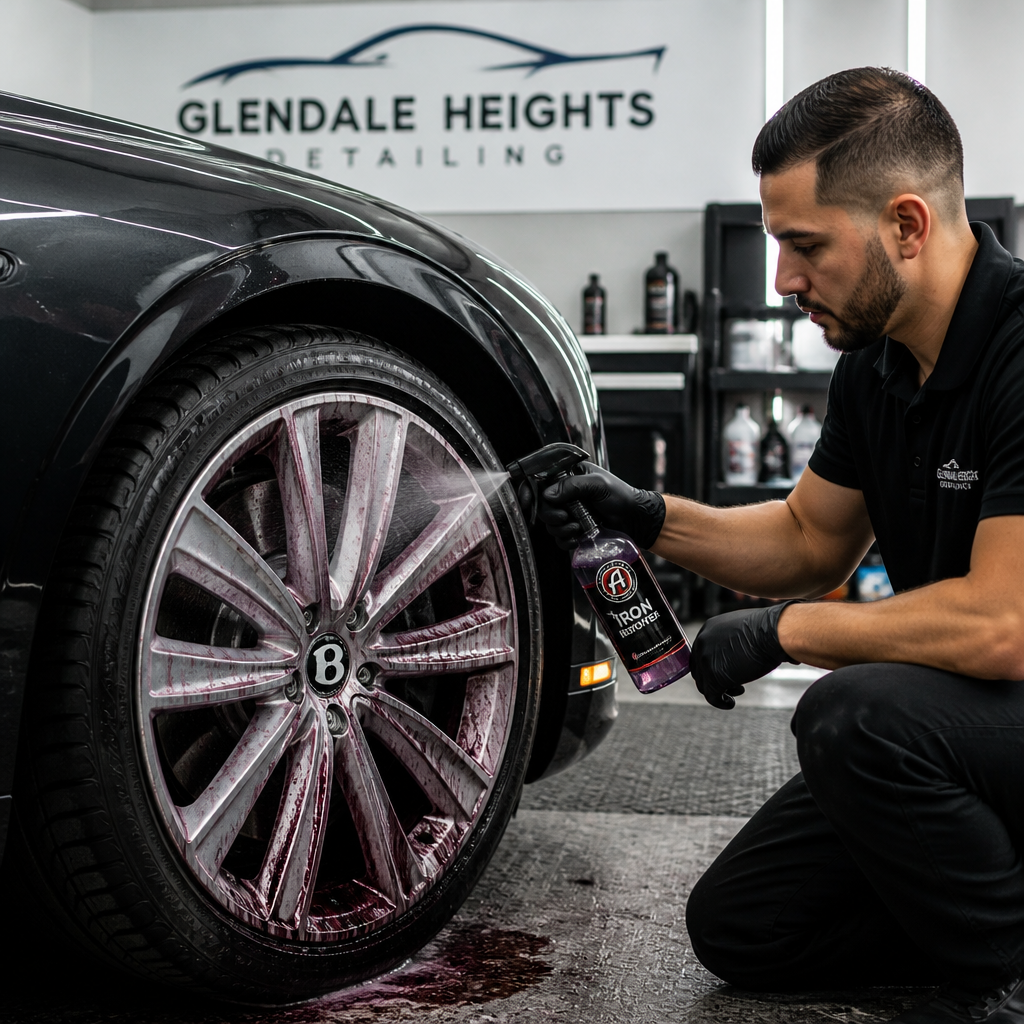
This is the step that most detailers skip, and it is the most important one. A pH-neutral iron remover is sprayed liberally across the wheel face, barrel, and spokes. The product needs to dwell for a minimum of 3 to 5 minutes, long enough for the chemical reaction to break down the ferrous bonds. The visible sign that it is working is the color change to purple as the product reacts with iron contamination. Wheels consistently produce the most intense purple reaction on the entire vehicle, confirming the scale of contamination that washing alone leaves behind.
After dwell time, the wheel is agitated with a soft wheel brush and rinsed thoroughly. Do not let the product dry on the surface, which means working in shade and with cool panels, particularly important during Illinois summers when direct sun can evaporate the product before it finishes its reaction cycle.
Phase 3: Tar Removal on Lower Panels
Iron remover handles ferrous contamination, but it does not dissolve tar. After the iron decontamination rinse, the lower panels and wheel arches need an inspection for tar spots, the small black dots from road asphalt that are especially common on vehicles with highway miles. A dedicated tar remover is a different chemistry from iron remover, and both are required for a complete decontamination. Skipping the tar step forces the clay bar in the next phase to do chemistry it was not designed to do, which loads it up quickly and produces poor results.
Phase 4: Clay Bar or Clay Mitt on Wheel Surfaces
Even after thorough chemical decontamination, silica particles, industrial overspray, and mineral deposits remain physically bonded to the surface. Running your fingertips across a chemically decontaminated wheel and feeling any roughness confirms that physical decontamination is still needed. A clay bar on a heavily lubricated surface extracts these contaminants by shearing them away from the finish. A clay mitt covers flat panel areas faster but a traditional bar conforms more precisely to tight barrel and spoke contours. Both approaches work, and the right choice depends on wheel geometry.
Pro tip: Always use a fresh or clean section of clay when moving from wheel to wheel. A clay bar loaded with iron particles from one heavily contaminated wheel will marr the finish on the next wheel rather than clean it.
Comparing Wheel Decontamination Approaches
Not every wheel cleaning approach produces the same result. The difference between these methods is not marginal when it comes to long-term wheel finish health and coating performance.
| Approach | What It Removes | What It Leaves Behind |
|---|---|---|
| Basic Soap and Rinse | Loose surface dirt, fresh dust, light road grime | All bonded iron particles, embedded brake dust, tar spots, silica fallout. Surface looks clean but contamination remains. |
| Chemical Decontamination Only (Iron Remover + Tar Remover) | Bonded ferrous contamination, tar spots, oxidized brake dust | Physically bonded silica, industrial fallout, and mineral deposits that require mechanical extraction. Leaves surface chemically clean but still physically rough. |
| Full Professional Decontamination (Chemical + Clay) | All bonded ferrous contamination, tar, silica, industrial fallout, mineral deposits | Nothing. Surface is chemically and physically prepared for protective coating or polishing. The only approach that produces a genuinely clean substrate. |
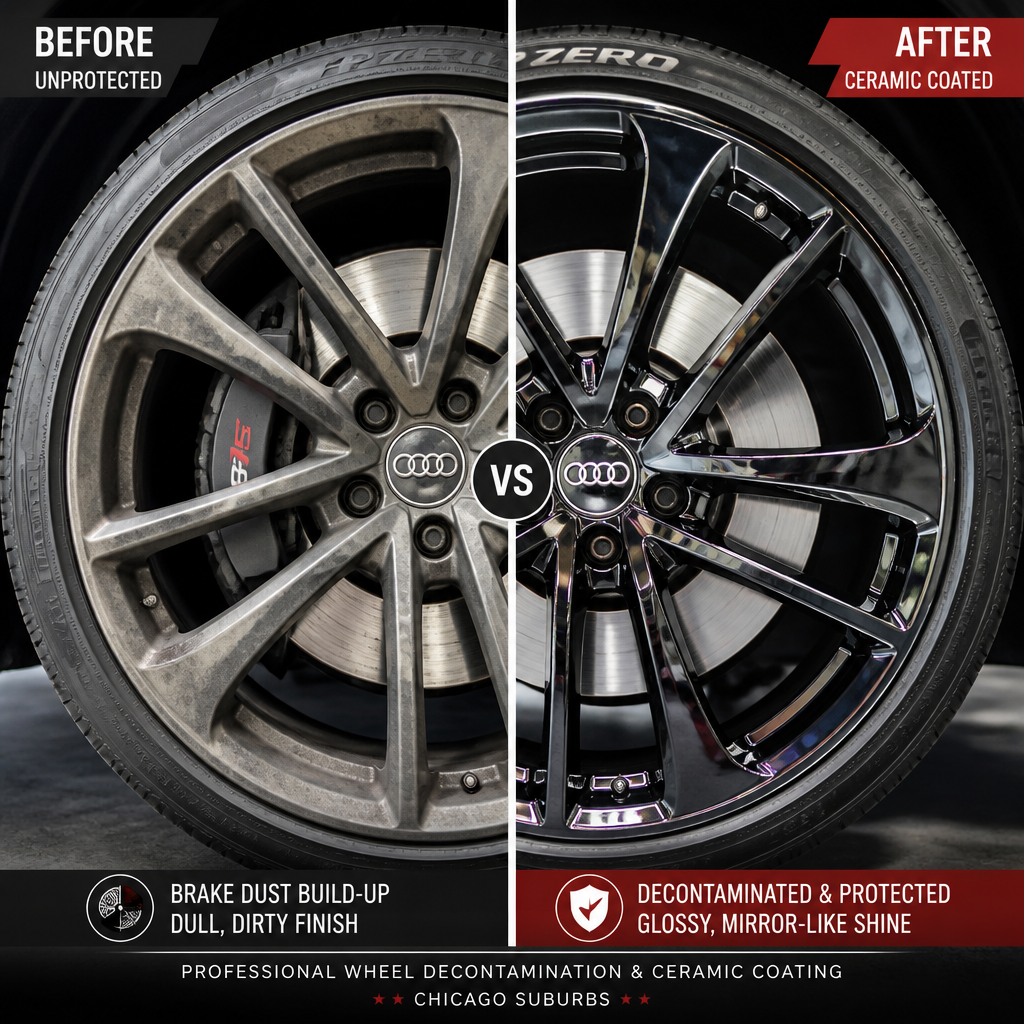
The practical conclusion from this comparison is straightforward. If wheel decontamination is not part of a detail service, the wheels are not actually clean when the job ends, regardless of how they look. For vehicles in the Chicago suburbs receiving a ceramic coating, this matters at a structural level because the coating bonds to whatever is on the wheel surface at the time of application.
Why Skipping Decontamination Destroys Coating Performance
The connection between wheel decontamination and ceramic coating longevity is direct and unforgiving. When a nano-ceramic SiO2 coating is applied to a contaminated wheel surface, it bonds to the iron particles and silica fallout sitting on the finish, not to the wheel finish itself. The coating does not know the difference. It cures over whatever substrate it touches.
The result is a coating that delaminates prematurely at the contamination points, loses hydrophobic performance unevenly across the wheel face, and provides none of the corrosion resistance it was designed to deliver. A five-year coating on a contaminated wheel may fail in under a year, not because the coating was poor quality, but because the prep work was skipped.
This same principle applies to paint correction work. Multi-stage machine polishing on contaminated paint or wheels produces different results than polishing on a decontaminated surface. Polishing over embedded iron particles can drive those particles deeper into the clear coat rather than removing the surface defects above them.
The decontamination stage is one of the most important steps in the entire detailing process precisely because it is invisible work. The vehicle does not leave looking dramatically different from having had its wheels decontaminated versus not. But the difference in how long any subsequent protection lasts is substantial, and it shows up months down the road when one vehicle's coating still beads water and another's has failed.
How Hersheys Detailing Handles Wheel Decontamination
At Hersheys Detailing, every vehicle that goes through an exterior detail service receives a complete wheel decontamination sequence, not just a wheel wash. The iron remover step is standard, not an upsell. The reason is simple: decontamination is foundational to every other step that follows it. Polishing contaminated paint, applying coatings over contaminated wheels, or delivering a vehicle with embedded iron still present in the finish is not a finished job by this shop's standard.
For vehicles receiving a professional ceramic coating with a 5 to 8 year warranty, the pre-coating decontamination is thorough enough to prepare the substrate for a product that needs to last nearly a decade. That means the full sequence: foam pre-soak, wheel wash with dedicated brushes, iron remover with full dwell time, tar removal, and clay work on both the wheels and painted surfaces. A full paint decontamination process is not a quick extra step. It takes time, and it is factored into every job accordingly.
Owners of luxury vehicles in Wheaton, Carol Stream, and Bloomingdale who have experienced a detail elsewhere and noticed their coating wearing unevenly, or their wheels looking contaminated again within weeks, are often dealing with the downstream consequences of skipped decontamination. The fix is not a better coating. It is proper prep before the coating goes on.
Pro tip: After any professional decontamination and coating service, establish a maintenance rhythm of rinsing your wheels every one to two weeks rather than waiting for visible contamination. Fresh brake dust that has not yet bonded comes off with water pressure alone. Once it bonds, you are back to the full chemical decontamination sequence to remove it properly.
Frequently Asked Questions
How often should wheels be decontaminated in the Chicago suburbs?
For most daily drivers in the Glendale Heights, Carol Stream, and Bloomingdale area, a full chemical decontamination every two to three months keeps contamination from permanently bonding. Vehicles that do heavy stop-and-go commuting or are exposed to road salt through Illinois winters benefit from decontamination at the start and end of winter season at a minimum. Any vehicle receiving a ceramic coating should have a complete decontamination immediately before the coating application, regardless of the last service date.
Why does iron remover turn purple?
The purple color change is a chemical reaction between the iron remover's active compounds and ferrous contamination on the surface. The more intense the purple, the higher the concentration of bonded iron at that spot. Wheels almost always produce the deepest purple reaction on the entire vehicle, which is a direct indicator of how much contamination a basic wash leaves behind. This visible reaction is also useful as a confirmation that the product is working and that dwell time is proceeding correctly.
Can I decontaminate my wheels at home between professional details?
Yes, consumer-grade iron removers are available and can be effective for maintenance decontamination between professional services. The key variables are proper dwell time, agitation with a soft brush, and a thorough rinse. Where home decontamination falls short compared to professional work is in the clay bar step and in the ability to follow up with protective coating application. Home maintenance extends the intervals between professional services, but it does not replace a full professional decontamination sequence.
Does brake dust decontamination apply to painted wheels, not just polished alloy?
Yes, and painted wheels can actually be more vulnerable. The brake dust removal process applies regardless of wheel finish type. Painted wheels have a clear coat that bonded iron particles can etch and pit just as they do on polished alloy. The iron remover chemistry works the same on both surfaces because it is targeting the ferrous particles, not the wheel material itself. The agitation and clay steps need to be gentler on painted finishes that show more sensitivity to abrasion.
Is wheel decontamination the same as a standard wheel cleaning service?
No, and this distinction is important when evaluating what a detail service actually includes. A standard wheel cleaning removes loose surface dirt and freshly settled dust using soap, water, and wheel brushes. Wheel decontamination specifically addresses bonded contamination that does not respond to soap and water. It requires chemical iron removers and physical clay work. Many basic detail packages include wheel cleaning. Far fewer include true wheel decontamination, which is the step that actually prepares the surface for long-term protection.
Does wheel decontamination need to happen before every detail?
A complete decontamination is essential before any paint correction, ceramic coating, or sealant application, because these processes require a fully clean substrate. For maintenance washes in between, a full decontamination sequence is not always required if the interval is short and the wheels have been properly maintained. However, if any roughness is detectable on the wheel surface by touch, or if visible brake dust has accumulated beyond light surface dust, the chemical iron removal step should be performed regardless of whether a full detail is on the schedule.
Have you noticed your wheels looking contaminated again within weeks of a detail, or felt that gritty texture on a supposedly clean wheel finish? Share your experience below, and let us know what you found when you finally had a proper decontamination done.
References
- Four-step guide to brake dust removal from Professional Carwashing and Detailing
- Complete decontamination detailing guide from Detailed Image Ask a Pro
- Wheel and brake dust management guide covering cleaning frequency and bonding prevention
- Complete four-step paint decontamination guide including iron remover dwell times and clay work
- Correct order to decontaminate a car before ceramic coating application