White is the most popular car color in the world, and drivers in the Chicago suburbs know exactly why it looks so sharp pulling out of the driveway on a clear morning. The problem is that Illinois is one of the hardest environments on the planet for keeping white paint looking the way it did on delivery day. Road salt from November through March, hard water from suburban sprinkler systems, iron fallout from brake dust, and summer humidity that bakes contaminants into your clear coat, all of these work against you on a daily basis. White car detailing in Illinois is not the same job as detailing a white car in Arizona or Florida. The seasonal abuse here demands a different plan.
Table of Contents
- Why White Paint Is Harder Than It Looks
- Quick Takeaways
- Illinois-Specific Threats to White Paint
- The Correct Wash Process for White Vehicles
- Paint Correction for White Cars in the Chicago Suburbs
- Ceramic Coating on White Paint in Illinois
- Protection Method Comparison
- Maintenance Between Professional Details
- Frequently Asked Questions
- References
Why White Paint Is Harder Than It Looks
There is a popular belief that white cars are easy to maintain because swirl marks do not show up the way they do on black or dark blue paint. That is partially true. Under casual observation, light scratches blend into the brightness of the paint. But white has its own set of problems, and some of them are worse than what dark paint owners deal with.
The first issue is iron contamination. Brake dust particles, microscopic when they first land on your paint, oxidize over time and expand into visible orange-brown specks. On a black car you might not notice them for months. On white paint, they stand out immediately, like rust freckles across the hood and roof. No amount of washing removes embedded iron particles. You need a dedicated iron remover, followed by clay bar decontamination.
The second issue is yellowing. White automotive paint, especially older factory finishes, oxidizes in the presence of UV radiation and loses its bright, cool tone. Without a proper UV barrier, the paint shifts toward a dingy cream or yellow-white that no amount of washing corrects. This is a clear coat failure problem, not a dirt problem, and it requires paint correction to address once it sets in.
The third issue is contrast. Mud splatter, dark road grime, and hard water mineral deposits show up against white paint in a way they simply would not on silver or gray. White paint forgives nothing that is darker than itself.
White paint is more forgiving of swirl marks under casual observation, but it is uniquely unforgiving of contamination, oxidation, and water spotting. The detailing plan has to account for all three, not just the polishing stage.
Quick Takeaways
| Key Insight | Explanation |
|---|---|
| Iron decontamination is non-negotiable on white paint | Brake dust oxidizes into orange spots that are highly visible on white surfaces and cannot be removed by washing alone. |
| Illinois road salt attacks clear coat all winter | Liquid salt brine used on suburban roads chemically bonds to paint pores. A ceramic coating seals the surface before salt can penetrate. |
| Two-bucket washing prevents swirl-mark buildup | One bucket for clean soapy water, one for rinsing your mitt. Skipping this step drags abrasive grit across the panel on every pass. |
| White paint yellows without UV protection | Chicago summers deliver significant UV load. Without a coating or sealant, oxidation turns bright white into a dull cream finish over time. |
| Hard water from suburban sprinklers leaves mineral etch marks | DuPage County water is mineral-rich. Spots that dry on white paint show immediately and etch into the clear coat if not addressed quickly. |
| Paint correction must come before any coating | Applying ceramic over contaminated or oxidized white paint locks the defects in. Correction first, protection second, always. |
| A nano-ceramic SiO₂ coating on white paint deepens clarity noticeably | White paint under a quality ceramic coating takes on a crisp, optical-glass look that factory wax or sealant cannot replicate. |
Understanding these issues upfront is what separates a detail that lasts from one that looks good for two weeks. The approach at Hersheys Detailing is built around addressing all of these failure points in sequence, not skipping straight to the polish and calling it done.
Illinois-Specific Threats to White Paint
Drivers in Glendale Heights, Carol Stream, Bloomingdale, and Wheaton are dealing with a specific combination of environmental hazards that make paint protection genuinely difficult. Understanding them is the first step toward addressing them correctly.
Road Salt and Liquid Brine
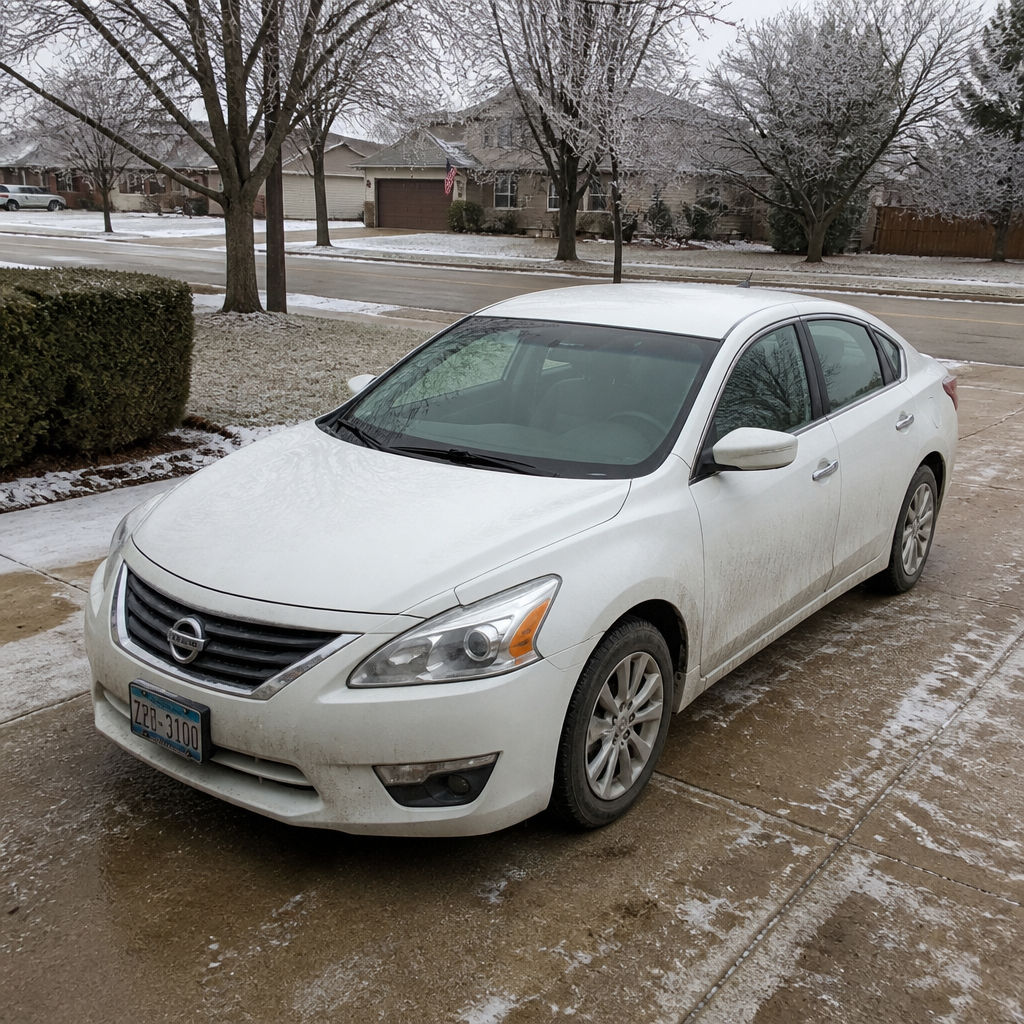
Illinois roads are treated with liquid salt brine before and during winter storms. This brine is more aggressive than traditional rock salt because it stays in contact with painted surfaces longer and penetrates microscopic pores in clear coat. On white paint specifically, brine residue dries into visible white crystalline streaks along door sills, lower panels, and wheel arches. Without a sealed surface, repeated brine exposure leads to clear coat degradation that starts invisibly and becomes a paint correction job by spring.
Pro tip: After any winter drive that involved wet roads or active salting, rinse the lower third of your vehicle as soon as possible. Do not wait for your weekly wash. A five-minute rinse removes brine before it has time to bond and crystallize.
Hard Water and Mineral Deposits
The Chicago suburb water supply is notably hard. When water evaporates on white paint, whether from washing, rain, or irrigation overspray, it leaves calcium and magnesium mineral deposits behind. On white paint these spots are immediately visible, and if the minerals are allowed to etch into the clear coat, they cannot be removed by washing. Mild cases require a dedicated water spot remover. Severe cases require machine polishing to cut them out.
Industrial and Brake Dust Fallout
The western Chicago suburbs sit near freight rail lines and industrial corridors. Airborne iron particles from rail activity, combined with the brake dust generated by stop-and-go commuter traffic on routes like Route 53 and Army Trail Road, settle on paint surfaces constantly. These particles are invisible when fresh but oxidize into orange-brown specks within weeks. On white paint, they are unmistakable.
UV Exposure in Summer
Illinois summers combine high UV index readings with humidity. UV radiation degrades the topmost layer of clear coat over time, causing white paint to lose its crisp, bright appearance and shift toward a dull or chalky finish. A UV-resistant ceramic coating is the most durable barrier available against this process.
The Correct Wash Process for White Vehicles
Most swirl marks and fine scratches on white cars come from improper washing, not road debris or door dings. The wash process is the most frequently repeated maintenance step, which means it is also the most common source of cumulative paint damage.
Pre-Wash and Snow Foam
Start with a pre-wash rinse to remove loose dirt and grit before any mitt or cloth touches the surface. A foam cannon application of a pH-neutral pre-wash product dwells on the surface and loosens bonded contamination without physical contact. On white paint, this step alone prevents a significant percentage of the fine scratches that accumulate over a season of washing.
The Two-Bucket Wash Method
Use one bucket containing fresh soapy water and a second bucket for rinsing your wash mitt between panels. The rinse bucket catches the grit and contamination removed from each panel so it does not get dragged back across the paint on the next stroke. This is the single most important habit change for anyone washing their own white vehicle at home.
Wash from the top of the vehicle downward. Roof first, then glass, then upper panels, then lower panels and sills. The lower third of the car carries the most contamination, and washing it first and working upward means dragging that contamination across clean paint.
Drying Without Scratching
Drying is where a lot of damage happens on white paint. Dragging a damp chamois or a low-quality towel across a white panel introduces micro-scratches that accumulate into a hazy, swirled finish over months of washing. Use a clean, high-pile microfiber drying towel and work in straight lines rather than circular motions. Better still, use a forced-air blower to remove water from panel gaps and mirrors before the towel work begins.
Pro tip: Never wash your white car in direct sunlight, especially in summer. Water evaporates faster than you can work, leaving streaks and water spots before you finish the first panel. Park in shade or wash early morning when temperatures are lower.
Paint Correction for White Cars in the Chicago Suburbs
Paint correction on white paint follows the same process as any other color, but the inspection and measurement phase requires specific attention because white paint hides some defects that would be obvious on dark paint while amplifying others that are invisible elsewhere.
Decontamination Before Polish
Before any machine polishing begins, the paint needs to be chemically and physically decontaminated. Chemical decontamination means applying an iron remover to dissolve embedded iron particles, followed by a tar and fallout remover for organic contaminants. Physical decontamination means clay bar treatment to pull out anything the chemical stage left behind. Skipping this step and going straight to polishing means dragging those particles across the clear coat with a rotating machine, which creates new scratches while removing old ones.
On white paint in the Chicago suburbs specifically, the iron decontamination step almost always produces a dramatic purple bleed reaction from the iron remover, even on vehicles that were washed regularly. This is not a sign of neglect. It is a sign that the environment genuinely loads iron particles onto every painted surface constantly.
Multi-Stage Machine Polishing
Once the surface is decontaminated, paint thickness measurements are taken to understand how much clear coat is available to work with. Multi-stage polishing begins with a cutting compound on a cutting pad to remove oxidation, hard water etching, and deeper scratches, followed by a finishing polish on a softer pad to refine the surface to a high gloss. On white paint, oxidation removal is often the most impactful stage because restoring the brightness and depth of white paint is visually dramatic. A dull, oxidized white can be transformed back to the crisp, optical-white appearance it had when new.
Inspection Under Correct Lighting
White paint requires inspection under both bright white LED lighting and dedicated swirl-finder lighting to confirm that all defects are fully corrected before the polishing stage ends. Under showroom lighting, white paint looks clean at a lower standard than it actually meets. Swirl-finder light cuts through the brightness and reveals any remaining haze or fine marring that needs another pass.
Ceramic Coating on White Paint in Illinois
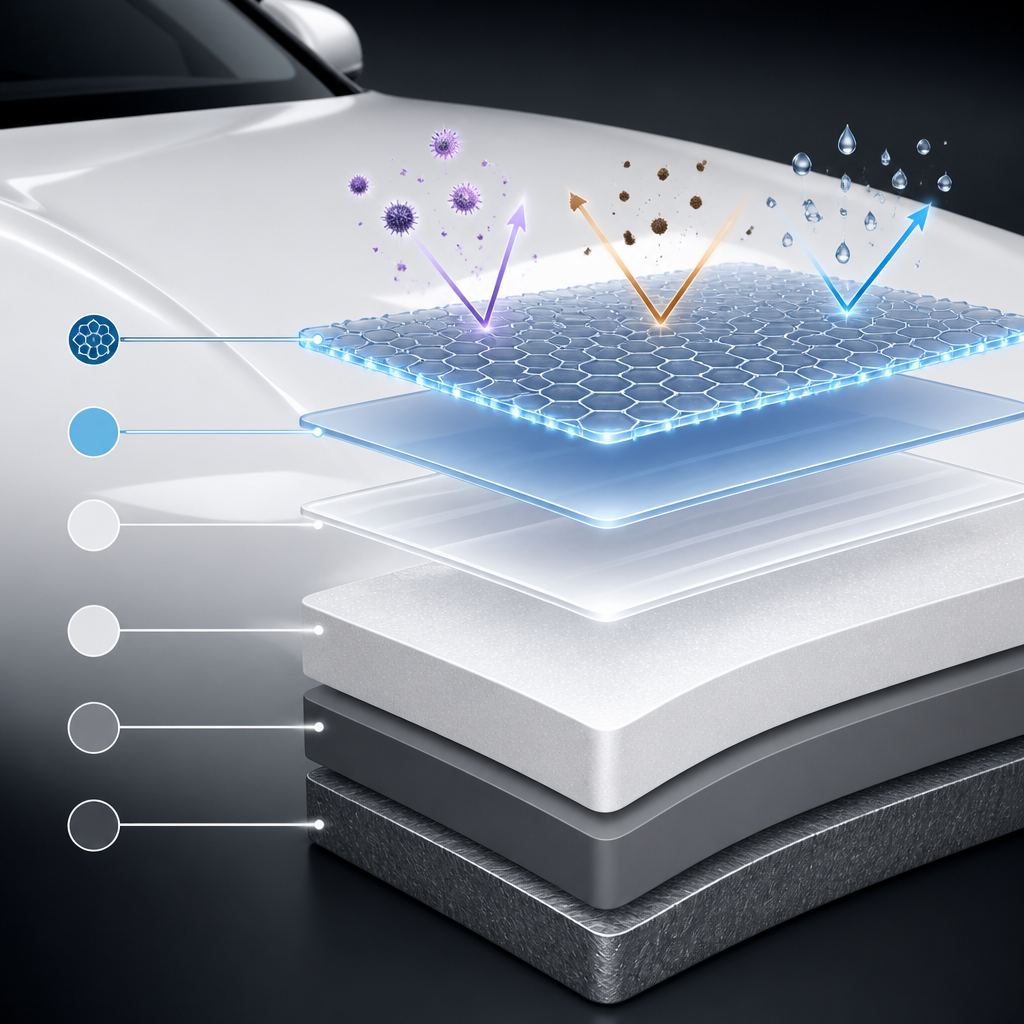
A professional nano-ceramic SiO₂ coating on white paint does two things that nothing else on the market replicates. It seals the microscopic pores of the clear coat so that contaminants, road salt brine, and mineral deposits cannot bond to the paint surface. And it adds an optical clarity to the paint surface that makes white look crisp and deep rather than flat and ordinary.
Why White Paint Responds Well to Ceramic
White paint under a properly applied ceramic coating takes on a quality that is immediately noticeable. The coating fills micro-texture in the clear coat and creates an optically flat, reflective surface. On white, this reads as a bright, glass-like finish with depth. On a car that had oxidation corrected before coating, the improvement is dramatic. The paint looks newer than the vehicle's age would suggest.
Protection Against Illinois-Specific Conditions
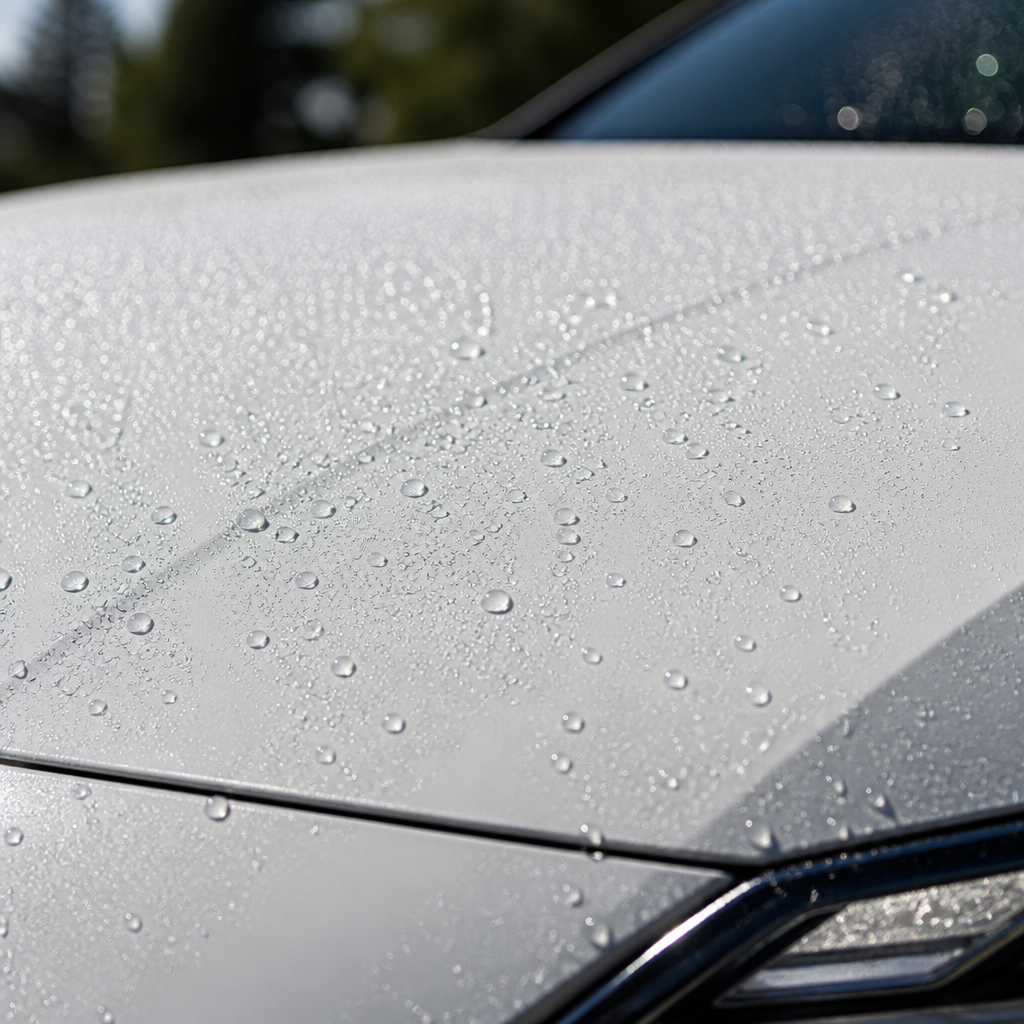
The hydrophobic surface created by a ceramic coating causes water, salt brine, and mud to sheet off rather than bonding to the paint. During an Illinois winter, this means that road grime and salt residue that would normally require serious washing effort can be rinsed away with far less work. Brake dust and iron fallout still land on the surface, but they cannot embed into sealed paint the way they embed into unprotected clear coat. Maintenance washes between seasonal details become noticeably faster and more effective.
At Hersheys Detailing, ceramic coatings are applied with warranties ranging from five to eight years, which means the protection installed today is still working through multiple Illinois winter seasons without reapplication. That warranty is only possible because the preparation process, decontamination and multi-stage correction before coating, is done properly every time.
What a Ceramic Coating Does Not Do
A ceramic coating is not a substitute for paint correction. Applying a coating over contaminated or oxidized white paint seals those defects permanently. It does not fill scratches deep enough to be visible to the eye, and it does not prevent rock chips or physical abrasion. For white cars that spend significant time on highways with chip exposure, a paint protection film on the front end combined with a ceramic coating over the rest of the vehicle is a more comprehensive solution than either product alone.
Protection Method Comparison
Choosing the right protection level for a white vehicle in Illinois depends on how the car is used, how long the owner plans to keep it, and how much maintenance they want to manage between professional details. Here is a practical comparison of the three main options.
| Protection Method | Best For | Limitations for Illinois White Cars |
|---|---|---|
| Carnauba Wax or Paint Sealant | Short-term gloss enhancement, low upfront cost, vehicles detailed a few times per year | Degrades in 2-4 months under Illinois UV and salt exposure. Provides minimal chemical resistance to brine. Requires frequent reapplication. Does not seal against iron fallout embedding. |
| Nano-Ceramic SiO₂ Coating | Long-term protection for vehicles kept 3 or more years, daily drivers, luxury and high-value vehicles | Requires professional paint correction before application. Higher upfront investment. Does not prevent rock chips or physical impacts. Cannot be applied over contaminated paint. |
| Paint Protection Film plus Ceramic Coating | High-mileage highway vehicles, new cars, front-end chip protection combined with full-body coating | Highest upfront cost. PPF edges require professional installation to avoid lifting. Best results require professional application of both products in correct sequence. |
For most white vehicle owners in the Carol Stream, Bloomingdale, and Wheaton area who drive daily and want to maintain their paint through multiple winters, a professional ceramic coating after thorough paint correction is the best return on investment. It handles the salt, the UV, the iron fallout, and the water spots in a single application that lasts years.
Maintenance Between Professional Details
A professional detail with paint correction and ceramic coating is not a one-time event that requires no follow-up. The coating needs proper maintenance to perform at its rated lifespan, and white paint in Illinois will always attract contamination that needs to be addressed on a regular schedule.
Wash Frequency and Products
During the winter salt season, washing every one to two weeks is practical and necessary. Using a pH-neutral car wash shampoo protects the ceramic coating. Harsh alkaline degreasers and automatic touchless car washes that use high-pH chemicals will degrade a ceramic coating faster than road exposure alone. A dedicated ceramic coating maintenance spray used after each hand wash adds a sacrificial layer that replenishes the hydrophobic properties between professional maintenance visits.
Seasonal Decontamination
Even on a coated white vehicle, iron decontamination twice a year, once in spring after salt season and once in autumn before it begins, removes the accumulated iron fallout that settles on the coating surface. This prevents the oxidized orange spotting that makes white paint look neglected, and it keeps the coating performing at its best going into the next season.
When to Schedule a Professional Maintenance Detail
A professional maintenance detail, typically a decontamination wash, inspection, light polish if needed, and coating top-up, is appropriate once per year for a coated white vehicle driven daily in Illinois conditions. Vehicles stored indoors during winter or driven less frequently may be fine with a professional maintenance detail every eighteen months. The goal is to catch and correct any light defects before they compound into a full paint correction job.
Hersheys Detailing's maintenance programs are built specifically for vehicles that received professional coating services. Keeping the work maintained properly is how a five-year warranty actually delivers five years of protection rather than degrading ahead of schedule from inadequate upkeep.
Frequently Asked Questions
Does white paint really need paint correction before ceramic coating?
Yes, without exception. The ceramic coating forms a semi-permanent bond with whatever surface it is applied to. Applying it over oxidized paint, embedded iron, or fine scratches seals those defects in place and amplifies them under certain lighting. On white paint, yellowing or a dingy flat appearance locked under a coating cannot be corrected without removing the coating first, which is expensive and avoidable. Decontamination and correction before coating is not an upsell. It is the reason the coating works properly.
How does Illinois road salt specifically affect white car paint?
Liquid salt brine chemically bonds to the microscopic pores in clear coat and, over repeated winter seasons without protection, causes the clear coat to degrade from the top layer down. On white paint this shows first as a slight dullness, then as visible etching, and eventually as clear coat separation. A properly applied nano-ceramic coating seals those pores so that brine contacts a chemically resistant surface rather than the clear coat itself. This is the primary functional reason to coat a white vehicle before winter in Illinois, not just aesthetics.
Can I remove the orange iron spots from my white car myself?
The chemical decontamination step, applying an iron remover spray and allowing it to dwell, is something informed owners can do at home. You will see the product turn purple as it reacts with and dissolves iron particles. However, if the spots have already oxidized deeply into the clear coat, chemical decontamination alone will not fully remove them. Those cases require machine polishing to cut the affected clear coat layer away. Attempting to remove deep iron staining with abrasive home products on white paint without professional guidance often creates new scratches that are more visible than the original problem.
How often should I wash my white car in winter in the Chicago suburbs?
Every one to two weeks during active salt season is the practical target for a daily driver. After any drive that involved wet, salted roads, a rinse of the lower panels and wheel arches within twenty-four hours prevents brine from crystallizing and bonding. Waiting two or three weeks between washes during an Illinois winter means the salt has had time to embed into unprotected paint or begin degrading even a coated surface if the coating is due for maintenance. More frequent washing during this period is never the wrong call.
Is a ceramic coating worth the cost on a white car compared to wax?
For a white vehicle driven daily in Illinois, the comparison is straightforward. Wax or sealant applied in autumn will largely be gone before the salt season ends, which is when the protection matters most. A professional ceramic coating applied once lasts through multiple winters with proper maintenance, resists chemical attack from brine, and dramatically reduces the time and effort required for each wash. The upfront cost is higher, but the per-year protection cost over a five-to-eight-year coating life is considerably lower than repeated wax applications. More importantly, wax does not seal pores. Ceramic does.
What is the difference between white car detailing in summer versus winter in Illinois?
Summer detailing on a white car focuses on UV protection, water spot prevention from mineral-heavy suburban water, and removing accumulated iron fallout from brake dust after a full winter and spring season. Winter preparation means ensuring the coating is intact, scheduling a decontamination detail before the first salt application, and increasing wash frequency. Summer is also when paint correction work is most effective because panels can be worked in controlled conditions. Scheduling a full paint correction and ceramic coating in late summer or early autumn means the vehicle is fully protected before the hardest season begins.
Have you noticed a specific challenge with keeping your white car clean in the Chicago suburbs? Share what has worked for you or drop a question in the comments below.
References
- Paint correction considerations specific to white automotive paint, including iron contamination and oxidation
- How swirl marks form during washing and the two-bucket method for prevention
- Chicago road salt effects on clear coat and how ceramic coatings provide chemical protection
- Environmental threats to paint protection in Chicago including UV exposure, road salt, and oxidation
- Safe wash practices for Illinois and Indiana vehicles dealing with salt brine, lake-effect grit, and hard water